Question
A uniform square plate S(side c) and a uniform rectangular plate R(sides b, a) have identical areas and masses:
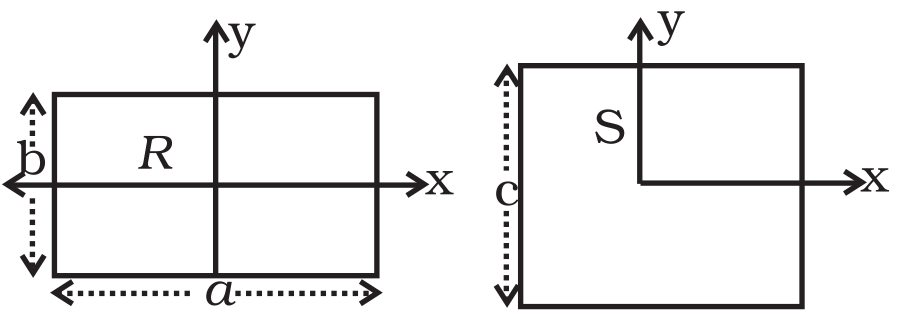
Show that:
  1. $\frac{\text{I}_\text{xR}}{\text{I}_\text{xS}}<1$
  2. $\frac{\text{I}_\text{ys}}{\text{I}_\text{ys}}>1$
  3. $\frac{\text{I}_{2\text{R}}}{\text{I}_{2\text{s}}}>1$
Answer

According to the problem, Area of square = Area of rectangular plate $\Rightarrow c^2 = a \times b \Rightarrow c^2 = ab$
  1. $\frac{\text{I}_\text{XR}}{\text{I}_\text{XS}}=\frac{\text{b}^2}{\text{c}^2}$
It is clear from diagram that b < c.
$\Rightarrow\ \frac{\text{I}_\text{XR}}{\text{I}_\text{XS}}=\Big(\frac{\text{b}}{\text{c}}\Big)^2<1$
$\Rightarrow{\text{I}_\text{XR}}<{\text{I}_\text{XS}}$
  1. $\frac{\text{I}_\text{YR}}{\text{I}_\text{RS}}=\frac{\text{a}^2}{\text{c}^2}$ (It is clear that a > c)
$\Rightarrow\ \frac{\text{I}_\text{YR}}{\text{I}_\text{RS}}=\Big(\frac{\text{a}}{\text{c}}\Big)^2>1$
  1. $\text{I}_\text{zR}=\frac{1}{12}\text{M}(\text{a}^2+\text{b}^2)$
$\Rightarrow\ \text{I}_\text{zS}=\frac{1}{12}\text{M}(\text{c}^2+\text{c}^2)$
Now, $\text{I}_\text{zR}-\text{I}_\text{zS}=\frac{1}{12}\text{M}\big[\text{a}^2+\text{b}^2-2\text{c}^2\big]$
$\Rightarrow\ \text{I}_\text{zR}-\text{I}_\text{zS}=\frac{1}{12}\text{M}\big(\text{a}^2+\text{b}^2-2\text{ab}\big)$
$\Rightarrow\ \text{I}_\text{zR}-\text{I}_\text{zS}=\frac{1}{12}\text{M}\big(\text{a}-\text{b}\big)^2>0$
$\Rightarrow\ \frac{\text{I}_\text{zR}}{\text{I}_\text{zS}}>1$

Need a full question paper?

Generate a complete, print-ready paper with questions like this in minutes — across 16+ boards, with answer keys.

Start Generating Free

Similar questions

A body of mass m makes an elastic collision with another identical body at rest. Show that if the collision is not head-on, the bodies go at right angle to each other after the collision.
A uniform disc of radius R, is resting on a table on its rim.The coefficient of friction between disc and table is $\mu.$Now the disc is pulled with a force F as shown in the figure. What is the maximum value of F for which the disc rolls without slipping?
A charged particle is accelerated through a potential difference of 12kV and acquires a speed of $1.0 \times 10^6m s^{−1}$. It is then injected perpendicularly into a magnetic field of strength 0.2T. Find the radius of the circle described by it.
A square-shaped copper coil has edges of length 50cm and contains 50 turns. It is placed perpendicular to a 1.0T magnetic field. It is removed from the magnetic field in 0·25s and restored in its original place in the next 0·25s. Find the magnitude of the average emf induced in the loop during:
  1. Its removal.
  2. Its restoration.
  3. Its motion.
Use the formula $\text{v}=\sqrt{\frac{\gamma\text{P}}{\rho}}$ to explain why the speed of sound in air:
Is independent of pressure,
When a proton is released from rest in a room, it starts with an initial acceleration $a_0$ towards west. When it is projected towards north with a speed $v_0$, it moves with an initial acceleration $3a_0$ towards west. Find the electric field and the maximum possible magnetic field in the room.
What is meant by limit of elasticity? Write Hooke's law of elasticity. Based on this establish the formula of Young's Modulus of elasticity and give the definition of Young's Modulus of elasticity.
A $20\mu\text{F}$ capacitor is joined to a battery of emf 6.0V through a resistance of $100\Omega.$ Find the charge on the capacitor 2.0ms after the connections are made.
Write Newton's formula for the speed of sound in air. Discuss the correction made by Laplace in this formula.
The transverse displacement of a string (clamped at its both ends) is given by
$\text{y}(\text{x, t})=0.06\sin\Big(\frac{2\pi}{3}\text{x}\Big)\cos(120\pi\text{ t})$
where x and y are in m and t in s. The length of the string is 1.5m and its mass is $3.0 \times 10^{–2}kg$.
Answer the following:
Interpret the wave as a superposition of two waves travelling in opposite directions. What is the wavelength, frequency, and speed of each wave?