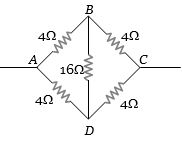
A uniform wire of $16\,\Omega $ is made into the form of a square. Two opposite corners of the square are connected by a wire of resistance $16\,\Omega $. The effective resistance between the other two opposite corners is ............... $\Omega$
Medium
Download our app for free and get started
According to the principle of Wheatstone’s bridge, the effective resistance between the given points is $4\,\Omega$.

Download our appand get started for free
Experience the future of education. Simply download our apps or reach out to us for more information. Let's shape the future of learning together!No signup needed.*
Similar Questions
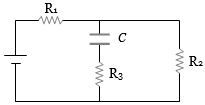
- 1In the circuit here, the steady state voltage across capacitor $C$ is a fraction of the battery $e.m.f.$ The fraction is decided byView Solution
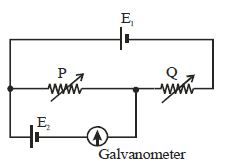
- 2Two cells of $e.m.f.$ $s\, E_1$ and $E_2$ and of negligible internal resistances are connected with two variable resistors as shown in Fig. When the galvanometer shows no deflection, the values of the resistances are $P$ and $Q$. What is the value of the ratio $E_2/E_1$ ?View Solution
- 3View SolutionThe relaxation time in conductors
- 4An ideal cell of emf $10\, V$ is connected in circuit shown in figure. Each resistance is $2\, \Omega .$ The potential difference (in $V$) across the capacitor when it is fully charged isView Solution
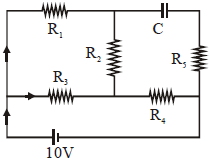
- 5Find the value of current $i_1$ for the circuit shown in figure :- ............ $A$View Solution
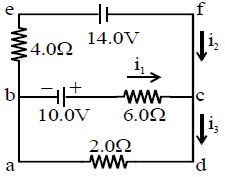
- 6A set of $n$ equal resistors, of value $R$ each, are connected in series to a battery of emf $E$ and internal resistance $R.$ The current drawn is $I.$ Now, the $n$ resistors are connected in parallel to the same battery. Then the current drawn from battery becomes $10\,I.$ The value of $n$ isView Solution
- 7View SolutionWhen current flows through a conductor, then the order of drift velocity of electrons will be
- 8A cylindrical conductor has uniform cross-section. Resistivity of its material increase linearly from left end to right end. If a constant current is flowing through it and at a section distance $x$ from left end, magnitude of electric field intensity is $E$, which of the following graphs is correctView Solution
- 9Find the number of photons emitted per second from of source of light which results in a photocurrent with drift velocity of $1.5\ m/s$ in a conductor with cross-section area $0.25\ m^2$ , volume density of electrons $10^{20}\ per \ m^3$ , (Assume that $60\%$ of photons emitted result in electron emission)View Solution
- 10View SolutionThe net resistance of a voltmeter should be large to ensure that