A uniform wire of resistance $20\,ohm$ having resistance $1\Omega /m$ is bent in the adjoining form of a circle as shown in the figure. If the equivalent resistance between $M$ and $N$ is $1.8 \,\Omega $, then the length of the shorter section is ................ $m$
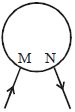
Medium


Download our appand get started for free
Experience the future of education. Simply download our apps or reach out to us for more information. Let's shape the future of learning together!No signup needed.*
Similar Questions
- 1The terminal potential difference of a cell when short-circuited is ($E$ = $E.M.F.$ of the cell)View Solution
- 2Suppose the drift velocity $v_d$ in a material varied with the applied electric field $E$ as ${v_d}\, \propto \,\sqrt E $ .Then $V - I$ graph for a wire made of such a material is best given byView Solution
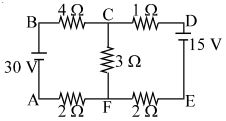
- 3The figure shows a network of five resistances and two batteries The current through the $15\,V$ battery is .............. $A$View Solution
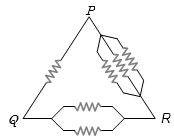
- 4Six equal resistances are connected between points $P$, $Q$ and $R$ as shown in the figure. Then the net resistance will be maximum betweenView Solution
- 5A hot electric iron has a resistance of $80\,\Omega $ and is used on a $200\, V$ source. The electrical energy spent, if it is used for two hours, will be ........... $Wh$View Solution
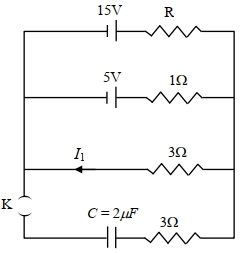
- 6In a circuit shown in the figure, the capacitor $C$ is initially uncharged and the key $K$ is open. In this condition, a current of $1 \mathrm{~A}$ flows through the $1 \Omega$ resistor. The key is closed at time $t=t_0$. Which of the following statement($s$) is(are) correct?View Solution
[Given: $\mathrm{e}^{-1}=0.36$ ]
($A$) The value of the resistance $R$ is $3 \Omega$.
($B$) For $t$
($C$) At $t=t_0+7.2 \mu \mathrm{s}$, the current in the capacitor is $0.6 \mathrm{~A}$.
($D$) For $t \rightarrow \infty$, the charge on the capacitor is $12 \mu C$.
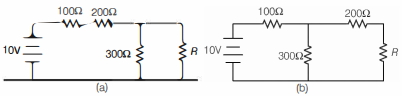
- 7A student was trying to construct the circuit shown in the figure below marked $(a)$, but ended up constructing the circuit marked $(b)$. Realising her mistake, she corrected the circuit, but to her surprise, the output voltage (across $R$ ) did not change. The value of resistance $R$ is ............ $\Omega$View Solution
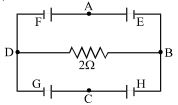
- 8In the circuit shown $E, F, G$ and $H$ are cells of $\mathrm{e.m.f.}$ $2\,V, 1\,V, 3\,V$ and $1\,V$ respectively and their internal resistances are $2\,\Omega , 1\,\Omega , 3\,\Omega$ and $1\,\Omega$ respectively.View Solution
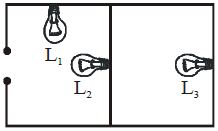
- 9Figure shows three similar lamps $L_1, L_2$ and $L_3$ connected across a power supply. If the lamp $L_3$ fuses, how will the light emitted by $L_1$ and $L_2$ change ?View Solution
- 10Four wires of the same diameter are connected in turn between two points, maintained at a constant potential difference. Their resistivities are; $\rho $ and $L$ (wire $1$ )., $1.2\,\rho $ and $1.2\,L$ (wire $2$ ), $0.9\,\rho $ and $0.9\,L$ (wire $3$ ) and $\rho $ and $1.5\,L$ (wire $4$ ). Rank the wires according to the rates at which energy is dissipated as heat, greatest firstView Solution