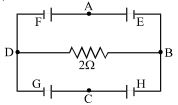
In the circuit shown $E, F, G$ and $H$ are cells of $\mathrm{e.m.f.}$ $2\,V, 1\,V, 3\,V$ and $1\,V$ respectively and their internal resistances are $2\,\Omega , 1\,\Omega , 3\,\Omega$ and $1\,\Omega$ respectively.
Advanced
Download our app for free and get started
Applying Kirchhoff's law
for loop $AFDBEA:$ $E_{F}-E_{E}=i_{1}\left(r_{F}+r_{E}+R\right)-R i_{2}$
or $1-2=i_{1}(1+2+2)-2 i_{2} \Rightarrow 5 i_{1}-2 i_{2}=-1 \ldots(1)$
for loop $CGDBHC:$ $E_{H}-E_{G}=i_{2}\left(r_{H}+r_{G}+R\right)-R i_{1}$
or $1-3=i_{2}(1+3+2)-2 i_{1} \Rightarrow-2 i_{1}+6 i_{2}=-2 \ldots(2)$
$(1)$ $\times 3 \Rightarrow 15 i_{1}-6 i_{2}=-3 \ldots(3)$
$(2)+(3), 13 i_{1}=-5 \Rightarrow i_{1}=-\frac{5}{13} A$
putting the value of $I_{1}$ in $(1),$ we get $I_{2}=-\frac{6}{13}$
$V_{D}-V_{B}=$ potential drop across $R=2 \Omega$ is $R\left(i_{2}-i_{1}\right)=2\left[-\frac{6}{13}+\frac{5}{13}\right]=-\frac{2}{13} V$
Thus, $V_{G}=E_{G}+i_{2} r_{G}=3+3\left(-\frac{6}{13}\right)=\frac{21}{13} V$ (as current
drawn from cell and $i_{2}$ are opposite direction)
and $V_{H}=E_{H}-i_{2} r_{H}=1-\left(-\frac{6}{13}\right) 1=1+\frac{6}{13}=\frac{19}{13} V$ (as
current drawn from cell and $i_{2}$ are same direction.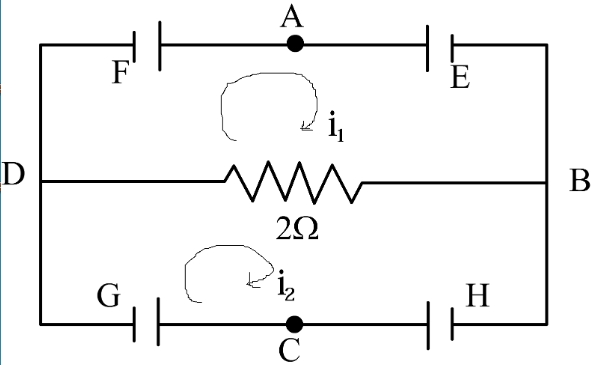

Download our appand get started for free
Experience the future of education. Simply download our apps or reach out to us for more information. Let's shape the future of learning together!No signup needed.*
Similar Questions
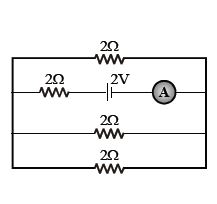
- 1View SolutionThe reading of the ammeter as shown in figure
- 2A cell of emf $6\, V$ and resistance $0.5\, ohm$ is short circuited. The current in the cell is ............... $amp$View Solution
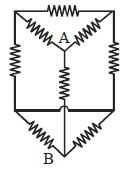
- 3Effective resistance between points $A$ and $B$ for following network is (each branch of resistance is $R$)View Solution
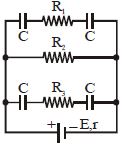
- 4In the circuit diagram of figure, $E = 5\, volt, r = 1\, \Omega ,$$ R_2 = 4\, \Omega , R_1 = R_3 = 1 \Omega$ and $C = 3\, μF.$ Then the magnitude of the charge on each capacitor plate is......$\mu C$View Solution
- 5A $100\, watt$ bulb working on $200 \,volt$ and a $200\, watt$ bulb working on $100\, volt$ haveView Solution
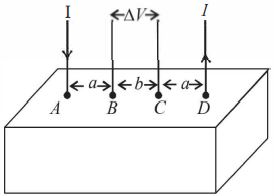
- 6Consider a block of conducting material ofresistivity '$\rho$' shown in the figure. Current '$I$' enters at '$A$' and leaves from '$D$'. We apply superp osition principle to find voltage '$\Delta V$ ' developed between '$B$' and '$C$'. The calculation is done in the following steps:View Solution
$(i)$ Take current '$I$' entering from '$A$' and assume it to spread over a hemispherical surface in the block.
$(ii)$ Calculatefield $E(r)$ at distance '$r$' from $A$ by using Ohm's law $E = \rho j$, where j is the current per unit area at '$r$'.
(iii) From the '$r$' dependence of $E(r)$, obtain the potential $V(r)$ at $r$.
(iv) Repeat $(i), (ii)$ and $(iii)$ for current '$I$' leaving '$D$' and superpose results for '$A$' and '$D$'.$\Delta V$ measured between $B$ and $C$ is
- 7If you are provided three resistances $2 \,\Omega$, $3 \,\Omega$ and $6 \,\Omega$. How will you connect them so as to obtain the equivalent resistance of $4 \,\Omega$View Solution
- 8A capacitor is connected to a cell of $emf$ $E$ having some internal resistance $r$. The potential difference across theView Solution
- 9A steady current $I$ is set up in a wire whose cross-sectional area decreases in the direction of the flow of the current. Then, as we examine the narrowing region,View Solution
- 10The Kirchhooff's first law $\left(\sum i=0\right)$ and second law ( $\left.\sum i R=\sum E\right)$, where the symbols have their usual meanings, are respectively based onView Solution