Question
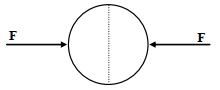
A uniformly charged thin spherical shell of radius $\mathrm{R}$ carries uniform surface charge density of $\sigma$ per unit area. It is made of two hemispherical shells, held together by pressing them with force $\mathrm{F}$ (see figure). $\mathrm{F}$ is proportional to
Answer

Pressure $=\frac{\sigma^2}{2 \varepsilon_0}$ and force $=\frac{\sigma^2}{2 \varepsilon_0} \times \pi \mathrm{R}^2$

Need a full question paper?

Generate a complete, print-ready paper with questions like this in minutes — across 16+ boards, with answer keys.

Start Generating Free

Similar questions

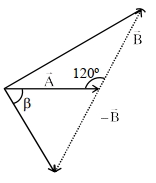
The angle between vector $(\overrightarrow{{A}})$ and $(\overrightarrow{{A}}-\overrightarrow{{B}})$ is :
Which gives lactic acid on hydrolysis after reacting with $HCN$
A bomb is released from a horizontal flying aeroplane. The trajectory of bomb is
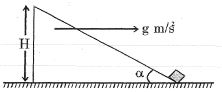
A wedge of height $H$ (fixed) and inclination $\alpha $ (variable) is moving on a smooth horizontal surface with constant acceleration $g\ m/s^2$ . A small block is placed at bottom of incline as shown in figure, slips on the smooth surface of incline . Choose $CORRECT$ statement about time taken by block to reach the top of incline
A ball whose density is $0.4 × 10^3 kg/m^3$ falls into water from a height of $9 cm$ . To what depth does the ball sink........ $cm$
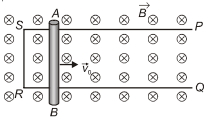
A conducting rod $A B$ of length $l$ is projected on a frictionless frame $P S R Q$ with velocity $v_0$ at any instant. The velocity of the rod after time $t$ is
The maximum amplitude for an amplitude modulated wave is found to be $12\, {V}$ while the minimum amplitude is found to be $3\, {V}$. The modulation index is $0.6\, {x}$ where ${x}$ is $....\, .$
Sun radiates continuously and maintains its brightness because
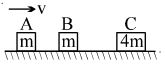
Three blocks are initially placed as shown in the figure. Block $A$ has mass $m$ and initial velocity $v$ to the right. Block $B$ with mass $m$ and block $C$ with mass $4m$ are both initially at rest. Neglect friction. All collisions are elastic. The final velocity of block $A$ is
Two mutually perpendicular simple harmonic vibrations have same amplitude, frequency and phase. When they superimpose, the resultant form of vibration will be