Question
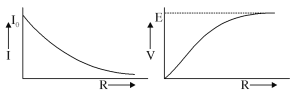
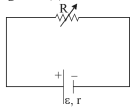
A variable resistor R, electromotive force and internal resistance $r$ are joined as shown in the given figure across the ends of the cell. Draw graph to show (i) terminal voltage and (ii) current $I$ as a function of $R$.
Image

Answer

Current in circuit
$ I=\frac{E}{R+r}=\frac{E}{R\left(1+\frac{r}{R}\right)} $
and terminal voltage
$V = IR$
$V =\frac{ E \times R }{ R \left(1+\frac{r}{ R }\right)}=\frac{ E }{\left(1+\frac{r}{ R }\right)}$
Image

Need a full question paper?

Generate a complete, print-ready paper with questions like this in minutes — across 16+ boards, with answer keys.
Start Generating Free

Similar questions

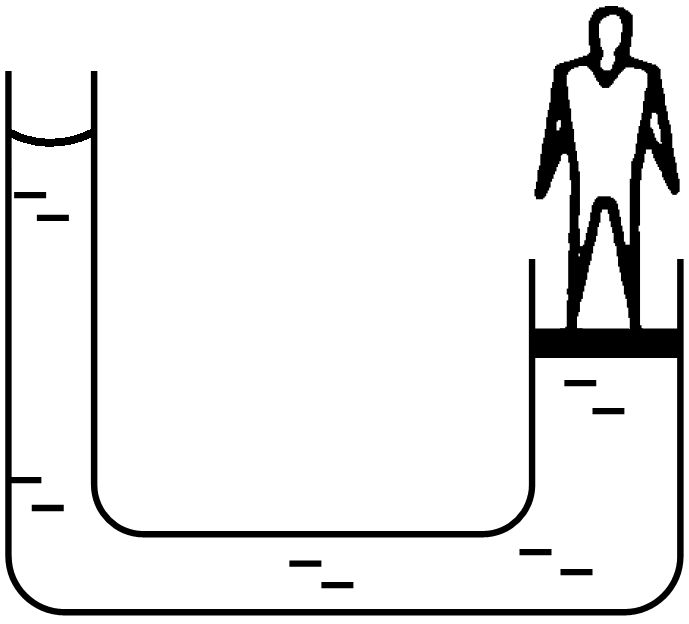
The area of cross$-$section of the wider tube shown in is $900\ cm^2.$ If the boy standing on the. Piston weighs $45\ kg,$ find the difference in the levels of water in the two tubes.
Why red signals are used an danger sign? Explain.
An ideal gas is taken from an initial state $i$ to a final state $f$ in such a way that the ratio of the pressure to the absolute temperature remains constant. What will be the work done by the gas?
The pressure of a gas changes linearly with volume from $10\ kPa, 200\ cc$ to $50\ kPa, 50\ cc$.
  1. Calculate the work done by the gas.
  2. If no heat is supplied or extracted from the gas, what is the change in the internal energy of the gas?
A particle executes simple harmonic motion. If you are told that its velocity at this instant is zero, can you say what is its displacement? If you are told that its velocity at this instant is maximum, can you say what is its displacement?
What is the importance of binding energy per nucleon ?
Answer the following questions:
  1. Optical and radio telescopes are built on the ground while X-ray astronomy is possible only from satellites orbiting the Earth. Why?
  2. The small ozone layer on top of the stratosphere is crucial for human survival. Why ?
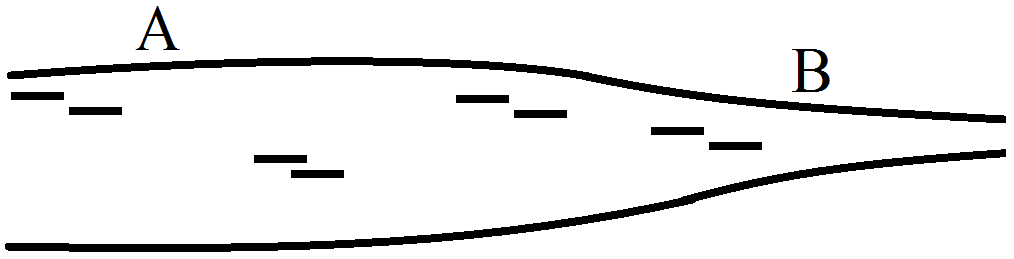
Water flows through a horizontal tube of variable cross$-$section. The area of cross-section at $A$ and $B$ are $4\ mm^2$ and $2\ mm^2$ respectively. If $1cc$ of water enters per second through $A,$ find,
  1. The speed ofwater at $A.$
  2. The speed of water at $B.$
  3. Thepressure difference $P_A- P_{B.}$
What is linear magnification? Obtain equation of linear magnification for mirror.
Figure. shows a cylindrical tube of cross$-$sectional area $A$ fitted with two frictionless pistons. The pistons are connected to each other by a metallic wire. Initially, the temperature of the gas is $T_0$ and its pressure is $P,$ which equals the atmospheric pressure. $(a)$ What is the tension in the wire? $(b)$ What will be the tension if the temperature is increased to $2T_0$?