MCQ
A vertical wire carries a current in upward direction. An electron beam sent horizontally towards the wire will be deflected:
  • A
    Towards right.
  • B
    Towards left.
  • Upwards.
  • D
    Downwards.

Answer

Correct option: C.
Upwards.
A vertical wire is carrying current in upward direction, so the magnetic field produced will be anticlockwise (according to the right-hand thumb rule). As the electron beam is sent horizontally towards the wire, the direction of the current will be horizontally away from the wire (direction of conventional current is opposite to the direction of the negative charge). According to Fleming's left-hand rule, the force will act in upward direction, deflecting the beam in the same direction.

Need a full question paper?

Generate a complete, print-ready paper with questions like this in minutes — across 16+ boards, with answer keys.
Start Generating Free

Similar questions

For a gas if $\gamma = 1.4$, then atomicity, ${C_p}$ and ${C_v}$ of the gas are respectively
A batsman deflects a ball by an angle of $45^o$ without changing its initial speed which is equal to $54\; km/h$. What is the impulse imparted to the ball in $kg\;m/s$? (Mass of the ball is $0.15 \;kg.)$
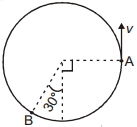
A particle of mass $m$ moves with constant speed $v$ on a circular path of radius $r$ as shown in figure. The average force on it during its motion from $A$ to $B$ is
A uniform rod $A B$ of mass $2 \mathrm{~kg}$ and Length $30 \mathrm{~cm}$ at rest on a smooth horizontal surface. An impulse of force $0.2\  \mathrm{Ns}$ is applied to end $B.$ The time taken by the rod to turn through at right angles will be $\frac{\pi}{\mathrm{x}}\  \mathrm{s}$, where  X=____
The coefficient of linear expansion of crystal in one direction is ${\alpha _1}$ and that in every direction perpendicular to it is ${\alpha _2}$. The coefficient of cubical expansion is
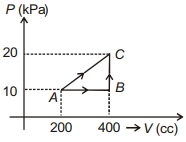
If a gas is taken from $A$ to $C$ through $B$ then heat absorbed by the gas is $8 \,J$. Heat absorbed by the gas in taking it from $A$ to $C$ directly is ............. $J$
The trajectory of a projectile near the surface of the earth is given as$ y = 2x -9x^2$. If it were launched at an angle $\theta_0$ with speed $v_0$ then $(g = 10\, ms^{-2}$)
A gas is taken in a sealed container at $300K$. it is heated at constant volume to a temperature $600K.$ the mean $K.E.$ of its molecules is:
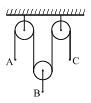
The pulleys in the diagram are all smooth and light. The acceleration of $A$ is a upwards and the acceleration of $C$ is $f$ downwards. The acceleration of $B$ is
An object, moving with a speed of $6.25\ m/s$, is decelerated at a rate given by:

$\frac{{dv}}{{dt}} = - 2.5\sqrt v $ where $v$ is the instantaneous speed. The time taken by the object, to come to rest, would be........$s$