MCQ
A wave of frequency 100 Hz travels along a string towards its fixed end. When this wave travels back, after reflection, a node is formed at a distance of 10 cm from the fixed end. The speed of the wave (incident and reflected) is
  • A
    $40 m / s$
  • B
    $10 m / s$
  • C
    $5 m / s$
  • D
    $20 m / s$

Need a full question paper?

Generate a complete, print-ready paper with questions like this in minutes — across 16+ boards, with answer keys.

Start Generating Free

Similar questions

The separation between the plates of a charged parallel-plate capacitor is increased. Which of the following quantities will change?
  1. Charge on the capacitor.
  2. Potential difference across the capacitor.
  3. Energy of the capacitor.
  4. Energy density between the plates.
If a particle moves in a circle describing equal angles in equal times, its velocity vector
A flask contains argon and oxygen in the ratio of $3: 2$ in mass and the mixture is kept at $27^{\circ} C$. The ratio of their average kinetic energy per molecule respectively will be ...........
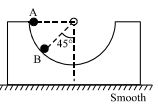
Aball of mass $m$ is released from Ainside $a$ smooth wedge of mass $m$ as shown in the figure. What is the speed of the wedge when the ball reaches point $B$ ?
The intensity of a progressing plane wave in loss-free medium is
The bob of a simple pendulum (mass m and length $ l$) dropped from a horizontal position strikes a block of the same mass elastically placed on a horizontal frictionless table. The K.E. of the block will be
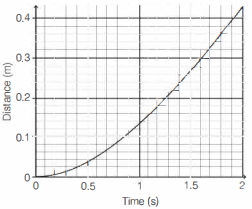
A steel ball is dropped in a viscous liquid. The distance of the steel ball from the top of the liquid is shown below. The terminal velocity of the ball is closest to .......... $m/s$
If the body is moving in a circle of radius $ r$ with a constant speed $v$, its angular velocity is
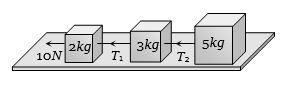
Three blocks of masses $2 \,kg, 3 \,kg$ and $5\, kg$ are connected to each other with light string and are then placed on a frictionless surface as shown in the figure. The system is pulled by a force $F = 10N,$ then tension ${T_1} = $  .......... $N$ 
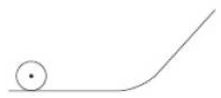
A solid sphere and solid cylinder of identical radii approach an incline with the same linear velocity (see figure). Both roll without slipping all throughout. The two climb maximum heights $h_{sph}$ and $h_{cyl}$ on the incline. The radio $\frac{{{h_{sph}}}}{{{h_{cyl}}}}$ is given by