MCQ
If a particle moves in a circle describing equal angles in equal times, its velocity vector
  • A
    Remains constant
  • B
    Changes in magnitude
  • Changes in direction
  • D
    Changes both in magnitude and direction

Answer

Correct option: C.
Changes in direction
c
(c)It is always directed in a direction of tangent to circle.

Need a full question paper?

Generate a complete, print-ready paper with questions like this in minutes — across 16+ boards, with answer keys.
Start Generating Free

Similar questions

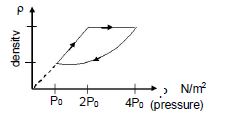
An ideal gas undergoes cyclic process as shown in density pressure graph. During the process $AB$ the work done $|W_{AB}| = 70\,J$ . During the process $BC$, the gas absorbs $150\,J$ of heat. During the process $CA$ , gas undergoes expansion and does $210\,J$ of work
One projectile moving with velocity $v$ in space, gets burst into $2$ parts of masses in the ratio $1 : 3$ . The smaller part becomes stationary. What is the velocity of the other part ?
The number of molecules in a gas at pressure $1.64 \times {10^{ - 3}}$atmospheres and temperature $200\, K$ having the volume $1 \,cc$ are
A shell is fired from a cannon with a velocity V at an angle $\theta$ with the horizontal direction. At the highest point in its path, it explodes into two pieces of equal masses. One of the pieces retraces its path to the cannon. The speed of the other piece immediately after the explosion is:

  1. $\text{3V}\cos\theta$

  2. $2\text{V}\cos\theta$

  3. $\frac{3}{2}\text{V}\cos\theta$

  4. $\text{V}\cos\theta$

A force acts on a $3 \,gm$ particle in such a way that the position of the particle as a function of time is given by $x = 3t - 4{t^2} + {t^3}$, where $x$ is in metres and $t$ is in seconds. The work done during the first $4 \,seconds$ is ..... $mJ$
In an inelastic collision:
  1. The initial kinetic energy is equal to the final kinetic energy.
  2. The final kinetic energy is less than the initial kinetic energy.
  3. The kinetic energy remains constant.
  4. The kinetic energy first increases then decreases.
A stone is projected with a velocity $20 \sqrt{2}\,m / s$ at an angle of $45^{\circ}$ to the horizontal. The average velocity of stone during its motion from starting point to its maximum height is $..........\,m/s$ (take $g=10\,m / s ^2$ )
Consider a thin square plate floating on a viscous liquid in a large tank. The height $h$ of the liquid in the tank is much less than the width of the tank. The floating plate is pulled horizontally with a constant velocity $u_0$. Which of the following statements is (are) true?

$(A)$ The resistive force of liquid on the plate is inversely proportional to $h$

$(B)$ The resistive force of liquid on the plate is independent of the area of the plate

$(C)$ The tangential (shear) stress on the floor of the tank increases with $u _0$

$(D)$ The tangential (shear) stress on the plate varies linearly with the viscosity $\eta$ of the liquid

A particle of mass $m$ is thrown upwards from the surface of the earth, with a velocity $u.$ The mass and the radius of the earth are, respectively, $M$ and $R.$  $G$ is gravitational constant and $g$ is acceleration due to gravity on the surface of the earth. The minimum value of $u$ so that the particle does not return back to earth, is
A bullet of mass $0.1\,kg$ is fired with a speed of $100\, m/sec$, the mass of gun is $50\, kg$. The velocity of recoil is ........ $m/sec$