Question
(a) What do you understand by the term zero error?
(b) When does a vernier callipers has
1. positive error
2. negative error?
(c) State the correction if
1. positive error is 7 divisions
2. negative error is 7 divisions, when the least count is 0.01 cm .
Answer

(a) Zero Error : A vernier callipers is said to have a zero error when zero of the main scale does not coincide with zero of vernier scale.
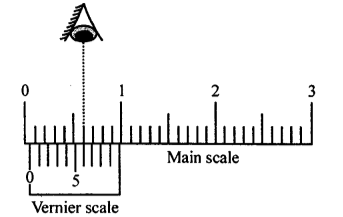
(b) Positive Error : If the zero of the vernier scale is on right hand side of zero of the main scale, then error is said to be positive and correction is said to be negative.
Image
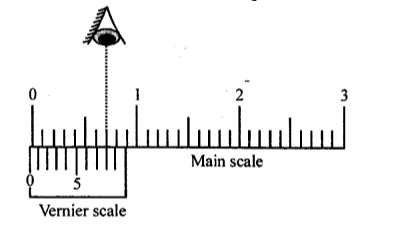
Negative Error : If the zero of the vernier scale is on the left hand side of zero of the main scale, the error is said be negative and the correction is said to be positive.
Image
(c) When positive error is 7 divisions and L.C. is 0.01 cm Then correction $=-(+7 \times$ L.C. $)$
$
=-7 \times 0.01 cm=-0.07 cm
$
When negative error is 7 divisions and count (L.C.) is 0.01 cm
$
\text { Then correction }=-(-7 \times \text { L.C. })
$
$
=-(-7 \times 0.01) cm=+0.07 cm
$

Need a full question paper?

Generate a complete, print-ready paper with questions like this in minutes — across 16+ boards, with answer keys.

Start Generating Free

Similar questions

Name the spherical mirror which (i) diverges (ii) converges the beam of light incident on it. Justify your answer by drawing a ray diagram in each case.
Prove mathematically F = ma
a. Calculate the height of a water column which will exert on its base the same pressure as the 70 cm column of mercury. Density of mercury is $13.6 g cm ^{-3}$.
b. Will the height of the water column in part (a) change if the cross-section of the water column is made wider?
A solid of density $7600 kgm { }^2$ is found to weigh 0.950 kgf in air. If $4 / 5$ volume of solid is completely immersed in a solution of density $900 kgm ^2$, find the apparent weight of solid in liquid.
(a) What do you understand by the term hydroelectric power?
(b) Explain the energy changes taking place in a hydroelectric dam?
Diagram given below shows velocity - time graphs of car P and Q, starting from same place and in same direction. Calculate:
1. Acceleration of car P.
2. Acceleration of car Q between 2 s5 s.
3. At what time intervals both cars have same velocity?
4. Which car is ahead after 10 s and by how much?
Image
A beaker contains a liquid of density ‘ρ’ upto height ‘h’such that ‘PA’ is atmospheric pressure and ‘g’ is acceleration due to gravity. Answer the following questions :
(a) What is the pressure on the free surface of liquid?
(b) What is the pressure on the base of beaker?
(c) What is the lateral pressure at the base on the inner walls of beaker?

What is nuclear energy? Name the process used for producing electricity using the nuclear energy.
How does the time period (T) of a simple pendulum depend on its length (l)? Draw a graph showing the variation of $T^2$ with l. How will you use this graph to determine the value of g (acceleration due to gravity)?
AB is the object, $A_1B_1$ is its image. MM' is the position of the mirror. Complete the ray diagram and find the position of the center of curvature and focus of the mirror. Also, measure the focal length.
Image