Question
(a) What is van't Hoff factor? Explain.
(b) Write the equation of molecular number properties including van't Hoff factor.

Answer

self

Need a full question paper?

Generate a complete, print-ready paper with questions like this in minutes — across 16+ boards, with answer keys.
Start Generating Free

Similar questions

(i) Define the order of a reaction.
(ii) Explain the effect of concentration of reactant on the rate constant.
(iii) For a first order reaction, if the rate constant at 500 K and 600 K are $0.03 s^{-1}$ and $0.06 s^{-1}$ respectively, then calculate the activation energy.
$
\left[R=8.314 JK^{-1} mol^{-1}, \log 2=0.3010\right]
$
At $291K$, the molar conductivities at infinite dilution of $NH_4Cl, NaOH$ and $NaCl$ are $129.8, 217.4$ and $108.9S \ cm^2 mol^{-1}$ respectively. If the molar conductivity of a centinormal solution of $NH_4OH$ is $9.33S \ cm^2 mol^{-1},$ what is the percentage dissociation of $NH_4OH$ at this dilution? Also calculate the dissociation constant of $NH_4OH.$
From the rate expression for the following reactions, determine their order of reaction and the dimensions of the rate constants.
(i) $3 NO ( g ) \rightarrow N _2 O ( g ) ; \quad$ Rate $= k [ NO ]^2$
(ii) $\begin{array}{r} H _2 O _2( aq )+3 I ^{-}( aq )+2 H ^{+} \rightarrow 2 H _2 O ( l )+ I _3^{-} ; \text {Rate }= k \left[ H _2 O _2 \mid\left[ I ^{-}\right]\right.\end{array}$
(iii) $\begin{aligned} CH _3 CHO ( g ) \rightarrow CH _4(g)+ CO ( g ) ; \text { Rate }= k \left[ CH _3 CHO \right]^{3 / 2}\end{aligned}$
(iv) $\begin{aligned} C _2 H _5 Cl ( g ) \rightarrow C _2 H _4(g) & + HCl ( g ) \ \text { Rate }= k \left[ C _2 H _5 Cl \right]\end{aligned}$
What is crystal field theory? On the basis of this, explain the crystal field splitting in octahedral coordinaton compounds.
Answer the following question:
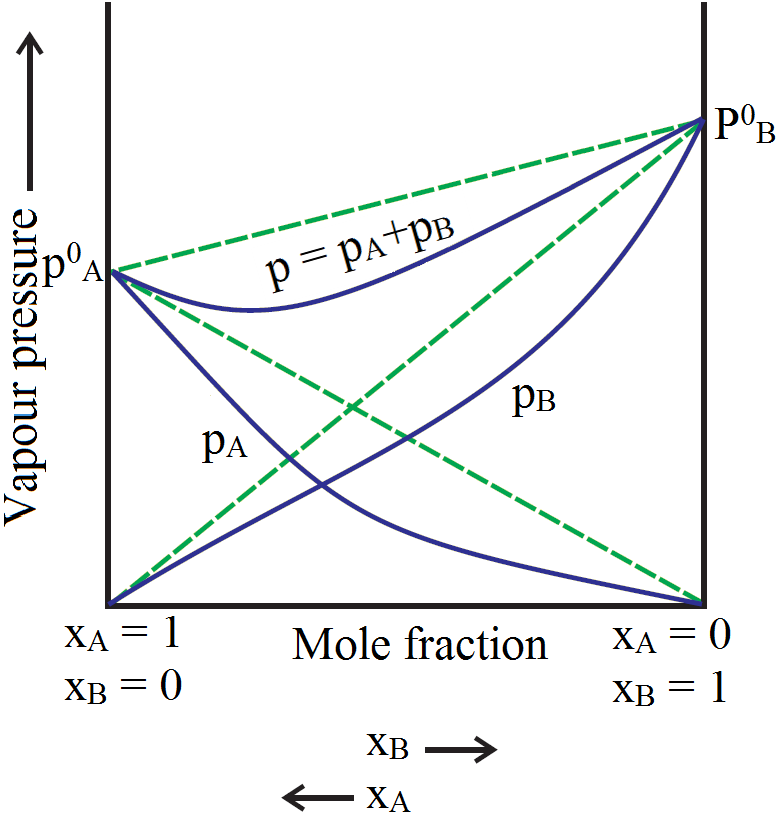
The graphical representation of vapour pressures of two component system as a function of composition is given alongside. By graphic inspection, answer the following questions:
  1. Are the A-B interactions weaker, stronger or of the same magnitude as A-A and B-B?
  2. Name the type of deviation shown by this system from Raoult’s law.
  3. Predict the sign of $\Delta_\text{mix}\text{H}$ for this system.
  4. Predict the sign of $\Delta_\text{mix}\text{H}$ for this system.
  5. Give an example of such a system.
  6. What type of azeotrope will this system form, if possible?
Explain the method of preparing haloalkanes by free radical substitution of alkanes.
Explain with two examples each of the following: Coordination entity, ligand coordination number, coordination polyhedron, homoleptic and heteroleptic.
Match the terms given in Column I with the units given in Column II.
 
Column I   Column II
i. $\wedge_{\text{m}}$ a. Intensive property.
ii. $\text{E}^{\ominus}_{\text{Cell}}$ b. Depends on number of ions/volume.
iii. $\text{K}$ c. Extensive property.
iv. $\Delta_{\text{r}}\text{G}_{\text{Cell}}$ d. Increases with dilution.
Describe the reactions of -COOH group present in carboxylic acids.
$(a).$ Give reasons for the following:
$(i)$ The reaction of ethanol with acetyl chloride is carried out in the presence of pyridine. Cresols are less acidic than phenol. Williamson's process is used for the preparation of ethers from alkyl halide. Identify the alkyl bromide and sodium alkoxide used for the preparation of $2-$ Ethoxy$-3-$methylpentane
$(c).$ Convert:
$(i)$ Toluene to $3-$nitrobenzoic acid.
$(ii)$ Benzene to $m-$nitroacetophenone.