Question
Explain with two examples each of the following: Coordination entity, ligand coordination number, coordination polyhedron, homoleptic and heteroleptic.

Answer

Coordination entity: This entity usually constitutes a central metal atom or ion, to which are attached a fixed number of other atoms or ions or groups by coordinate bonds. Examples are $\ce{[Ni(CO)_4], [COC]_3(NH_3)_3],}$ etc.
Ligands: It is an ion having at least one lone pair of electrons and capable of forming a coordinate bond with central atom/ion in the coordination entity.
Examples are: $\ce{Cl^-, (OH)^-, (CN)^-}$ etc.
Coordinate number: The total number of coordinate bonds with which central atom/ion is linked to ligands in the coordination entity is called coordination number of central atom / ion.
Coordination polyhedron: The spatial arrangement of the ligands which are directly attached to the central atom / ion defines a coordination polyhedron about the central atom.
Examples are: $\ce{[Co(NHM_3)_6]^{3+}}$ is octahedral,
$\ce{[Ni(CO)_4]}$ is tetrahedral.
Homoleptic and hedroleptic: Complexes in which a metal is bound to only one kind of donor groups are known as homoleptic.
Example $\ce{[CO(NH_3)_6]^{3+}}$
Complex in which a metal is bound to more than one kind of donor groups are called hetroleptic. Example: $\ce{[Co(NH_3)_4Cl_2]^+}$

Need a full question paper?

Generate a complete, print-ready paper with questions like this in minutes — across 16+ boards, with answer keys.

Start Generating Free

Similar questions

The experimental data for decomposition of $\ce{N2O5}$
$[\ce{2N2O5 \rightarrow 4NO2 + O2}]$
in gas phase at $318K$ are given below:
$t/s$ $0$ $400$ $800$ $1200$ $1600$ $2000$ $2400$ $2800$ $3200$
$10^2 \times [\ce{N2O5}]/mol \ L^{-1}$ $1.63$ $1.36$ $1.14$ $0.93$ $0.78$ $0.64$ $0.53$ $0.43$ $0.35$
  1. Plot $[\ce{N2O5}]$ against $t$.
  2. Find the half-life period for the reaction.
  3. Draw a graph between $\log[\ce{N2O5}]$ and $t$.
  4. What is the rate law?
  5. Calculate the rate constant.
  6. Calculate the half$-$life period from $k$ and compare it with $(ii)$.
How are carboxylic acids prepared from the following compounds? Explain with examples:
(a) Primary alcohol
(b) Acyl halide
(c) Acid anhydride
(d) Grignard reagent
(e) Alkyl benzene.
Explain the cyclic structure of glucose.
In the reaction
$Q + R \rightarrow$ Products
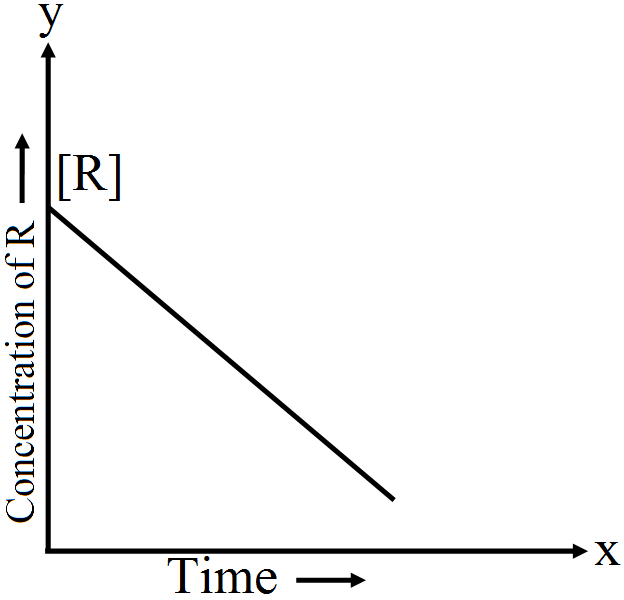
The time taken for $99\%$ reaction of $Q$ is twice the time taken for $90\%$ reaction of $R.$ The concentration of $R$ varies with time as shown in the figure given alongside.

What is the overall order of the reaction? Give the units of the rate constant for the same. Write the rate expression for the above reaction.
Write the rate law for a first order reaction. Justify the statement that half life for a first order reaction is independent of the initial concentration of the reactant.
What is the difference between lanthanoids and actinoids?
Image
Describe the methods of studying various first order reactions with examples.
Derive the Nernst equation and explain how $E_{\text {cell }}^{\circ}$ depends on concentration of ions.
$\ce{COSO_4Cl._5NH_3}$ exists in two isomeric forms $'A\ '$ and $'B\ '.$ Isomer $'A\ '$ reacts with $AgNO_3$ to give white precipitate but does not react with $BaCl_2.$ Isomer $'B\ '$ gives a white precipitate with $BaCl_2$ but does not react with $AgNO_3.$ Answer the following questions.
i. Identify $'A\ '$ and $'B\ '$ and write their structural formulas.
ii. Name the type of isomerism involved.
iii. Give the $\text{IUPAC}$ name of $'A\ '$ and $'B\ '.$