A wire of resistance $R$ is bent to form a square $ABCD$ as shown in the figure. The effective resistance between $E$ and $C$ is ( $E$ is mid-point of arm $CD$ )
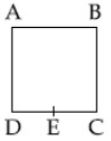
JEE MAIN 2019, Medium
Download our app for free and get started
$\frac{1}{R_{e q}}=\frac{8}{7 R}+\frac{8}{R}$
$\frac{1}{R_{e q}}=\frac{8+56}{7 R} ; \quad R_{e q i}=\frac{7 R}{64}$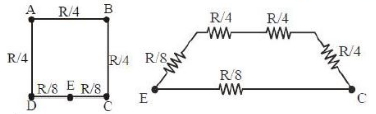

Download our appand get started for free
Experience the future of education. Simply download our apps or reach out to us for more information. Let's shape the future of learning together!No signup needed.*
Similar Questions
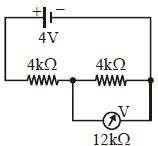
- 1The percentage error in the reading of the voltmeter in the figure shown here is nearly ............ $\%$View Solution
- 2$A$ wire of cross-section area $A$, length $L_1$, resistivity $\rho_1$ and temperature coefficient of resistivity $\alpha_1$ is connected to a second wire of length $L_2$, resistivity $\rho_2$ , temperature coefficient of resistivity $\alpha_1$ and the same area $A$, so that wire carries same current. Total resistance $R$ is independent of temperature for small temperature change if (Thermal expansion effect is negligible)View Solution
- 3The heating coils rating at $220\, volt$ and producing $50\, cal/sec$ heat are available with the resistances $55\,\Omega $ , $110\,\Omega$ , $220\,\Omega $ and $440\,\Omega $. The heater of maximum power will be of............. $\Omega$View Solution
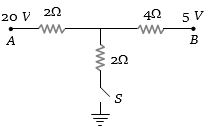
- 4As the switch $S$ is closed in the circuit shown in figure, current passed through it is .................. $A$View Solution
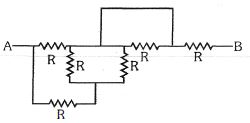
- 5What is the equivalent resistance between $A$ and $B$View Solution
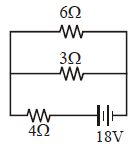
- 6The total power dissipated (in $watt$ ) in the circuit shown isView Solution
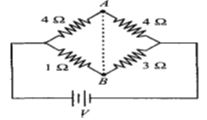
- 7In the circuit shown, if a conducting wire is connected between points $A$ and $B,$ the current in this wire willView Solution
- 8View SolutionAssertion : A current continues to flow in superconducting coil even after switch is off.
Reason : Superconducting coils show Meissner effect
- 9Calculate equivalent resistance across $A-B$ ............... $\Omega$View Solution
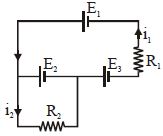
- 10The current $i_1$ and $i_2$ through the resistor $R_1 (= 10\,\Omega )$ and $R_2 (=30 \,\Omega )$ in the circuit diagram with $E_1 = 3\,V, E_2 = 3\,V$ and $E_3 = 2\,V$ are respectively:View Solution