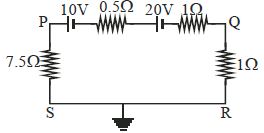
A wire when connected to $220\,V$ mains supply has power dissipation ${P_1}$. Now the wire is cut into two equal pieces which are connected in parallel to the same supply. Power dissipation in this case is ${P_2}$. Then ${P_2}:{P_1}$ is
AIEEE 2002, Medium


Download our appand get started for free
Experience the future of education. Simply download our apps or reach out to us for more information. Let's shape the future of learning together!No signup needed.*
Similar Questions
- 1Wheatstone bridge principle is used to measure the specific resistance $\left(S_1\right)$ of given wire, having length $L$, radius $r$. If $X$ is the resistance of wire, then specific resistance is: $S_1=X\left(\frac{\pi r^2}{L}\right)$. If the length of the wire gets doubled then the value of specific resistance will be :View Solution
- 2Two electric bulbs have tungsten filament of same length. If one of them gives $60\ W$ and the other $100\ W$ , thenView Solution
- 3A current of $5\; {A}$ is passing through a non-linear magnesium wire of cross-section $0.04\; {m}^{2}$. At every point the direction of current density is at an angle of $60^{\circ}$ with the unit vector of area of cross-section. The magnitude of electric field at every point of the conductor is ....${V} / {m}$ (Resistivity of magnesium is $\rho=44 \times 10^{-8}\, \Omega m$)View Solution
- 4There is a current of $40$ ampere in a wire of ${10^{ - 6}}\,{m^2}$ area of cross-section. If the number of free electron per ${m^3}$ is ${10^{29}}$, then the drift velocity will beView Solution
- 5A student obtained following observations in an experiment of meter bridge to find the unknown resistance of the circuit The most accurate value of unknown resistance is ............ $\Omega$View Solution
S.No. $R$ $l$ $100-l$ $S = \left( {\frac{{100 - l}}{l}} \right)R$ $1$ $20\,\Omega $ $43$ $57$ $26.51\,\Omega $ $2$ $30\,\Omega $ $51$ $49$ $28.82\,\Omega $ $3$ $40\,\Omega $ $59$ $41$ $27.80\,\Omega $ $4$ $60\,\Omega $ $70$ $30$ $25.71\,\Omega $ - 6View SolutionIn meter bridge or Wheatstone bridge for measurement of resistance, the known and the unknown resistances are interchanged. The error so removed is
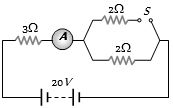
- 7In the circuit shown, the reading of ammeter when switch $S$ is open and when switch $S$ is closed respectively areView Solution
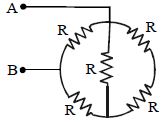
- 8The equivalent resistance between $A$ and $B$ isView Solution
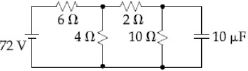
- 9Determine the charge on the capacitor in the following circuit ................ $\mu C$View Solution
- 10View SolutionIn the circuit shown in figure, which of the statement is incorrect ?