A wooden cube (density of wood $'d'$ ) of side $'l'$ floats in a liquid of density $'\rho '$ with its upper and lower surfaces horizontal. If the cube is pushed slightly down and released, it performs simple harmonic motion of period $'T'$. Then, $'T'$ is equal to
AIEEE 2011, Diffcult


Download our appand get started for free
Experience the future of education. Simply download our apps or reach out to us for more information. Let's shape the future of learning together!No signup needed.*
Similar Questions
- 1The equation of motion of a particle is $\frac{{{d^2}y}}{{d{t^2}}} + Ky = 0$, where $K$ is positive constant. The time period of the motion is given byView Solution
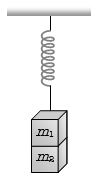
- 2Two masses $m_1$ and $m_2$ are suspended together by a massless spring of constant $K$. When the masses are in equilibrium, $m_1$ is removed without disturbing the system. The amplitude of oscillations isView Solution
- 3The amplitude of a particle executing $SHM$ about $O$ is $10\, cm.$ Then :View Solution
- 4Two simple harmonic motions of angular frequency $100$ and $1000\,\,rad\,s^{-1}$ have the same displacement amplitude. The ratio of their maximum acceleration isView Solution
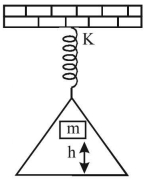
- 5A load of mass $m$ falls from a height $h$ on to the scale pan hung from the spring as shown in the figure. If the spring constant is $k$ and mass of the scale pan is zero and the mass $m$ does not bounce relative to the pan, then the amplitude of vibration isView Solution
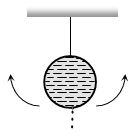
- 6View SolutionA simple pendulum is made of a body which is a hollow sphere containing mercury suspended by means of a wire. If a little mercury is drained off, the period of pendulum will
- 7$Assertion :$ For a particle performing $SHM$, its speed decreases as it goes away from the mean position.View Solution
$Reason :$ In $SHM$, the acceleration is always opposite to the velocity of the particle. - 8If a Second's pendulum is moved to a planet where acceleration due to gravity is $4$ times, the length of the second's pendulum on the planet should be made .......... timesView Solution
- 9A cylindrical plastic bottle of negligible mass of filled with $310\, ml$ of water and left floating in a pond with still water. If pressed downward slightly and released, it starts performing simple harmonic motion at angular frequency $\omega $. If the radius of the bottle is $2.5\, cm$ then $\omega $ is close to ..... $rad\, s^{-1}$ (density of water $= 10^3\, kg/m^3$)View Solution
- 10The time period of a mass suspended from a spring is $T$. If the spring is cut into four equal parts and the same mass is suspended from one of the parts, then the new time period will beView Solution