Question
A Young's double slit experiment is performed with white light:
  1. The central fringe will be white.
  2. There will not be a completely dark fringe.
  3. The fringe next to the central will be red.
  4. The fringe next to the central will be violet.
Answer

  1. The central fringe will be white.
  2. There will not be a completely dark fringe.
  1. The fringe next to the central will be violet.
Explanation:
The superposition of all the colours at the central maxima gives the central band a white colour. As we go from the centre to corner, the fringe colour goes from violet to red. There will not be a completely dark fringe, as complete destructive interference does not take place.

Need a full question paper?

Generate a complete, print-ready paper with questions like this in minutes — across 16+ boards, with answer keys.

Start Generating Free

Similar questions

Which of the following can be chosen to analogously represent the behavior of a particle?
The reason for the energy associated with a moving charge is:
A circular disc $A$ of radius $r$ is made from an iron plate of thickness $(t)$ and another circular disc $B$ of radius $4r$ is made from an iron plate of thickness $\frac{\text{t}}{4}.$ The relation between the moments of inertia $I_A$ and $I_B$ is:
One end of a uniform rod of mass m and length (l) is clamped. The rod lies on a smooth horizontal surface and rotates on it about the clamped end at a uniform angular velocity $\omega.$ The force exerted by the clamp on the rod has a horizontal component:
  1. $\text{m}\omega^2\text{l}$
  2. $\text{Zero.}$
  3. $\text{mg}$
  4. $\frac{1}{2}\text{m}\omega^2\text{l}$
If the phase difference between Alternating Voltage and Alternating Current is $\frac{\pi}{6}$​ and the resistance in the circuit is $\sqrt{300}\Omega,$ then the impedance of the circuit will be.
A chain reaction is continuous due to(a) Large mass defect(b) Large energy(c) Production of more neutrons in fission(d) None of these


A thin lens made of glass of refractive index 1.5 has a front surface + 11 D power and back surface – 6 D. If this lens is submerged in a liquid of refractive index 1.6, the resulting power of the lens is(a) – 0.5 D(b) + 0.5 D (c) – 0.625 D(d) + 0.625 D
       
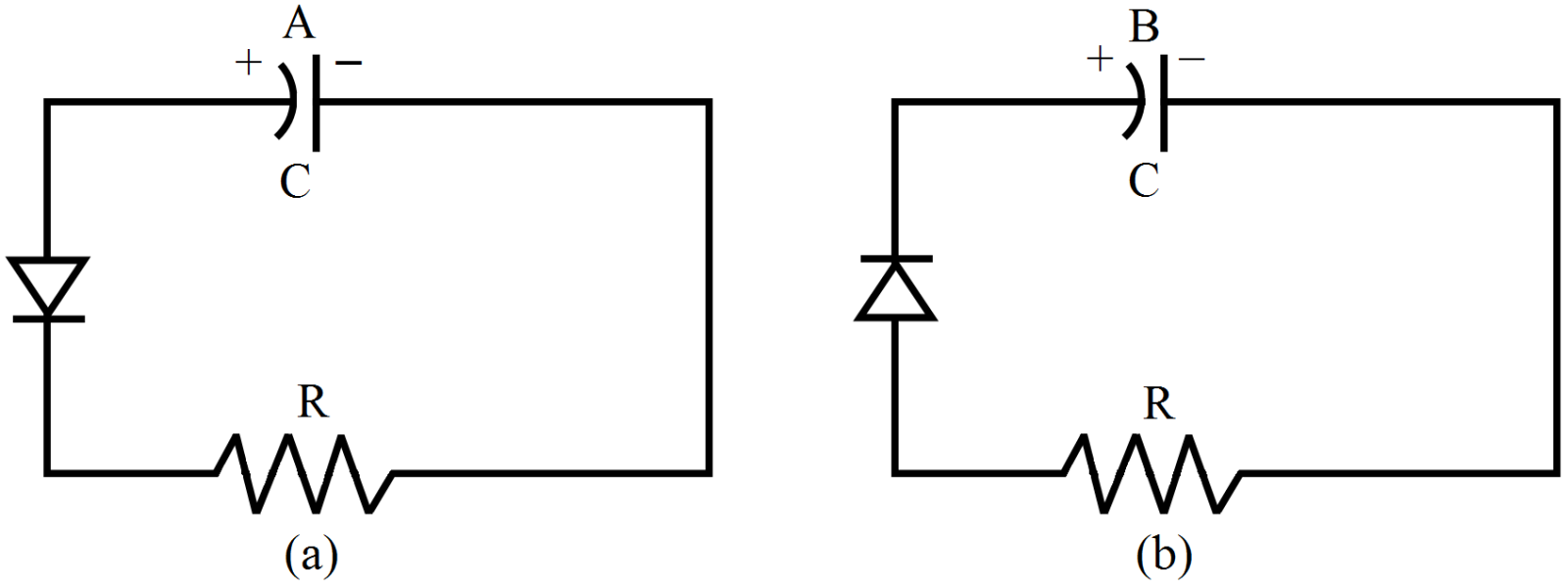
Two identical capacitors A and B are charged to the same potential V and are connected in two circuits at t = 0 as shown in figure. The charges on the capahltors at a time t = CR are, respectively:
  1. $\text{VC}, \text{VC}$
  2. $\frac{\text{VC}}{\text{e}}, \text{VC}$
  3. $\text{VC}, \frac{\text{VC}}{\text{e}}$
  4. $\frac{\text{VC}}{\text{e}}, \frac{\text{VC}}{\text{e}}$
In Young's experiment, one slit is covered with a blue filter and the other (slit) with a yellow filter. Then the interference pattern(a) Will be blue(b) Will be yellow(c) Will be green(d) Will not be formed
       
GaAs is(a) Element semiconductor(b) Alloy semiconductor(c) Bad conductor(d) Metallic semiconductor