MCQ
A Young's double slit experiment is performed with white light:
  • A
    The central fringe will be white.
  • B
    There will not be a completely dark fringe.
  • C
    The fringe next to the central will be violet.
  • All of the above

Answer

Correct option: D.
All of the above
The superposition of all the colours at the central maxima gives the central band a white colour. As we go from the centre to corner, the fringe colour goes from violet to red. There will not be a completely dark fringe, as complete destructive interference does not take place.

Need a full question paper?

Generate a complete, print-ready paper with questions like this in minutes — across 16+ boards, with answer keys.
Start Generating Free

Similar questions

Two bodies of masses $m$ and $4 \,m$ are moving with equal $K.E.$ The ratio of their linear momentums is
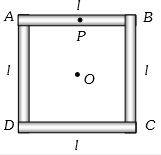
Four thin rods of same mass $M$ and same length $l$, form a square as shown in figure. Moment of inertia of this system about an axis through centre $O$ and perpendicular to its plane is
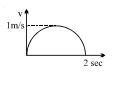
Velocity-time graph for a car is semicircle as shown here. Which of the following is correct :
The ratio of inertial mass and gravitational mass has been found to be $1$ for all material bodies. Were this ratio different for different bodies, the two bodies having same gravitational mass but different inertial mass would have?
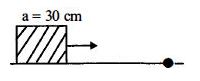
A cubical block of side $30\,cm$  is moving with  velocity $2\,\,ms^{-1}$ on a smooth horizontal surface. The surface has a bump at a point $O$ as shown in figure. The angular velocity (in rad/s) of the block immediately after it hits the bump, is
A particle is moving along a straight line with increasing speed. Its angular momentum about a fixed point on this line
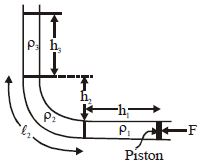
A tube is bent into $L$ shape and kept in a vertical plane. If these three liquids are kept in equilibrium by the piston of area $A$ , the value of $\frac {F}{A}$ is
A point source emits sound equally in all directions in a non-absorbing medium. Two points P and Qare at distances of 2 m and 3 m respectively from the source. The ratio of the intensities of the waves at P and Q is:
The mean square speed of the molecules of a gas at absolute temperature $T$ is proportional to:
A small block of mass $m$ is projected horizontally with speed $u$ where friction coefficient between block and plane is given by $\mu = cx$, where $x$ is displacement of the block on plane. Find maximum distance covered by the block