Question
A1. Simple Factual Activities:
Complete the sentences:
(1) A tiny bird was rushing towards _________.
(2) A heavy fire had broken out in the _________.
(3) The speaker is appealing to globalise _________.
(4) The tiny bird was going to _________.

     We can do it ...
     You may ask that - what can one person do? I would recall a story of my childhood: A heavy fire had broken out in the forest. All the animals were running away, including lion, the king of the forest. Suddenly, then he saw a tiny bird rushing towards the fire. He asked the bird, “What are you doing?” To the lion’s surprise, the bird replied “I am going to extinguish the fire.” The lion laughed and said, “How can you do it keeping just one drop of water, in your beak?” The bird was adamant, and she said, “I am doing my bit.”
     Eighteen years ago, millions of individuals marched across the globe. And demanded a new international law for the abolition of worst form of child labour, and it has happened, we did it, millions of individuals did it.
     Friends! We live in an age of rapid globalisation. We are connected through high-speed Internet. We exchange our goods and services in one single global market. Thousands of flights every day connect us from one corner to another corner of the globe. But there is one serious disconnect and there is a lack of compassion. Let us inculcate and transform these individuals’ compassion into a global compassion.
Let us globalise compassion.
     Mahatma Gandhi said, “If we are to teach real peace in this world... we shall have to begin with the children.” I humbly add, let us unite the world through the compassion for our children.
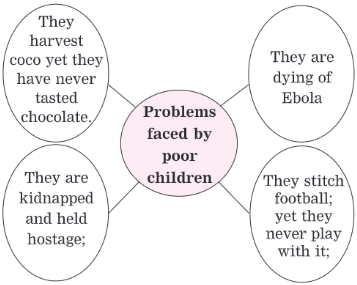
     I ask - Whose children are they who stitch footballs, yet never played with one?
     Whose children are they who harvest cocoa, yet have never tasted chocolate?
     Whose children are they who are dying of Ebola?
     Whose children are they who are kidnapped and held hostage?
     They are all our children.
     I remember an eight-year-old girl we rescued from intergenerational forced labour from stone quarries. When she was sitting in my car right after her rescue, she asked me: “Why did you not come earlier?”
     Her angry question still shakes me – and has the power to shake the whole world. Her question is for all of us. What are we doing? What are we waiting for? How many girls will we allow to go without rescue?
     Children are questioning our inaction and watching our actions. We need collective actions with a sense of urgency.
     Every single minute matters, every single child matters, every single childhood matters.
     Therefore, I challenge the passivity and pessimism surrounding our children. I challenge this culture of silence and this culture of passivity, this culture of neutrality.

A2. Complex Factual Activities:

Complete the following web:
Image

A3. Activities based on Vocabulary:
(1) Use the word 'stitch' as a Noun and a Verb in separate meaningful sentences.
A4. Activities based on Contextual Grammar:
Add a question tag:
(1) We are connected through high-speed internet.
(2) We exchange our goods and services in one single global market.
A5. Personal Response:
(1) What lesson does the story of the lion and the tiny bird teach us? 
Answer

A1. Simple Factual Activities:
(1) A tiny bird was rushing towards the fire.
(2) A heavy fire had broken out in the forest.
(3) The speaker is appealing to globalise compassion.
(4) The tiny bird was going to extinguish the fire.
A2. Complex Factual Activities:
Image
A3. Activities based on Vocabulary:

(1) The tailor was asked to stitch the clothes quickly. (verb)
(2) The wound needed eight stitches. (noun)
A4. Activities based on Contextual Grammar:
(1) We are connected through high-speed internet, aren't we?
(2) We exchange our goods and services in one single global market, don't we?
A5. Personal Response:
(1) I think the story of the lion and the tiny bird teaches us not to belittle other individials  who at least do something and make an effort. No matter how small it is in our eyes but it might be big in result. Small things shouldn't be valued too little sometimes. Big things always start from something small.

Need a full question paper?

Generate a complete, print-ready paper with questions like this in minutes — across 16+ boards, with answer keys.

Start Generating Free

Similar questions

A1. Simple Factual Activities:
Write whether the following sentences are True or False:
(1) Writer's journey from India to Norway is a connect between the two centre of global peace.
(2) The Nobel Committee did not invite the writer to deliver a lecture.
(3) Writer represented the sound of silence and cry of innocence.
(4) Writer humbly accepted the award on behalf of all activists.

     My dear children of the world ... Your Majesties, Your Royal Highnesses, Excellencies, distinguished members of the Norwegian Nobel Committee, dear brother Tom Harkin, brothers and sisters, and my dear daughter Malala.
      From this podium of peace and humanity, I am deeply honoured to recite a mantra from the ancient texts of wisdom, Vedas. This mantra carries a prayer, an aspiration and a resolve that has the potential to liberate humanity from all man-made crises.
      Let’s walk together. In the pursuit of global progress, not a single person should be left out or left behind in any corner of the world, from East to West, from South to North. Let’s speak together, let our minds come together! Learning from the experiences of our ancestors, let us together create knowledge for all that benefits all.
      I bow to my late parents, to my motherland India, and to the mother earth.
      With a warm heart I recall how thousands of times, I have been liberated, each time I have freed a child from slavery. In the first smile of freedom on their beautiful faces, I see the Gods smiling.
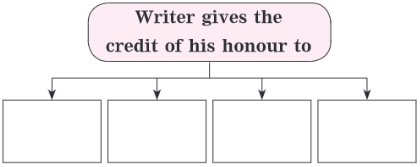
      I give the biggest credit of this honour to my movement’s Kaalu Kumar, Dhoom Das and Adarsh Kishore from India and Iqbal Masih from Pakistan who made the supreme sacrifice for protecting the freedom and dignity of children. I humbly accept this award on behalf of all such martyrs, my fellow activists across the world and my countrymen.
      My journey from the great land of Lord Buddha, Guru Nanak and Mahatma Gandhi; India to Norway is a connect between the two centres of global peace and brotherhood, ancient and modern.
      Friends, the Nobel Committee has generously invited me to present a “lecture.” Respectfully, I am unable to do that. Because, I am representing here - the sound of silence. The cry of innocence. And, the face of invisibility. I represent millions of those children who are left behind and that’s why I have kept an empty chair here as a reminder.

A2. Complex Factual Activities:
Complete the following :
Image
A3. Activities based on Vocabulary:
(1) Use the word 'credit' as a noun and a verb to make a meaningful sentence.
A4. Activities based on Contextual Grammar:
Do as directed:
(1) I humbly accept this award. (Choose the correct question tag.)
(a) do I?  (b) don't I? (c) did I? (d) didn't I?
(2) I am unable to do that.
(Make it negative without changing its meaning)
A5. Personal Response:
(1) What do you know about Kailash Satyarthi? 
A1. Simple Factual Activities:
Who said to whom-
(1) "Now tell me your name."
(2) "Didn't I tell you? Now take this book."

     When the school bell rang. All the girls scurried out of the classroom. But Bholi dared not leave her corner. Her head still lowered. She kept on sobbing.
    ‘‘Bholi.’’
     The teacher’s voice was so soft and soothing! In all her life she had never been called like that. It touched her heart.
    ‘‘Get up.’’ said the teacher. It was not a command, but just a friendly suggestion. Bholi got up.
    ‘‘Now tell me your name.’’
     Sweat broke out over her whole body. Would her stammering tongue again disgrace her? For the sake  of this kind woman. However she decided to make an effort. She had such a soothing voice : she would not laugh at her.
    ‘‘Bh-Bh-Bho-Bho-,’’ she began to stammer.
    ‘‘Well done, well done.’’ The teacher encouraged her. ‘‘Come on now- the full name?’’
    ‘‘Bh-Bh-Bho-Bholi.’’ At last she was able to say it and felt relieved as if it was a great achievement.
    ‘‘Well done.’’ The teacher patted her affectionately and said. ‘‘Put the fear out of your heart and you will be able to speak like everyone else.’’
     Bholi looked up as if to ask. ‘Really?’
    ‘‘Yes, yes, it will be very easy. You just come to school everyday, will you come?’’
     Bholi nodded.
    ‘‘No. say it aloud.’’
    ‘‘Ye-Ye-Yes.’’ And Bholi herself was astonished that she had been able to say it.
    ‘‘Didn’t I tell you? Now take this book.’’
     The book was full of nice pictures and the pictures were in colour dog, cat, goat, house, parrot, tiger and a cow just like Lakshmi. And with every picture was a word in big black letters.
     ‘‘In one month you will be able to read this book. Then I will give you a bigger book, then a still bigger one. In time you will be more learned than anyone else in the village. Then no one will ever be able to laugh at you. People will listen to you with respect and you will be able to speak without the slightest stammer. Understand? Now go
home, and come back early tomorrow morning”
      Bholi felt as if suddenly all the bells in the village temple were ringing and the trees in front of the school house had blossomed into big red flowers. Her heart was throbbing with a new hope and a new life. 

A2. Complex Factual Activities:
(1) How would you describe the teacher's attitude towards Bholi? Give 3 to 4 points.
A3. Activities based on Vocabulary:
Complete the following sentences using the words given in the brackets:
(scurried, affectionately, a great achievement)
(1) After class, the students _______________ out for their lunch-break.
(2) My father always tries to solve my problem _______________.
A4. Activities based on Contextual Grammar:
Change the voice:
(1) The teacher patted her affectionately. (Begin the sentence with "She....)
(2) The teacher encouraged her. (Begin the sentence with "She....)
A5. Personal Response:
(1) Why does positive encouragement work better than criticism? 
A1. Simple Factual Activities:
Choose the correct alternative and complete the following sentences:
(1) Bholi is compared with _______________.
(a) a dumb cow (b) a kind cow (c) a dead cow
(2) _______________ was not ready to get married.
(a) Bishamber (b) Bholi (c) Bholi's friend

     The bridegroom lifted the garland of yellow marigolds. A woman slipped back the silken veil from the bride’s face. Bishamber took a quick glance. The garland remained poised in his hands. The bride slowly pulled down the veil over her face.
     “Have you seen her ?” said Bishamber to the friend next to him. “She has pockmarks on her face.”
     “So what ? You are not young either.”
     “Maybe. But if I am to marry her, her father must give me five thousand rupees.”
     Ramlal went and placed his turban - his honour - at Bishamber’s feet. “Do not humiliate me so. Take two thousand rupees.”
     “No. Five thousand, or we go back. Keep your daughter.”
     “Be a little considerate, please. If you go back, I can never show my face in the village.”
     “Then out with five thousand.”
     Tears streaming down his face, Ramlal went in, opened the safe and counted out the notes. He placed the bundle at the bridegroom’s feet.
     On Bishamber’s greedy face appeared a triumphant smile. He had gambled and won. “Give me the garland,” he announced.
     Once again the veil was slipped back from the bride face but this time her eyes were not downcast. She was looking up, looking straight at her prospective husband, and in her eyes there was neither anger nor hate, only cold contempt.
      Bishamber raised the garland to place it round the bride’s neck but before he could do so, Bholi’s hand struck out like a streak of lightening and garland was flung into the fire. She got up and threw away the veil.
     “Pitaji” said Bholi in a clear loud voice; and her father, mother, sisters, brothers, relations and neighbours were startled to hear her speak without even the slightest stammer.
     “Pitaji”, take back your money. I am not going to marry this man.”
      Ramlal was thunderstruck. The guests began to whisper, “So shameless! So ugly and so shameless !”
     “Bholi, are you crazy ?” shouted Ramlal. “You want to disgrace your family? Have some regard for out izzat!”
     “For the sake of your izzat,” said Bholi, “I was willing to marry this lame old man. But I will not have such a mean, greedy and contemptible coward as my husband. I won’t, I won’t, I won’t.”
     What a shameless girl! We all thought she was a harmless dumb cow.”

A2. Complex Factual Activities:
(1) What shocked the family members?
A3. Activities based on Vocabulary:
Find out synonyms from the passage for the following words:
(1) humiliate
(2) contempt 
(3) prospective
(4) startled 
A4. Activities based on Contextual Grammar:
Rewrite the following into indirect speech:
(1) "Be a little considerate, please. If you go back, I can never show my face in the village." "Then out with five thousand."
(2) "Pitaji, take back your money. I am not going to marry this man." "Bholi, are you crazy?" shouted Ramlal.
A5. Personal Response:
(1) What did you learn from Bholi's action of not getting married to Bishamber? 
A1. Simple Factual Activity:
Complete the sentences using the information from the passage:
(1) According to Mrs Bhushan,  _______________.
(2) Mr Bhushan said to his wife, "You go from one shop to another, like  _______________.

      And Sitaram, glad that he had been of service to both a customer and his friend, hoisted his bag on his shoulders and went his way.
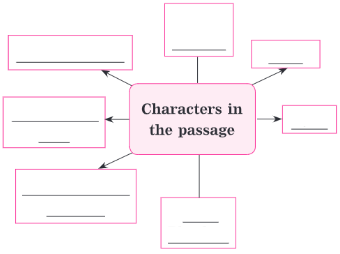
      Mrs. Srivastava had to do some shopping. She gave instructions to the ayah about looking after the baby, and told the cook not to be late with the midday meal. Then she set out for the Pipalnagar market place, to make her customary tour of the cloth shops.
      A large shady tamarind tree grew at one end of the bazaar, and it was here that Mrs. Srivastava found her friend Mrs. Bhushan sheltering from the heat. Mrs. Bhushan was fanning herself with a large handkerchief. She complained of the summer, which she affirmed, was definitely the hottest in the history of Pipalnagar. She then showed Mrs. Srivastava a sample of the cloth she was going to buy, and for five minutes they discussed its shade, texture and design. Having exhausted this topic, Mrs. Srivastava
said, ‘Do you know, my dear, that Seth Govind Ram’s bank can’t even pay its employees? Only this morning I heard a complaint from their sweeper, who hasn’t received his wages for over a month!’
     ‘Shocking!’ remarked Mrs. Bhushan. ‘If they can’t pay the sweeper they must be in a bad way. None of the others could be getting paid either.’
     She left Mrs. Srivastava at the tamarind tree and went in search of her husband, who was sitting in front of Kamal Kishore’s photography shop, talking with the owner.
    ‘So there you are!’ cried Mrs. Bhushan. ‘I’ve been looking for you for almost an hour. Where did you disappear ?’
    ‘Nowhere,’ replied Mr. Bhushan. ‘Had you remained stationary in one shop, I might have found you. But you go from one shop to another, like a bee in a flower garden.’
    ‘Don’t start grumbling. The heat is trying enough.I don’t know what’s happening to Pipalnagar. Even the bank’s about to go bankrupt.’   

A2. Complex Factual Activity:
Complete the following web:
Image
A3. Activities based on Vocabulary:
Complete the followinig sentences by using the correct form of the phrases from the bracket:
[to complain of, at the end of, to set out for]
(1) There is an old Shiva's temple at the end of the village.
(2) The travellers set out early in the morning for the tour.
A4. Activities based on Contextual Grammar:
(1) That summer was the hottest in the history of Pipalnagar.
(Change the sentence into Positive Degree.)
(2) I heard a complaint.
(Begin the sentence with 'A complaint.....')
A5. Personal Response:
(1) Do you think, Mr Bhushan was right to compare his wife with a bee in a flower garden? Give your reason.
A1. Simple Factual Activities:
State whether the following statements are Right or Wrong:
(1) We should have vision for today not tomorrow.
(2) If we close our eyes and feel the child inside us, we can listen to that child.
(3) Mahatına Gandhi, Nelson Mandela and Martin Luther King are calling on us.
(4) Satyarthi's vision of tomorrow is to see that cobbler's boy sitting with him in his classroom.

     As a child, I had a vision of tomorrow. A vision of that cobbler boy sitting with me in my classroom.
     Now, that tomorrow has become TODAY.
     I am TODAY, and you are TODAY. TODAY it is time for every child to have a right to life, right to freedom, right to health, right to education, right to safety, right to dignity, right to equality, and right to peace.
     TODAY, beyond the darkness, I see the smiling faces of our children in the blinking stars. TODAY, in every wave of every ocean, I see my children are playing and dancing. TODAY, in every plant, in every tree, and mountain, I see our children growing freely with dignity.
     Friends, I want you to see and feel this TODAY inside you.
     My dear sisters and brothers, as I said many interesting things are happening today. May I please request you to put your hand close to your heart - close your eyes and feel the child inside you?
     I am sure you can - Now, listen to that child.Listen please.
     Today, I see thousands of Mahatma Gandhis, Nelson Mandelas and Martin Luther Kings calling on us.
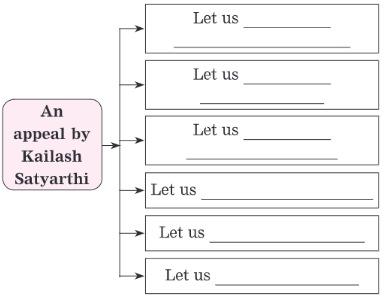
     Let us democratise knowledge. Let us universalise justice. Together, let us globalise compassion!
     I call upon you in this room, and all across the world. I call for a march from exploitation to education, I call for a march from poverty to shared prosperity, a march from slavery to liberty, and a march from violence to peace.
     Let us march from ignorance to awakening. Let us march from darkness to light. Let us march from mortality to divinity.
     Let us march!  

A2. Complex Factual Activities:
Complete the following web-chart :
Image
A3. Activities based on Vocabulary:
Write the infinitive forms of the following and use any two of them in your own sentences:
(1) dancing
(2) playing
(3) growing 
(4) happening 
A4. Activities based on Contextual Grammar:
Make nouns of the following:
(1) universal
(2) global
(3) knowledge
(4) exploitation
A5. Personal Response:
(1) What do you mean by 'Every child has a right to life'? 
A1. Simple Factual Activities:
Choose the correct alternatives:
(1) What kind of text is it?
(A) story (B) speech (C) interview (D) essay
(2) Which State does Mary Kom belong to?
(A) Maharashtra (B) Tamil Nadu (C) Kerala (D) Manipur

   There had to be one successful story if Indians were to survive in sports and we have that story now. Enough has been said about this great warrior who conquered the world. This warrior is none other than Mary Mangte Kom-the Komqueror and the Komrade. She is famed as a five times World Boxing Champion and the only boxer to win a medal in every one of the six world championships. In the 2012 Olympics, she became the first Indian woman boxer to qualify and win a bronze medal in the 51
kg flyweight category of Boxing.
     Kom was born in Kangthei village, Moirang Lamkhai in Churachandpur district of rural Manipur in eastern India. She came from a poor family. Her parents, Mangte Tonpa Kom and Mangte Akham Kom were tenant farmers who worked in jhum fields.
Kom grew up in humble surroundings, helping her parents with farm related chores, going to school and learning athletics initially and later boxing simultaneously. Her father was a keen wrestler in his younger age.
     She had an eager interest in athletics since childhood and the success of Dingko Singh a fellow Manipuri returned from the 1998 Bangkok Asian games with a gold medal, Kom recollects, had inspired many youngsters in Manipur to try boxing
and she too thought of giving it a try.
     Mary Kom’s career started in 2000 after her victory in the Manipur State women’s boxing championship and the regional championship in West Bengal. In 2001, she started competing at international level. She was only 18 years old when she made her international debut at the first AIBA Women’s World Boxing Championship in United States, winning a silver medal in the 48 kg weight category. Her greatness is reinforced by the way she apoligized to the whole nation for not being able to win the Gold. She is a legend for sure and an idol for all the sportswomen to look up to.

A2. Complex Factual Activities:
(1) What has added to Mary Kom's greatness as a boxing champion? 
A3. Activities based on Vocabulary:
Use the following words in your own sentences:
(1) debut :
(2) legend :
A4. Activities based on Contextual Grammar:
Choose the tail tags given in the brackets and complete the following sentences:
(isn't she?, hadn't he?, wasn't he?)
(1) Her father was a keen wrestler in his younger age, _______________
(2) Dingko Singh had inspired many youngsters in Manipur, _______________
A5. Personal Response:
(1) Write any two names of indoor games and two names of outdoor games.
A1. Simple Factual Activity:
Name the following:
(1) The country where Mount Huangshan is situated in
(2) The famous dam in Egypt on River Nile

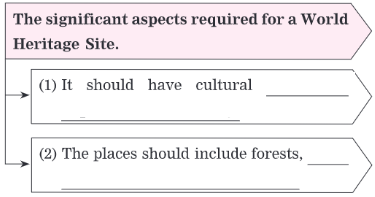
     A World Heritage Site is a site determined by the United Nations Educational, Scientific and Cultural Organization (UNESCO) to have significant cultural or natural importance to humanity. As such the sites are protected and maintained by the
International World Heritage Programme which is administered by the UNESCO World Heritage Committee. Because World Heritage Sites are places that are significant culturally and naturally, they vary in type and include forests, lakes, monuments, buildings and cities.
    World Heritage Sites can also be a combination of both cultural and natural areas. For example, Mount Huangshan in China is a site with significance to human culture because it played a role in historical Chinese art and literature. The mountain is also
significant because of its physical landscape characteristics.
     Although the idea of protecting cultural and natural heritage sites around the world began in the early twentieth century, momentum for its actual creation was not until the 1950s. In 1954, Egypt started plans to build the Aswan High Dam to collect and control water from the Nile River. The initial plan for the dam’s construction would have flooded the valley containing the Abu Simbel Temples and scores of ancient Egyptian artefacts. To protect the temples and artifacts, UNESCO launched an international campaign in 1959 that called for the dismantling and movement of the temples to higher ground. The project cost an estimated US $80 million, $40 million of which came from 50 different countries. Because of the project’s success, UNESCO and the
International Council on Monuments and Sites initiated a draft convention to create an international organization responsible for protecting cultural heritage
 
A2. Complex Factual Activity:
Complete the web:
Image
A3. Activities based on Vocabulary:
Look at the words and their meanings.Underline the correct alternatives:
(i) determine: (a) think over (b) decide (c) ask for (d) look over
(ii) monument: (a) statue (b) pillar (c) memorial building (d) fort
A4. Activities based on Contextual Grammar:
This does not mean that the book is filled with heavy Grammar.Rewrite the following sentences using 'not only ... but also' and 'as well as in two separate sentences:
(1) World Heritage Sites can be a combination of both cultural and natural areas.
A5. Personal Response:
(1) What are our duties towards preservation of any historical site?
A1. Simple Factual Activity:
(1) He was bestowed with numerous honorary doctorates and awards.
(2) Dr Hawking's 'A Brief History of Time' is one of the best selling books of our time.

    Though confined to a wheel chair with no control over his body save a finger and with
a computer to help him express his thoughts. Dr Hawking is an authority on profound subjects of science. Numerous honorary doctorates and awards have been bestowed
on him. He is a Fellow of The Royal Society and a Member of the US National Academy of Sciences.
     In spite of being considered Einstein’s equal in intelligence, Dr Hawking is a very humble man. A simple, down to earth man, he has authored many books dealing with his awesome ideas keeping a layman in mind. His writing is full of wit and humour. His style is so lucid that non-scientists can also understand him. His book, “A Brief History of Time” is one of the best selling books of our times.
     On being asked, how he feels about having the dreadful ALS, Dr Hawking, the quintessence of optimism and hope, says, “Not very different from the rest. I try and lead as normal a life as possible, and not think about my condition or regret the things it prevents me from doing, which are not many.”
      Dr Hawking firmly believes that in the next millenium, science will discover the core secrets of the universe, its origin, its history and maybe even predict its ultimate demise.
      Like Dr Hawking, there are many people who display exemplary courage in their lives. Let us salute all those brave people, who in spite of being disabled strive to do their best.

A2. Complex Factual Activity:
(1) Which of Dr Hawking's achievements are mentioned in this passage? 
A3. Activities based on Vocabulary:
Write the adjectives for the following nouns from the passage:
(1) ideas
(2) style
(3) courage
(4) secrets.
A4. Activities based on Contextual Grammar:
Do as directed:
(1) His writing is full of wit and humour.
(Rewrite the sentence using Past Perfect Tense.)
(2) He is a fellow of the Royal Society and a member of the US National Academy of Science.(Use not only but also.)
A5. Personal Response:
(1) How do you know that Dr Hawking is a perfect example of optimism and hope?  
A1. Simple Factual Activities:
State whether you Agree or Disagree with the following statements: 
Statements
(1) The narrator made a mistake by saving the baby langur.
(2) Animals cannot convey emotions.

    For a few seconds, the mother langur looked straight into my eyes. Even today, I cannot forget that look in her eyes, showering silent gratitude on me for saving her child. I was overwhelmed by the emotion, the sentiment and the way she said thanks to me. There sat a universal mother holding a stricken child in her lap.
    Then, in a flash, she jumped with her baby clinging to her belly and reached our kitchen roof. She surveyed the area for the vicious male langur and then leapt away in the direction opposite to the place of the violent encounter.
    The brief meeting with the mother and the baby langur convinced me that interspecies communication and mutual trust is indeed a reality and should anyone strike the right chord, the relationship hums into action. The mother langur showed me that food was not the only means of communication between man and animal but that there were other means of establishing a bond through trust, compassion and mutual understanding.
     Fifty-five years have passed since that day. I am now seventy years old. But I still fondly remember that ‘encounter of a special kind’.

A2. Complex Factual Activities:
Complete the web:
Image
 
A3. Activities based on Vocabulary:
Match the words in column 'A' with their meanings in column 'B':

 Column 'A'Column 'B'
 (1) to be overwhelmed by (a) to do something that makes people feel to have  sympathy with.
 (2) in a flash (b) very quickly
 (3) strike the right chord (c) belief felt equally by both people involved.
 (4) mutual trust (d) to be affected emotionally in a powerful way.

A4. Activities based on Contextual Grammar:
Rewrite the sentences as per the tenses mentioned in the brackets:
(1) The mother langur looked straight into my eyes. (Simple Present Tense.)
(2) She surveyed the area for the vicious male langur. (Simple Future Tense.)
A5. Personal Response:
(1) What did the mother langur seem to convey to the narrator?

A1. Simple Factual Activities:
State whether you Agree or Disagree with the following statements:
Image

Interviewer : Do you think interest in boxing in India will ever go beyond the Olympics ?
Mary Kom : Yes, I am sure that in a few years boxing will be very popular among everyone in India, all the year round.
Interviewer : How aware are Indian women of their nutritional requirements ? Diet and nutrition must’ve been a key factor in your conditioning for the Olympics. Do you think nutrition is a neglected area in Indian sports ?
Mary Kom : The awareness is growing now among the female athletes when it comes to nutritional requirements. Nutrition has definitely been a neglected area in Indian sports. I had to gain 3 kgs since I had to fight in the 51kg event instead of the usual 48kgs that I fight in. So I had to focus on what to eat. I gained weight by eating the right kind of healthy food rather than bad saturated fats.
Interviewer : How big a role did OGQ play in shaping the boxing scene in India for the better ?
Mary Kom : OGQ really played an important part in my success. They helped me out whenever I needed something. They took care of everything, which helped me focus on my boxing and kept me stress - free.
Interviewer : What’s your opinion on the future of Indian boxing ?
Mary Kom : The future is very bright and I am sure many more boxers will get medals for us.
Interviewer : Do you find it difficult to convince your children not to fight when they watch you go out and do it in style all the time ?
Mary Kom : Well, I have twins and yes, sometimes it becomes really difficult to keep them under control.
Interviewer : Will you train your kids to become boxers as well ?
Mary Kom : I haven’t really thought about it. As of now, just let their mother box !
Interviewer : You have broken several stereotypes about the women in India by showing that women can compete with men in any field. But how good are you at the ‘traditional’ feminine activities like cooking ?
Mary Kom : Well, I am good at cooking and other household work too.
Interviewer : Would you be interested in coaching Indian women in boxing one day ?
Mary Kom : Let’s see. In the future, may be yes.
Interviewer : What do you prefer being called -Super Mom or Super Boxer ?
Mary Kom : I love being a mom. That’s the best thing that has ever happened to me. 
Awards and recognitions
• Arjuna Award (Boxing) in 2003
• Padma Shree (Sports) in 2006
• Contender for Rajiv Gandhi Khel Ratna Award in 2007
• People of the Year - Limca Book of Records in 2007
• CNN-IBN and Reliance Industries Real Heroes Award in 2008
• Pepsi MTV Youth, AIBA in 2008
• ‘Magnificent Mary’, AIBA in 2008
• Felicitation by Zomi Student’s Federation (ZSF) at New Lamka YPA Hall in 2008
• Rajiv Gandhi Khel Ratna award in 2009
• International Boxing Association’s Ambassador for Women’s Boxing in 2009
• Sportswoman of the year, Sahara Sports Award in 2010.

A2. Complex Factual Activities:
(1) How did Mary Kom increase her weight?
A3. Activities based on Vocabulary:
Write down the full forms of-
(1) OGQ - 
(2) CNN - 
A4. Activities based on Contextual Grammar:
Identify the tense:
(1) Sometimes it becomes really difficult to keep them under control.
(2) They took care of everything.
A5. Personal Response:
(1) What is Mary Kom more proud of being a boxer or a mother?