Question
A1. Simple Factual Activity:
State whether the following statements are True or False:
(1) The book is filled with heavy grammar and difficult technical words.
(2) The book circles round the mischief of the kids in a view of the kid.
(3) R. K. Narayan's 'Swami and Friends' is a good read for the kids and teens alike.
(4) Mischievous kids are not as sensitive as other people.

     Significance of the book...
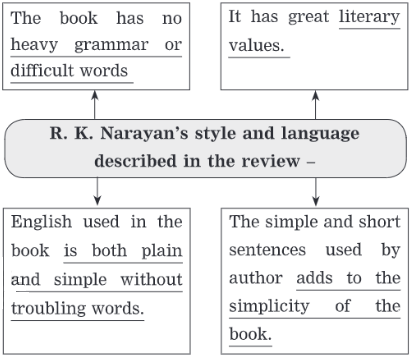
    ‘Swami and Friends’ by R. K. Narayan is not merely an interesting read that could be enjoyed from top to bottom, but the work attributes a lot of literary values even if it is a teen book ‘Swami and Friends’ is a good read for the kids and teens alike. Also the book is widely used in the Asian continent as a study text for the students who study literature as a subject at schools. This does not mean that the book is filled with heavy grammar and technical jargon. Actually the truth is in contrary to this.
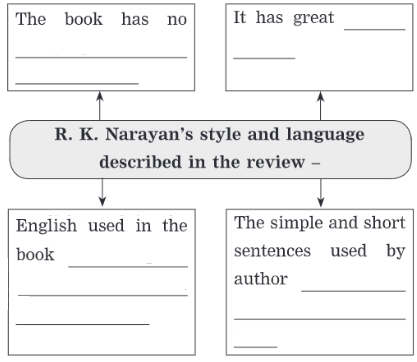
     Swami and Friends is written in such simple English it is hard to imagine that it is a work of such a literary genius like R. K. Narayan. The English used in the book is both plain and simple, without any troubling words for the kids. Also the use of simple and short sentences adds to the simplicity of the book.
      It is mentioned in the description that the book is about a mischievous ten year old Indian boy, and some parents may be concerned about the influence this will have on their already mischievous children. But the book is as such, that it encompasses the
mischief of the kids in a view of the kid which is harmless and pure in his perspective. Also amidst all the mischief and naughtiness, we actually find that Swami is a loving and a tender kid who's actually very sensitive. It is also a known fact that mischievous
kids are the most sensitive and loving people of all. And R. K. Narayan does a great job conveying that to all of us.

A2. Complex Factual Activity:
Complete the web:
Image
A3. Activities based on Vocabulary:
Find the following from the passage:
(i) Noun forms of : simple, describe, naughty
(ii) Verb forms of : meaning, attribution imagination, loving
A4. Activities based on Contextual Grammar:
Add question tags:
(1) This does not mean that the book is filled with heavy Grammar.
(2) R. K. Narayan does a great job conveying ving that th to all of us.
A5. Personal Response:
(1) What difference do you find between the children of Swami's days and today's children?
Answer

A1. Simple Factual Activity:
(1) False
(2) True
(3) False
(4) True
A2. Complex Factual Activity:
Image
A3. Activities based on Vocabulary:
(i) simple - simplicity, describe - description, naughty - naughtiness
(ii) meaning mean, attribution attribute, imagination - imagine, loving - love
A4. Activities based on Contextual Grammar:
(1) This does not mean that the book is filled with heavy grammar, does this?
(2) R. K. Narayan does a great job conveying that to all of us, doesn't he?
A5. Personal Response:
(1) I don't think there is any peculiar difference between the children of Swami's days and today's children. Children all over the world and of all the times are the same. The only difference between them, according to me, is that many of today's children keep themselves busy in mobiles, other gadgets and mobile games instead of playing in open space.

Need a full question paper?

Generate a complete, print-ready paper with questions like this in minutes — across 16+ boards, with answer keys.

Start Generating Free

Similar questions

A1. Simple Factual Activities:
Complete the following sentences with the correct alternatives: 
(1) After her victory in the Manipur State, Mary Kom's career started in _______________.
(a) 2001 (b) 2009 (c) 2005 (d) 2000
(2) Mary Kom made her International debut in _______________.
(a) United Kingdom (b) U.S.A (c) United States (d) Manipur

   There had to be one successful story if Indians were to survive in sports and we have that story now. Enough has been said about this great warrior who conquered the world. This warrior is none other than Mary Mangte Kom-the Komqueror and the Komrade. She is famed as a five times World Boxing Champion and the only boxer to win a medal in every one of the six world championships. In the 2012 Olympics, she became the first Indian woman boxer to qualify and win a bronze medal in the 51
kg flyweight category of Boxing.
     Kom was born in Kangthei village, Moirang Lamkhai in Churachandpur district of rural Manipur in eastern India. She came from a poor family. Her parents, Mangte Tonpa Kom and Mangte Akham Kom were tenant farmers who worked in jhum fields.
Kom grew up in humble surroundings, helping her parents with farm related chores, going to school and learning athletics initially and later boxing simultaneously. Her father was a keen wrestler in his younger age.
     She had an eager interest in athletics since childhood and the success of Dingko Singh a fellow Manipuri returned from the 1998 Bangkok Asian games with a gold medal, Kom recollects, had inspired many youngsters in Manipur to try boxing
and she too thought of giving it a try.
     Mary Kom’s career started in 2000 after her victory in the Manipur State women’s boxing championship and the regional championship in West Bengal. In 2001, she started competing at international level. She was only 18 years old when she made her
international debut at the first AIBA Women’s World Boxing Championship in United States, winning a silver medal in the 48 kg weight category. Her greatness is reinforced by the way she apoligized to the whole nation for not being able to win the Gold. She is a legend for sure and an idol for all the sportswomen to look up to.

A2. Complex Factual Activities:
Arrange the following sentences as per their sequence occurred in the passage: 
(a) Mary Kom made her international debut when she was 18 years old.
(b) Dingko Singh won gold medal in 1998 Bangkok Asian games.
(c) Mary Kom started her career after winning Manipur State Women's Boxing Championship.
(d) Mary Kom is a legend for sure.
A3. Activities based on Vocabulary:
Match the following with their opposites:

WordsOpposites
 (1) success (a) young
 (2) winning (b) unable
 (3) old  (c) failure
 (4) able (d) losing

A4. Activities based on Contextual Grammar:
Do as directed:
(1) She is a legend for sure.
(a) is she? (b) does she? (c) isn't she? (d) doesn't she?
(2) She was 18 years old. (Frame 'Wh' question to get the underlined part as an answer) 
A5. Personal Response:
(1) What makes the writer call Mary Kom 'a legend'?

A1. Simple Factual Activity:
Complete the following web with the words associated with the passage and the given title:
Image

SMART goals have a specific rubric:
    Specific: Involves identifying a specific area for improvement. The more specific the area, the more refined the achievement of one’s goal can be. It makes it easier to set parameters and work towards the goal. For exaxmple, if it is building a house, what exactly is the capacity required and how long can it stretch ?
    Measurable: Quantifying goals provides specific ways to track progress against goals. This makes it easy to benchmark performance throughout the goal period, including areas to improve. While playing football, one’s exact role and position has to be clearly defined.
     Achievable: Setting goals that can be completed in the designated period of time. Often, these goals may act like stepping stones to help meet broader goals that further define a career. As students, we can’t become a President, a Prime Minister, but can hope to reach those heights in future.
      Realistic: It is important to create goals that are within one’s current skill set or area of expertise. Building expertise takes time, so expecting to become an expert in a short amount of time is unrealistic. Being realistic will make it easy to be successful at attaining goals. If defensive and not aggressive, the goal perhaps lacks realism. We must have the clear picture in mind and must have the ability to adhere to that picture.

A2. Complex Factual Activities:
Pick out examples from the text that support each of the following facts:
(1) Goals should be achievable.
(2) A specific field/area has to be fixed to achieve goals.
A3. Activities based on Vocabulary:
Cross the odd man out:
(1) involve, provide, important, create.
(2) specific, realistic, defensive, capacity.
(3) performance, achievement, aggressive, President.
(4) clearly, Ineky, freely, exactly.
A4. Activities based on Contextual Grammar:
Underline the Present Participles/ Infinitives: 
(1) Being realistic will make it easy to be successful at attaining goals.
(2) You must have the ability to adhere to that picture.
A5. Personal Response:
(1) Why is it necessary that our goals should be realistic?
A1. Simple Factual Activity:
State whether the following statements are True or False:
(1) The young seagull was not confident about the ability of his wings.
(2) The young seagull's parents guided and improved his siblings in the art of flying.
(3) The wings of the young seagull were not as short as his own.
(4) The whole family of seagulls commended him for his cowardice.

     The young seagull was alone on his ledge. His two brothers and his sister had already flown away the day before. He had been afraid to fly with them. Somehow when he had taken a little run forward to the brink of the ledge and attempted to flap his
wings he became afraid. The great expanse of sea stretched down beneath, and it was such a long way down - miles down. He felt certain that his wings would never support him; so he bent his head and ran away back to the little hole under the ledge where he slept at night. Even when each of his brothers and his little sister, whose wings were far
shorter than his own, ran to the brink, flapped their wings, and flew away, he failed to muster up courage to take that plunge which appeared to him so desperate. His father and mother had come around calling to him shrilly, upbraiding him, threatening to let him starve on his ledge unless he flew away. But for the life of him he could not move.
      That was twenty-four hours ago. Since then nobody had come near him. The day before, all day long, he had watched his parents flying about with his brothers and sister, perfecting them in the art of flight, teaching them how to skim the waves and how to dive for fish. He had, in fact, seen his older brother catch his first herring and devour it, standing on a rock, while his parents circled around raising a proud cackle. And all the morning the whole family had walked about on the big plateau midway down the opposite cliff taunting him for his cowardice.

A2. Complex Factual Activity:

(1) How did the seagull parents perfect the young seagull's brothers and sister in the art of flight? 
A3. Activities based on Vocabulary:
Pick out from the passage the Homophones for the following:
(1) see 
(2) wood 
(3) there 
(4) scene
A4. Activities based on Contextual Grammar:
Read the following sentences carefully, underline the verbs and then find out the tenses in the sentences:
(1) His two brothers and his sister had already flown away.
(2) But for the life of him he could not move.
A5. Personal Response:
(1) Are you afraid of playing any outdoor game? Explain why? 
A1. Simple Factual Activities:
State whether the following statements are True or False:
(1) Pitchblende is a black, very hard and cheap substance.
(2) Men could see many substances through the powerful rays of Uranium.
(3) The emperor of Austria gifted a ton of pitchblende to the Curies
(4) The Curies sacrificed all their luxuries of life to save money to buy pitchblende.

      Marie was specially interested in a substance called uranium which was obtained from pitchblende, a black, very hard and very expensive substance. Uranium was known to give off very powerful rays by which men could see through many substances. Now Marie discovered that what was left after obtaining uranium was even more powerful. Later on, Pierre and Marie found that there was not one, but two new substances giving off these rays although they had not yet been able to obtain either of them. They called one of them Polonium, in honour of her country. Poland and the other was called Radium. Radium is the most powerful of the radio-active elements. And radio-active elements can give off rays which can penetrate substances that are opaque to light. There was another French scientist called Henri Becquerel, who in 1896 had discovered that uranium possessed this property. But Polonium and Radium possessed radio-active in much higher degree.
     The Curies now began to work with greater enthusiasm, but they were poor and pitchblende itself was an extremely expensive substance, which they could not afford to buy in large quantity. They, however, sacrificed all the luxuries of life to save money to buy whatever little amount of pitchblende they could. They lived in utter penury, not buying costly food and warm clothes for the extremely cold Parisian winter. Often they could not sleep during the cold nights due to lack of warmth. Overwork seriously affected Madame Curie’s health. Often she was forced to leave the laboratory to take a much needed rest. Her husband begged her to give up the struggle, but she resolutely refused. Marie was driven by a mad determination to discover the mystery of radium. With courage she faced all the miseries of a life of poverty and carried on with her research along with her husband who loved and supported her.
      Luck, however, favoured the Curies and a windfall came to them. It was a gift of a ton of pitchblende from the emperor of Austria, who was an admirer of the Curies. It was the most precious gift the Curies had received and in their shabby laboratory they toiled along, boiled and burnt, overpowered by heat in summer and frozen with cold in winter.

A2. Complex Factual Activities:
(1) What proves Marie's strong will power?
A3. Activities based on Vocabulary:
Find out antonyms for the following from the passage:
(1) economical ×
(2) poverty × 
(3) chill × 
(4) worthless ×
A4. Activities based on Contextual Grammar:
Change the degree:
(1) Pitchblende was the most precious gift the Curies had received.
A5. Personal Response:
(1) What qualities, do you think, are important to get success in our life?
A1. Simple Factual Activities:
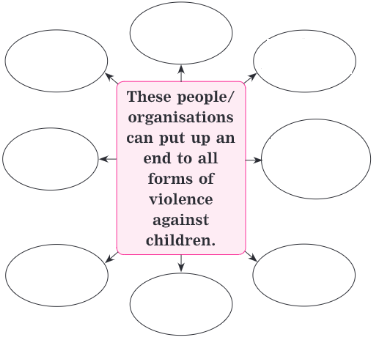
Make a list of the problems that we are facing and creating violence against children -

     I call upon all the governments, intergovernmental agencies, businesses, faith leaders, workers, teachers and NGOs, and each one of us, to put an end to all forms of violence against children. Slavery, trafficking, child marriages, child labour, sexual abuse, and illiteracy these things have no place in any civilised society.
     Friends, we can do this. Governments must make child - friendly policies, and invest in education and young people. Businesses must be more responsible, accountable and open to innovative partnerships.Intergovernmental agencies must work together to accelerate action. Global civil society must rise above the business-as-usual and fragmented agendas. Faith leaders and institutions, and all of us must stand with our children.
     We must be bold, we must be ambitious, and we must have the will. We must keep our promises. Over fifty years ago, on the first day of my school, I met a cobbler boy, my age sitting outside the gate of my school. I asked my teachers: “Why is he working outside? Why is he not with us in the school?” My teachers had no answer. One day, I
gathered the courage to ask the boys’ father. He said: “Sir, I have never thought about it. We are born to work.”
     His answer made me angry. It still makes me angry.

A2. Complex Factual Activities:
Image
A3. Activities based on Vocabulary:

Find out the describing words used for the following noun and make your own sentences by using any combination:
(1) _______________ agencies
(2) _______________ partnership
A4. Activities based on Contextual Grammar:
Make the sentences affirmative:
(1) My teacher had no answer.
(2) I have never thought about it.
A5. Personal Response:
(1) Why should we stop 'Child labour'?
A1. Simple Factual Activities:
Complete the following sentences using the information given in the passage:
(1) The langur baby was listless and _______________.
(2) The writer's parents and sisters had come out on the veranda and _______________.

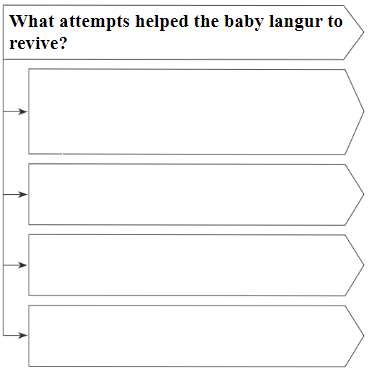
    The changed circumstances and the sudden unexpected attack from unknown quarters forced the langur to drop the baby from the sloping roof over the veranda. The baby was listless and appeared to be dead. As its body started to slide down, the excitement of the pack of dogs grew manifold at the prospect of a good kill and meal. Keeping the dogs at bay with the stick, I managed to catch hold of the baby langur’s tail just as it tipped over the edge of the tiled roof. The baby appeared inert and lifeless. It was indeed a male baby.
   By this time, my parents and sisters had come out on to the veranda and were witnessing my rescue operation. Some of our neighbours had also gathered in the distance.
    I took the baby langur to our backyard and gently laid him on the floor inside the poultry coop. His body was full of deep bite marks and scratches. Blood was oozing from some of the wounds. The baby remained motionless. My father provided first aid to clean the wounds and stop the bleeding. I was relieved to find out that the baby was breathing, even though his breaths were shallow.
   Splashes of cold water made the baby stir and after a few shaky attempts, he sat up. He was in state of shock and started trembling like a leaf in the wind. His two little twinkling eyes welled up with tears and he started to sob with a muffled cry - just like a human child would after experiencing trauma. I offered him a peeled banana which he
accepted with his unsteady hand and began taking hesitant bites.

A2. Complex Factual Activities:
Complete the following web and describe the condition of wounded baby langur:
 Image
A3. Activities based on Vocabulary:
Match the words in column 'A' with their meanings in column 'B':

 Column 'A'Column 'B'
 (1) shaky (a) rose to the surface
 (2) welled up (b) made the sound quieter
 (3) prospect (c) unsteady
 (4) muffled (d) future benefit

A4. Activities based on Contextual Grammar:
(1) He was in a state of shock. (Past Perfect Tense.)
(2) I took the baby langur to our backyard. (Past Perfect Tense.)
A5. Personal Response:
(1) Complete the following :"
Image

A1. Simple Factual Activity:
Complete the sentences using the information from the passage:
(1) Mr Srivastava was talking to Kamal Kishore the owner of the photography shop.
(2) Sitaram was glad that he had been of service to both a customer and his friend.

      And Sitaram, glad that he had been of service to both a customer and his friend, hoisted his bag on his shoulders and went his way.
      Mrs. Srivastava had to do some shopping. She gave instructions to the ayah about looking after the baby, and told the cook not to be late with the midday meal. Then she set out for the Pipalnagar market place, to make her customary tour of the cloth shops.
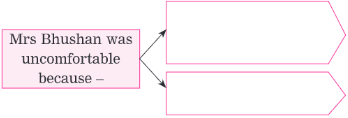
      A large shady tamarind tree grew at one end of the bazaar, and it was here that Mrs. Srivastava found her friend Mrs. Bhushan sheltering from the heat. Mrs. Bhushan was fanning herself with a large handkerchief. She complained of the summer, which she affirmed, was definitely the hottest in the history of Pipalnagar. She then showed Mrs. Srivastava a sample of the cloth she was going to buy, and for five minutes they discussed its shade, texture and design. Having exhausted this topic, Mrs. Srivastava
said, ‘Do you know, my dear, that Seth Govind Ram’s bank can’t even pay its employees? Only this morning I heard a complaint from their sweeper, who hasn’t received his wages for over a month!’
     ‘Shocking!’ remarked Mrs. Bhushan. ‘If they can’t pay the sweeper they must be in a bad way. None of the others could be getting paid either.’
     She left Mrs. Srivastava at the tamarind tree and went in search of her husband, who was sitting in front of Kamal Kishore’s photography shop, talking with the owner.
    ‘So there you are!’ cried Mrs. Bhushan. ‘I’ve been looking for you for almost an hour. Where did you disappear ?’
    ‘Nowhere,’ replied Mr. Bhushan. ‘Had you remained stationary in one shop, I might have found you. But you go from one shop to another, like a bee in a flower garden.’
    ‘Don’t start grumbling. The heat is trying enough.I don’t know what’s happening to Pipalnagar. Even the bank’s about to go bankrupt.’   

A2. Complex Factual Activity:
Complete the following web:
Image
A3. Activities based on Vocabulary:
Find describing words for the following from the passage:
(1) shop (2) meal (3) tour (4) tamarind tree
A4. Activities based on Contextual Grammar:
(1) Mrs Bhushan went in search of her husband. He was sitting in front of Kamal Kishore's photography shop.
(Rewrite the sentence joining it with 'who'.)
(2) That summer was the hottest in the history of Pipalnagar.
(Change the sentence into Positive Degree.)
A5. Personal Response:
(1) Do you think, Mr Bhushan was right to compare his wife with a bee in a flower garden? Give your reason.
A1. Simple Factual Activity:
Name the following:
(1) The International World Heritage Programme is administered by-
(2) The Nile valley contains many ancient-

     A World Heritage Site is a site determined by the United Nations Educational, Scientific and Cultural Organization (UNESCO) to have significant cultural or natural importance to humanity. As such the sites are protected and maintained by the
International World Heritage Programme which is administered by the UNESCO World Heritage Committee. Because World Heritage Sites are places that are significant culturally and naturally, they vary in type and include forests, lakes, monuments, buildings and cities.
    World Heritage Sites can also be a combination of both cultural and natural areas. For example, Mount Huangshan in China is a site with significance to human culture because it played a role in historical Chinese art and literature. The mountain is also
significant because of its physical landscape characteristics.
     Although the idea of protecting cultural and natural heritage sites around the world began in the early twentieth century, momentum for its actual creation was not until the 1950s. In 1954, Egypt started plans to build the Aswan High Dam to collect and control water from the Nile River. The initial plan for the dam’s construction would have flooded the valley containing the Abu Simbel Temples and scores of ancient Egyptian artefacts. To protect the temples and artifacts, UNESCO launched an international campaign in 1959 that called for the dismantling and movement of the temples to higher ground. The project cost an estimated US $80 million, $40 million of which came from 50 different countries. Because of the project’s success, UNESCO and the
International Council on Monuments and Sites initiated a draft convention to create an international organization responsible for protecting cultural heritage
 
A2. Complex Factual Activity:
(1) Why did UNESCO launch an international campaign in 1959? 
A3. Activities based on Vocabulary:
Find from the passage adjective forms for the following:
(1) culture (2) history (3) nature (4) significance
A4. Activities based on Contextual Grammar:
This does not mean that the book is filled with heavy Grammar.Rewrite the following sentences using 'not only ... but also' and 'as well as in two separate sentences:
(1) To protect the temples and artifacts, UNESCO launched an international campaign.
A5. Personal Response:
(1) What are our duties towards preservation of any historical site?
A1. Simple Factual Activities:
Choose the correct alternatives:
(1) What did Mary Kom prefer being called?
(a) Super mom    (b) Super woman
(c) Super being   (d) Super Boxer
(2) What would be a key factor in your conditioning for the Olympics? 
(a) saturated fats
(b) diet and nutrition
(c) trophies and medals

Interviewer :
Do you think interest in boxing in India will ever go beyond the Olympics ?
Mary Kom : Yes, I am sure that in a few years boxing will be very popular among everyone in India, all the year round.
Interviewer : How aware are Indian women of their nutritional requirements ? Diet and nutrition must’ve been a key factor in your conditioning for the Olympics. Do you think nutrition is a neglected area in Indian sports ?
Mary Kom : The awareness is growing now among the female athletes when it comes to nutritional requirements. Nutrition has definitely been a neglected area in Indian sports. I had to gain 3 kgs since I had to fight in the 51kg event instead of the usual 48kgs that I fight in. So I had to focus on what to eat. I gained weight by eating the right kind of healthy food rather than bad saturated fats.
Interviewer : How big a role did OGQ play in shaping the boxing scene in India for the better ?
Mary Kom : OGQ really played an important part in my success. They helped me out whenever I needed something. They took care of everything, which helped me focus on my boxing and kept me stress - free.
Interviewer : What’s your opinion on the future of Indian boxing ?
Mary Kom : The future is very bright and I am sure many more boxers will get medals for us.
Interviewer : Do you find it difficult to convince your children not to fight when they watch you go out and do it in style all the time ?
Mary Kom : Well, I have twins and yes, sometimes it becomes really difficult to keep them under control.
Interviewer : Will you train your kids to become boxers as well ?
Mary Kom : I haven’t really thought about it. As of now, just let their mother box !
Interviewer : You have broken several stereotypes about the women in India by showing that women can compete with men in any field. But how good are you at the ‘traditional’ feminine activities like cooking ?
Mary Kom : Well, I am good at cooking and other household work too.
Interviewer : Would you be interested in coaching Indian women in boxing one day ?
Mary Kom : Let’s see. In the future, may be yes.
Interviewer : What do you prefer being called -Super Mom or Super Boxer ?
Mary Kom : I love being a mom. That’s the best thing that has ever happened to me. 
Awards and recognitions
• Arjuna Award (Boxing) in 2003
• Padma Shree (Sports) in 2006
• Contender for Rajiv Gandhi Khel Ratna Award in 2007
• People of the Year - Limca Book of Records in 2007
• CNN-IBN and Reliance Industries Real Heroes Award in 2008
• Pepsi MTV Youth, AIBA in 2008
• ‘Magnificent Mary’, AIBA in 2008
• Felicitation by Zomi Student’s Federation (ZSF) at New Lamka YPA Hall in 2008
• Rajiv Gandhi Khel Ratna award in 2009
• International Boxing Association’s Ambassador for Women’s Boxing in 2009
• Sportswoman of the year, Sahara Sports Award in 2010.

A2. Complex Factual Activities:
(1) What did OGQ do for Mary Kom? 
A3. Activities based on Vocabulary:
Find out opposite words for the following from the passage.
(1) hated ×
(2) fair ×
(3) Inclusive ×
(4) diffident ×
A4. Activities based on Contextual Grammar:
Underline the subordinate clause and state its kind:
(1) The male boxers were kind enough to practise with me, whenever I required them.
Kind: _______________
(2) I think more and more people should take up sports as a full-time career.
Kind: _______________
A5. Personal Response:
(1) Name some sportswomen you know:
A1. Simple Factual Activity:
(1) Dr Hawking is a very humble man, though he is considered _______________ .
(2) Dr Hawking expressed his thoughts with the help of his _______________.

    Though confined to a wheel chair with no control over his body save a finger and with
a computer to help him express his thoughts. Dr Hawking is an authority on profound subjects of science. Numerous honorary doctorates and awards have been bestowed
on him. He is a Fellow of The Royal Society and a Member of the US National Academy of Sciences.
     In spite of being considered Einstein’s equal in intelligence, Dr. Hawking is a very humble man. A simple, down to earth man, he has authored many books dealing with his awesome ideas keeping a layman in mind. His writing is full of wit and humour. His style is so lucid that non-scientists can also understand him. His book, “A Brief History of Time” is one of the best selling books of our times.
     On being asked, how he feels about having the dreadful ALS, Dr Hawking, the quintessence of optimism and hope, says, “Not very different from the rest. I try and lead as normal a life as possible, and not think about my condition or regret the things it prevents me from doing, which are not many.”
      Dr Hawking firmly believes that in the next millenium, science will discover the core secrets of the universe, its origin, its history and maybe even predict its ultimate demise.
      Like Dr Hawking, there are many people who display exemplary courage in their lives. Let us salute all those brave people, who in spite of being disabled strive to do their best.

A2. Complex Factual Activity:
(1) What does the writer say about the books authored by Dr Hawking? 
A3. Activities based on Vocabulary:
Match the words in Column 'A' with their meanings in Column 'B':

Column 'A'Column 'B'
 (1) profound (a) a person without any special skill
 (2) awesome (b) a perfect example
 (3) layman (c) showing very great (knowledge) 
 (4) quintessence (d) very impressive

A4. Activities based on Contextual Grammar:
Convert the following to Interrogative (Question) Form:
(1) The prognosis was bad.
(2) Stephen decided to continue his research.
A5. Personal Response:
(1) How do you know that Dr Hawking is a perfect example of optimism and hope?