Question
A1. Simple Factual Activity:
State whether the following statements are True or False:
(1) The young seagull was not confident about the ability of his wings.
(2) The young seagull's parents guided and improved his siblings in the art of flying.
(3) The wings of the young seagull were not as short as his own.
(4) The whole family of seagulls commended him for his cowardice.

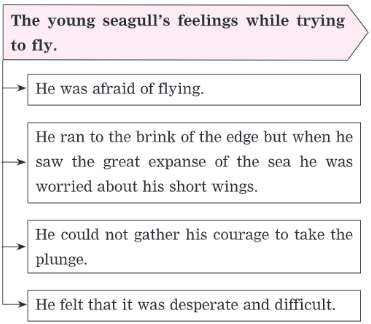
     The young seagull was alone on his ledge. His two brothers and his sister had already flown away the day before. He had been afraid to fly with them. Somehow when he had taken a little run forward to the brink of the ledge and attempted to flap his
wings he became afraid. The great expanse of sea stretched down beneath, and it was such a long way down - miles down. He felt certain that his wings would never support him; so he bent his head and ran away back to the little hole under the ledge where he slept at night. Even when each of his brothers and his little sister, whose wings were far
shorter than his own, ran to the brink, flapped their wings, and flew away, he failed to muster up courage to take that plunge which appeared to him so desperate. His father and mother had come around calling to him shrilly, upbraiding him, threatening to let him starve on his ledge unless he flew away. But for the life of him he could not move.
      That was twenty-four hours ago. Since then nobody had come near him. The day before, all day long, he had watched his parents flying about with his brothers and sister, perfecting them in the art of flight, teaching them how to skim the waves and how to dive for fish. He had, in fact, seen his older brother catch his first herring and devour it, standing on a rock, while his parents circled around raising a proud cackle. And all the morning the whole family had walked about on the big plateau midway down the opposite cliff taunting him for his cowardice.

A2. Complex Factual Activity:

Complete the web describing the young seagull's feelings while trying to fly:
Image
A3. Activities based on Vocabulary:
Guess the meanings of :
(1) muster up courage
(2) eliff
(3) upbraiding
(4) brink
A4. Activities based on Contextual Grammar:
(1) He became afraid.
(2) Since then nobody had come near him.
A5. Personal Response:
(1) Are you afraid of playing any outdoor game? Explain why?
Answer

A1. Simple Factual Activity:
(1) True
(2) True
(3) False
(4) False
A2. Complex Factual Activities:
Image
A3. Activities based on Vocabulary:
(1) muster up courage -to gather courage
(2) eliff - a high steep face of a rock
(3) upbraiding -scolding
(4) brink -the edge of a steep place
A4. Activities based on Contextual Grammar:
(1) He became afraid. Simple Past Tense
(2) Since then nobody had come near him. Past Perfect Tense
A5. Personal Response:
(1) Yes, I am afraid of playing Kabbadi. It appears to me that it is a very rough and tough game. I am very much afraid of the injuries caused in it. I cannot endure the thought of injury. I believe that it is a game for only strong and hefty people.

Need a full question paper?

Generate a complete, print-ready paper with questions like this in minutes — across 16+ boards, with answer keys.

Start Generating Free

Similar questions

A1. Simple Factual Activities:
Complete the following sentences:
(1) Even though we have made progress in the last couple of decades, we are facing _______________ .
(2) _______________ gives a sense of global citizenship among the youth.

     We have made progress in the last couple of decades. We have reduced the number of out-ofschool children by half. We have reduced the number of child labourers by a third. We have reduced child mortality and malnutrition, and we have prevented millions of child deaths.
     But, let us make no mistake, great challenges still remain.
     Friends! The biggest challenge or biggest crisis knocking on the doors of humankind is fear and intolerance.
     We have utterly failed our children in imparting an education. An education that gives the meaning and objective of life. An education that gives a sense of global citizenship among the youth.
     I am afraid that the day is not very far away when the cumulative result of this failure, will culminate in an unprecedented violence, and that will be suicidal for humankind.
     Rights, security, hope can only be restored through education.
     Young people like Malala ... I’ve started calling her my daughter Malala not just Malala ... So my daughter Malala and other daughters including Kayanat.. in fact.. two Kayanats, and Shazia, and the daughters from Africa, and from all over the world. They are rising up and choosing peace over violence, tolerance over extremism, and courage over fear.
     The solutions are emerging. But these solutions cannot be found in the deliberations in conferences alone, and cannot be found in prescriptions from a distance.
     They lie in small groups and local organisations and individuals, who are confronting with the problem every day. Even if they remain unacknowledged, unrecognised and unknown to the world the solution are with them.

A2. Complex Factual Activities:

(1) What are the children's issues highlighted by Kailash Satyarthi in this passage? 
A3. Activities based on Vocabulary:
Choose the correct option and write in front of the given word:
(1) culminate : _______________
(A) destroy (B) succeed (C) rise to a peak
(2) crisis:  _______________
(A) unstable situation(B) problems (C) difficulty
A4. Activities based on Contextual Grammar:

Complete the following sentences with the help of the sentence given below:
The biggest challenge knocking on the doors of humankind is fear and intolerance.
(1) No other challenge knocking _______________ is as big as _______________.
(2) Fear and intolerance are bigger than  ______________________________.
A5. Personal Response:
(1) What efforts will you take to enrol the out-of-school out-of children? 
A1. Simple Factual Activities:
Who said to whom?

 Sentence Who saidTo whom
 (1) "Let's chat."  
 (2) "We won't get a taxi in this rain."  

    ‘Then stay with me tonight,’ she said. ‘Let’s chat. Do you know that, old friends and memories are precious and rare ?’
     I couldn’t believe it. Was this really Meena ? I pinched myself hard to be sure it wasn’t a dream. But Meena was really standing there, right in front of me, squeezing my hand, smiling, and yes, she did look happy. In the three years she had been in Bangalore, I had never once seen her smiling like that. A few strands of grey in her hair reminded me that years had passed. There were a few wrinkles in her face, but the truth was that she looked more attractive than ever before.
     Finally, I managed to say, ‘No Meena, I can’t stay with you tonight. I have to attend a dinner. Give me your card and I’ll keep in touch with you, I promise.’
     For a moment, Meena looked disappointed, ‘Let’s go and have tea at least’, she insisted.
     ‘But Meena, it’s pouring.’
     ‘So what ? We’ll buy an umbrella and then go to the Grand Hotel,’ she said.
     ‘We won’t get a taxi in this rain’, I grumbled.
     ‘So what ? We’ll walk’.
      I was very surprised. This wasn’t the same Meena I had known. Today, she seemed ready to make any number of adjustments.
      We reached the Grand Hotel drenched. By then the only thought in my mind was to find out who or what had brought about such a change in the pessimistic Meena I had known. I was quite curious.
      ‘Tell me Meena, is there a Prince Charming who has managed to change you so ?’
       Meena was surprised by my question. ‘No, there isn’t anyone like that’, she said.
       ‘Then what’s the secret of your energy?’ I asked, like Tendulkar does in the  advertisement.
       She smiled, ‘A beggar changed my life.’ I was absolutely dumbfounded and she could see it.

A2. Complex Factual Activities:
Complete the following sentences:
(1) Old friends and memories are precious and rare.
(2) A few strands of grey in her hair had reminded the writer that years had passed.
A3. Activities based on Vocabulary:
Find out synonyms for the following from the passage:
(1) inquisitive -  _____________
(2) displeased -  _____________
(3) attractive -  _____________
(4) valued -  _____________.
A4. Activities based on Contextual Grammar:
Complete the following table:

 Present Tense Past Tense Past Participle
 (1) see _______ _______
 (2) pour _______ _______
 (3) _______ brought _______
 (4) _______ _______ known

A5. Personal Response:
(1) What, according to you, is the difference between an optimistic person and a pessimistic person?

A1. Simple Factual Activities:
Name the following: 
(1) Two discoverers of New lands.
(2) Two conquerers of the peak of Mt. Everest.

     The history of men’s progress from the darkness of ignorance to the glorious light of knowledge and enlightenment is full of chapters that tell of extraordinary men and women. These men and women worked with great courage, commitment, dedication and singleness of purpose in their effort to attain what seemed to be unattainable. These men and women were driven in their effort to uncover the truth and mystery of the universe with an indomitable spirit which characterises the human spirit. And this is the spirit that drove Columbus and Vasco de Gama to sail to the unknown seas, Robert Peary to race to the Pole, Sir Ronald Ross to fight against malaria, Hillary and Tenzing to reach the top of Everest, and Armstrong and his team to go to the moon. 
     One great woman who dedicated her life to the cause of science and to the welfare of humanity is Madame Curie, the discoverer of radium. The mere statement that Madame Curie discovered the radium will never tell the true story of the extraordinary courage, determination and singleness of purpose that this noble woman showed in the face of extreme poverty, pain and suffering that comes along with such condition.
     Born Maria Sklodowska in Warsaw, Poland on November, 7 1867, Marie Curie’s childhood dream was to study science in Paris, but her father could not afford the expense for this. So Maria took a job as a governess and saved a little money. With that little money she finally went to Sorbonne, the University of Paris, to study science. Her father could send her only a small amount and her life in the university was a disheartening experience in poverty and hunger. She lived only on bread, butter and tea, and she often fainted for lack of food. In spite of all this she pursued her studies indomitably and she topped her class with Honours in Physics and Mathematics.
     It was at the university that she met a Frenchman, Pierre Curie, a brilliant but poor scientist. Then they together began to work in a shabby laboratory. Soon, their friendship turned into love and in less than a year, in July, 1895, they were married. The couple then took a flat in Paris with scarcely any furniture in it except their books, a lamp, a white wooden table and two chairs.
      After the birth of a daughter, Irene, the next year, Marie and Pierre set up a laboratory in a wooden shed near their flat, It had a leaky skylight and an earthen floor. Here Marie, after her daily household work, settled down to study.

A2. Complex Factual Activities:
(1) What information do you get about Marie's early life? 
A3. Activities based on Vocabulary:
Find out the words from the passage which mean:
(1) unbeatable
(2) discouraging
(3) hardly
(4) illiteracy
A4. Activities based on Contextual Grammar:
(1) Her father could not afford the expenses of her education in Paris. (Make it affirmative.)
(2) Marie took a job as a governess and saved a little money. (Rewrite using 'by' + ing.)
A5. Personal Response:
(1) Describe your favourite scientist. 
A1. Simple Factual Activities:
(1) The garland of marriage was made of _______________.
(a) roses
(b) yellow marigolds
(c) lilies
(2) Bishamber demanded _______________ to get married to Bholi.
(a) two thousand rupees
(b) three thousand rupees
(c) five thousand rupees.

     The bridegroom lifted the garland of yellow marigolds. A woman slipped back the silken veil from the bride’s face. Bishamber took a quick glance. The garland remained poised in his hands. The bride slowly pulled down the veil over her face.
     “Have you seen her ?” said Bishamber to the friend next to him. “She has pockmarks on her face.”
     “So what ? You are not young either.”
     “Maybe. But if I am to marry her, her father must give me five thousand rupees.”
     Ramlal went and placed his turban - his honour - at Bishamber’s feet. “Do not humiliate me so. Take two thousand rupees.”
     “No. Five thousand, or we go back. Keep your daughter.”
     “Be a little considerate, please. If you go back, I can never show my face in the village.”
     “Then out with five thousand.”
     Tears streaming down his face, Ramlal went in, opened the safe and counted out the notes. He placed the bundle at the bridegroom’s feet.
     On Bishamber’s greedy face appeared a triumphant smile. He had gambled and won. “Give me the garland,” he announced.
     Once again the veil was slipped back from the bride face but this time her eyes were not downcast. She was looking up, looking straight at her prospective husband, and in her eyes there was neither anger nor hate, only cold contempt.
      Bishamber raised the garland to place it round the bride’s neck but before he could do so, Bholi’s hand struck out like a streak of lightening and garland was flung into the fire. She got up and threw away the veil.
     “Pitaji” said Bholi in a clear loud voice; and her father, mother, sisters, brothers, relations and neighbours were startled to hear her speak without even the slightest stammer.
     “Pitaji”, take back your money. I am not going to marry this man.”
      Ramlal was thunderstruck. The guests began to whisper, “So shameless! So ugly and so shameless !”
     “Bholi, are you crazy ?” shouted Ramlal. “You want to disgrace your family? Have some regard for out izzat!”
     “For the sake of your izzat,” said Bholi, “I was willing to marry this lame old man. But I will not have such a mean, greedy and contemptible coward as my husband. I won’t, I won’t, I won’t.”
     What a shameless girl! We all thought she was a harmless dumb cow.”

A2. Complex Factual Activities:
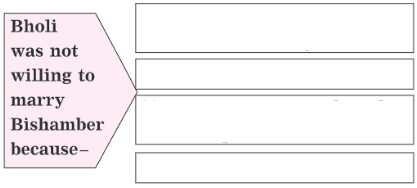
Complete the following web :
Image
A3. Activities based on Vocabulary:
(1) garment that covers the head and face
(2) hurt the pride of
(3) joyful and proud especially because of success
(4) related to the future
A4. Activities based on Contextual Grammar:
Do as directed:
(1) What a shameless girl! (Make it assertive.)
(2) Bishamber raised the garland to place it round the bride's neck. (Frame a wh-question to get the underlined part as an answer)
A5. Personal Response:
(1) What did you learn from Bholi's action of not getting married to Bishamber? 
A1. Simple Factual Activity:
Name the following:
(1) The International World Heritage Programme is administered by-
(2) The Nile valley contains many ancient-

     A World Heritage Site is a site determined by the United Nations Educational, Scientific and Cultural Organization (UNESCO) to have significant cultural or natural importance to humanity. As such the sites are protected and maintained by the
International World Heritage Programme which is administered by the UNESCO World Heritage Committee. Because World Heritage Sites are places that are significant culturally and naturally, they vary in type and include forests, lakes, monuments, buildings and cities.
    World Heritage Sites can also be a combination of both cultural and natural areas. For example, Mount Huangshan in China is a site with significance to human culture because it played a role in historical Chinese art and literature. The mountain is also
significant because of its physical landscape characteristics.
     Although the idea of protecting cultural and natural heritage sites around the world began in the early twentieth century, momentum for its actual creation was not until the 1950s. In 1954, Egypt started plans to build the Aswan High Dam to collect and control water from the Nile River. The initial plan for the dam’s construction would have flooded the valley containing the Abu Simbel Temples and scores of ancient Egyptian artefacts. To protect the temples and artifacts, UNESCO launched an international campaign in 1959 that called for the dismantling and movement of the temples to higher ground. The project cost an estimated US $80 million, $40 million of which came from 50 different countries. Because of the project’s success, UNESCO and the
International Council on Monuments and Sites initiated a draft convention to create an international organization responsible for protecting cultural heritage
 
A2. Complex Factual Activity:
(1) Why did UNESCO launch an international campaign in 1959? 
A3. Activities based on Vocabulary:
Find from the passage adjective forms for the following:
(1) culture (2) history (3) nature (4) significance
A4. Activities based on Contextual Grammar:
This does not mean that the book is filled with heavy Grammar.Rewrite the following sentences using 'not only ... but also' and 'as well as in two separate sentences:
(1) To protect the temples and artifacts, UNESCO launched an international campaign.
A5. Personal Response:
(1) What are our duties towards preservation of any historical site?
A1. Simple Factual Activities:
Who said to whom:
(1) "Come with me. I will take you to school."
(2) "What is your name, little one?"

     The next day Ramlal caught Bholi by the hand and said. ‘‘Come with me. I will take you to school.’’ Bholi was frightened. She did not know what a school was like. She remembered how a few days ago their old cow. Lakshmi had been turned out of
the house and sold.
     ‘‘N-n-n-n No. no-no-no’’ she shouted in terror and pulled her hand away from her father’s grip.
     ‘‘What’s the matter with you, you fool?’’ shouted Ramlal, ‘‘I am only taking you to school.’’ Then he told his wife. ‘‘Let her wear some decent clothes today. Or else what will the teachers and the other schoolgirls think of us when they see her?’’
      New clothes had never been made for Bholi. The old dresses of her sisters were passed on to her. No one cared to mend or wash her clothes. But today she was lucky to receive a clean dress which had shrunk after many washing and no longer fitted
Champa. She was even bathed and oil was rubbed into her dry and matted hair. Only then did she begin to believe that she was being taken to a place better than her home!
      When they reached the school, the children were already in their classrooms. Ramlal handed over his daughter to the headmistress. Left alone, the poor girl looked about her with fear laden eyes. There were several rooms. And in each room girls like her squatted on mats, reading from books or writing on slates. The headmistress asked        Bholi to sit down in a corner in one of the classrooms. Bholi did not know what exactly a school was like and what happened there. But she was glad to find so many girls almost of her own age present there. She hoped that one of these girls might become her friend.
      The lady teacher who was in the class was saying something to the girls but Bholi could understand nothing. She looked at the pictures on the wall. The colours fascinated her. The horse was brown just like the horse on which the Tehsildar had come to visit their village : the goat was black like the goat of their neighbour: the parrot was green like the parrots she had seen in the mango orchard : and the cow was just like their Lakshmi. And suddenly Bholi noticed that the teacher was standing by her
side, smiling at her.
      “What’s your name. little one?’’
      ‘‘Bh-Bho-Bho.’’ She could stammer no further than that.
       Then she began to cry and tears flowed from her eyes in a helpless flood. She kept her head down as she sat in her corner, not daring to look up at the girls who, she knew were still laughing at her.

A2. Complex Factual Activities:
(1) What shows that Bholi was unwilling to go to school? 
A3. Activities based on Vocabulary:
Complete the following sentences using words given in the brackets:
(disfigured, matted, fascinated)
(1) After the accident Juhi's face was _______________.
(2) It took a long time to straighten the _______________ bundle of wool.
A4. Activities based on Contextual Grammar:
(1) Change into indirect speech:
Ramlal's wife said to him, "I will tell you what to do."
(2) Rewrite as an exclamatory sentence:
The child was very fair and pretty.
A5. Personal Response:
(1) "If girls go to school, who will marry them?"-Why, do you think, that Bholi's mother thought so? 
A1. Simple Factual Activities:
Say whether the following statements are True or False:
(1) A big male langur did not intend to kill the baby langur.
(2) The narrator ignored the commotion at first.
(3) The narrator rushed to the veranda to see where his family was.
(4) According to the custom of animal clan, a dominant male protects another male baby or adult.

   Suddenly, I heard a group of street dogs barking furiously in the distance. I chose to ignore the commotion thinking that the pack of dogs might have cornered a hapless pig. But soon, the barking became louder and more aggressive and the alarmed cawing of a flock of crows added to the cacophony. I also heard the disturbance approaching closer.       
    Curiosity got the better of me. Leaving the book aside, I rushed to the veranda to see what was going on.
    I glanced towards the roof of the club house and saw something horrible. A big male langur, apparently the leader of its group, was holding a baby langur in his hands and mercilessly biting it all over with a definite intent to kill. The helpless mother of the baby and other lesser members of the langur group were scattered on the roofs of the buildings nearby watching the baby being killed. I recalled the terrible custom in the animal clan according to which a dominant male usually does not allow another male baby or adult to survive within its group.
    Without losing any time, I gathered a stout stick in one hand and hurled a piece of stone at the marauding langur. The langur was so infuriated that it hardly took any notice of my assault. But then I started throwing more stones. The dogs on their part raised their pitch of cry.

A2. Complex Factual Activities:
(1) What wicked custom is practised by animals who live in groups?
A3. Activities based on Vocabulary:
Match the phrases given in Column 'A' with their meanings in Column 'B':

Column 'A'Column 'B'
 (1) to take notice of (a) overpowered someone
 (2) got the better of (b) was happening
 (3) pitch of cry (c) to observe and give attention
 (4) was going on (d) high sound of cry

A4. Activities based on Contextual Grammar:
(1) Rewrite the sentence as per the tense mentioned in the brackets:
The big male langur was holding a baby langur in his hands. (Past Perfect Continuous Tense.)
(2) Do as directed:
I started throwing more stones.(Begin with 'More stones were ....')
A5. Personal Response:
(1) Do you think that the custom of baby killing by dominant male in animal clan is good? Explain.

A1. Simple Factual Activities:
Complete the following sentences using the information given in the passage:
(1) The langur baby was listless and _______________.
(2) The writer's parents and sisters had come out on the veranda and _______________.

    The changed circumstances and the sudden unexpected attack from unknown quarters forced the langur to drop the baby from the sloping roof over the veranda. The baby was listless and appeared to be dead. As its body started to slide down, the excitement of the pack of dogs grew manifold at the prospect of a good kill and meal. Keeping the dogs at bay with the stick, I managed to catch hold of the baby langur’s tail just as it tipped over the edge of the tiled roof. The baby appeared inert and lifeless. It was indeed a male baby.
   By this time, my parents and sisters had come out on to the veranda and were witnessing my rescue operation. Some of our neighbours had also gathered in the distance.
    I took the baby langur to our backyard and gently laid him on the floor inside the poultry coop. His body was full of deep bite marks and scratches. Blood was oozing from some of the wounds. The baby remained motionless. My father provided first aid to clean the wounds and stop the bleeding. I was relieved to find out that the baby was breathing, even though his breaths were shallow.
   Splashes of cold water made the baby stir and after a few shaky attempts, he sat up. He was in state of shock and started trembling like a leaf in the wind. His two little twinkling eyes welled up with tears and he started to sob with a muffled cry - just like a human child would after experiencing trauma. I offered him a peeled banana which he
accepted with his unsteady hand and began taking hesitant bites.

A2. Complex Factual Activities:
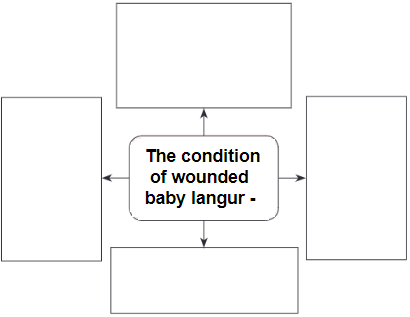
Complete the following web and describe the condition of wounded baby langur:
 Image
A3. Activities based on Vocabulary:
Find from the passage present participles and past participles used as adjectives:
(1) Present Participles: __________ roof, __________ eyes.
(2) Past Participles: __________ attack, __________ quarter, __________ cry, __________ banana.
A4. Activities based on Contextual Grammar:
(1) They were witnessing my rescue operation. (Simple Past Tense.)
(2) He was in a state of shock. (Past Perfect Tense.)
A5. Personal Response:
(1) Have you ever saved a puppy/dog or any other animal from naughty children who were throwing stones at him? Write about your experience.
A1. Simple Factual Activity:
Complete the following sentences with the help of the information from the passage:
(1) Dr. Stephen Hawking was born on _______________.
(2) Courage is the quality _______________.

    Exactly 300 years after the death of the great scientist Galileo, Dr Stephen Hawking was born in Oxford, London on the eighth day of January 1942. Little did his parents know that one day their little boy would be hailed as one of the greatest scientists
of this century. Neither could anybody imagine that his mind would soar up into space like light. More importantly, none could predict that he would be the very epitome of courage.
    Courage is a wonderful thing. It is that quality, which makes people not lose heart when faced with a great calamity. It would not be an exaggeration to say that Dr Stephen Hawking, a living legend of Cosmology, is the very personification of courage
and hope. Except his mind, his whole body is bound to a wheelchair, thanks to a cruel quirk of fate. Yet, he is one of the greatest scientists of this century.
     An average child, Stephen grew up to be a normal teenager, full of mischief and lots of love for music and mathematics. Even though his father wanted him to study medicine, he was bent on studying mathematics. The University of Oxford, at that time, did not have a course in mathematics so he opted to study physics instead. 

A2. Complex Factual Activity:
(1) What do you know about Dr. Stephen Hawking from this passage? 
A3. Activities based on Vocabulary:
Classify the following words into verbs, adjectives and nouns:
whole, know, little, predict, calamity, legend, mind, physics, great, imagine, wonderful, cruel, courage, faced, grew, heart, fate, course.people.
A4. Activities based on Contextual Grammar:
Make the following sentences exclamatory:
(i) Courage is truly a wonderful thing.
(ii) He was very clumsy.
A5. Personal Response:
(1) Do you think, that courage is a wonderful thing? Why do you think so?
A1. Simple Factual Activities:
Who said to whom?

 Sentence Who saidTo whom
 (1) "Then, what's the secret of your energy?"   
 (2) "A beggar changed my life."  

    ‘Then stay with me tonight,’ she said. ‘Let’s chat. Do you know that, old friends and memories are precious and rare ?’
     I couldn’t believe it. Was this really Meena ? I pinched myself hard to be sure it wasn’t a dream. But Meena was really standing there, right in front of me, squeezing my hand, smiling, and yes, she did look happy. In the three years she had been in Bangalore, I had never once seen her smiling like that. A few strands of grey in her hair reminded me that years had passed. There were a few wrinkles in her face, but the truth was that she looked more attractive than ever before.
     Finally, I managed to say, ‘No Meena, I can’t stay with you tonight. I have to attend a dinner. Give me your card and I’ll keep in touch with you, I promise.’
     For a moment, Meena looked disappointed, ‘Let’s go and have tea at least’, she insisted.
     ‘But Meena, it’s pouring.’
     ‘So what ? We’ll buy an umbrella and then go to the Grand Hotel,’ she said.
     ‘We won’t get a taxi in this rain’, I grumbled.
     ‘So what ? We’ll walk’.
      I was very surprised. This wasn’t the same Meena I had known. Today, she seemed ready to make any number of adjustments.
      We reached the Grand Hotel drenched. By then the only thought in my mind was to find out who or what had brought about such a change in the pessimistic Meena I had known. I was quite curious.
      ‘Tell me Meena, is there a Prince Charming who has managed to change you so ?’
       Meena was surprised by my question. ‘No, there isn’t anyone like that’, she said.
       ‘Then what’s the secret of your energy?’ I asked, like Tendulkar does in the  advertisement.
       She smiled, ‘A beggar changed my life.’ I was absolutely dumbfounded and she could see it.

A2. Complex Factual Activities:
Choose the correct alternative and complete the following sentences:
(1) The only thought in the writer's mind till they reached the Grand Hotel was _______________.
(a) why the rain was not stopping.
(b) what had brought about such a change in Meena.
(c) how the beggar had changed the entire life of Meena.
(2) The writer wanted to attend _______________.
(a) a marriage party.
(b) a dinner.
(c) a birthday party.
A3. Activities based on Vocabulary:
Find out antonyms for the following from the passage:
(1) lie ×   _____________
(2) dry ×  _____________
(3) common ×  _____________
(4) wrong ×  _____________.
A4. Activities based on Contextual Grammar:
Change into indirect speech:
(1) "We won't get a taxi in this rain," I grumbled.
(2) "So what? We'll buy an umbrella and then go to the Grand Hotel," she said.
A5. Personal Response:
(1) What, according to you, is the difference between an optimistic person and a pessimistic person?