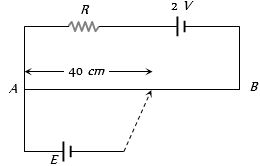
$AB$ is a potentiometer wire of length $100\, cm$ and its resistance is $10 \,\Omega$. It is connected in series with a resistance $R = 40 \,\Omega$ and a battery of $e.m.f.$ $2 \,V$ and negligible internal resistance. If a source of unknown $e.m.f.$ $E$ is balanced by $40\, cm$ length of the potentiometer wire, the value of $E$ is ................. $V$
Medium


Download our appand get started for free
Experience the future of education. Simply download our apps or reach out to us for more information. Let's shape the future of learning together!No signup needed.*
Similar Questions
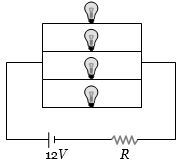
- 1Four identical electrical lamps are labelled $1.5\,V$, $0.5\,A$ which describes the condition necessary for them to operate at normal brightness. A $12\,V$ battery of negligible internal resistance is connected to lamps as shown, thenView Solution
- 2The current in the primary circuit of a potentiometer is $0.2\, A$. The specific resistance and cross section of the potentiometer wire are $4\times10^{-7}\,ohm$ $metre$ and $8\times10^{-7}\, m^2$ respectively. The potential gradient will be equal to .............. $V/m$View Solution
- 3Coefficient of linear expansion of material of resistor is $\alpha$. Its temperature coefficient of resistivity and resistance are $\alpha_\rho$ and $\alpha_R$ respectively, then correct relation isView Solution
- 4A current $I$ flows through a uniform wire of diameter $d,$ when the mean drift velocity is $v_d.$ The same current will flow through a wire of diameter $d/2$ made of the same material, if the mean drift velocity of the electrons isView Solution
- 5We have two wires $A$ and $B$ of same mass and same material. The diameter of the wire $A$ is half of that $B$. If the resistance of wire $A$ is $24\, ohm$ then the resistance of wire $B$ will be ................ $Ohm$View Solution
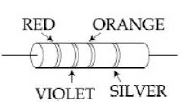
- 6View SolutionA resistance is shown in the figure. Its value and tolerance are given respectively by
- 7A wire has a resistance of $12\, ohm$. It is bent in the form of equilateral triangle. The effective resistance between any two corners of the triangle isView Solution
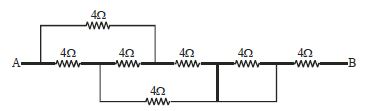
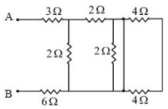
- 8In the given circuit, the equivalent resistance between the terminal $A$ and $B$ is $........\Omega$.View Solution
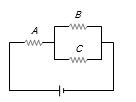
- 9Three identical resistances $A$, $B$ and $C$ are connected as shown in the given figure. The heat produced will be maximumView Solution
- 10Equivalent resistance between $A$ and $B$ is ............ $\Omega$View Solution