Coefficient of linear expansion of material of resistor is $\alpha$. Its temperature coefficient of resistivity and resistance are $\alpha_\rho$ and $\alpha_R$ respectively, then correct relation is
Diffcult
Download our app for free and get started
we will find the relation for small temperature changes.
resistance $R =\rho L / A$
coefficient of linear expansion $= \alpha$
length of conductor: $L = L _0(1+ a \Delta T ) \quad \Delta L = a L _0 \Delta T$
$\beta=$ coefficient of expansion in area : $=2 \alpha$
Area of cross section: $A=A_0(1+2 \alpha \Delta T)$
$\Delta A=2 \alpha A_0 \Delta T$
Resistivity $\rho=\rho_0(1+\alpha_p \Delta T)$
$\Delta \rho=\rho_0 \alpha_p \Delta T$
Resistance $R = R _0(1+\alpha_R \Delta T )$
$\Delta R =\alpha_R R _0 \Delta T$
If $\Delta A =2 a \Delta T$ is very small then, and for small $\Delta T$,
$R_0=\rho_0 L_0 / A_0$
$R =\rho_0(1+ \alpha_p \Delta T ) L _0(1+ a \Delta T ) /\left[ A _0(1+2 \alpha \Delta T )\right]$
$=\left(\rho_0 L_0 / A_0\right)(1+\alpha_p \Delta T)(1+\alpha \Delta T)(1-2 \alpha \Delta T)$
$=R_0(1+\alpha_p \Delta T)(1-a \Delta T) \quad$ ignoring the $2 a^2 \Delta T^2$ term
$=R_0[1+(\alpha_p-\alpha) \Delta T] \quad$ ignoring the $A \rho a \Delta T^2$ term
$\alpha_R=\alpha_P-\alpha$

Download our appand get started for free
Experience the future of education. Simply download our apps or reach out to us for more information. Let's shape the future of learning together!No signup needed.*
Similar Questions
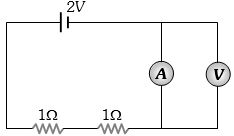
- 1In the circuit shown below, The reading of the voltmeter $V$ is ...........View Solution
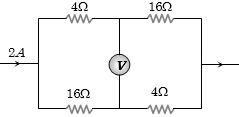
- 2To measure the temperature coefficient of resistivity $\alpha$ of a semiconductor, an electrical arrangement shown in the figure is prepared. The arm BC is made up of the semiconductor. The experiment is being conducted at $25^{\circ} \mathrm{C}$ and resistance of the semiconductor arm is $3 \mathrm{~m} \Omega$. Arm BC is cooled at a constant rate of $2^{\circ} \mathrm{C} / \mathrm{s}$. If the galvanometer $\mathrm{G}$ shows no deflection after $10 \mathrm{~s}$, then $\alpha$ is :View Solution
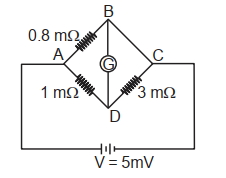
- 3$I-V$ characteristic of a copper wire of length $L$ and area of cross-section $A$ is shown in figure. The slope of the curve becomesView Solution
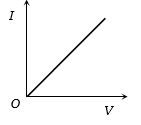
- 4Two uniform wires $A$ and $B$ are of the same metal and have equal masses. The radius of wire $A$ is twice that of wire $B$. The total resistance of A and $B$ when connected in parallel isView Solution
- 5You are given a resistance wire of length $50\, cm$ and a battery of negligible resistance. In which of the following cases is largest amount of heat generatedView Solution
- 6View SolutionSpecific resistance of a conductor increases with
- 7In a meter bridge, the balancing length from the left end (standard resistance of $1 \,ohm$ is in the right gap) is found to be $20\, cm$. The value of the unknown resistance is ............... $\Omega$View Solution
- 8A $25\, W$, $ 220\, V$ bulb and a $100\, W$, $220\, V$ bulb are connected in parallel across a $440\, V$ lineView Solution
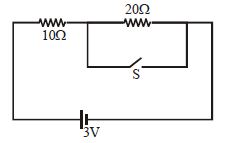
- 9Consider the circuit shown in fig. The current through the $10\,\Omega $ resistor when switch $'s'$ is $(a)$ open $(b)$ closed.View Solution
- 10In the circuit shown, $A$ and $V$ are ideal ammeter and voltmeter respectively. Reading of the voltmeter will be ............... $V$View Solution