Question
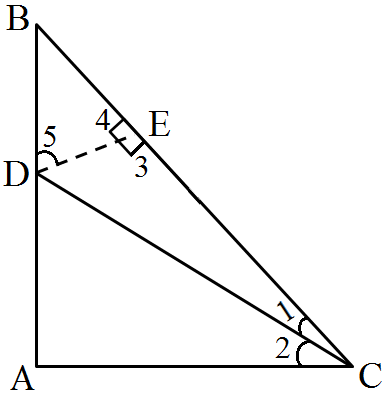
$ABC$ is a right triangle such that $AB = AC$ and bisector of angle $C$ intersects the side $AB$ at $D.$ Prove that $AC + AD = BC.$
Answer

Given in right angled $\triangle\text{ABC},\text{AB}= \text{AC}\text{ and }\text{CD}$ is the bisector of $\angle\text{C}.$ contruction draw $\text{DE}\ \bot\ \text{BC}.$ to prove $\text{AC}+\text{AD}= \text{BC}$ proof in right angled $\triangle\text{ABC},\text{AB}=\text{AC}\text{ and }\text{BC}$ is a hypotenuse [given]


$\angle1=\angle2$ [given,$\text{CD}$ isthe bisector of $\angle\text{C}$]
$\text{DC}=\text{DC} [$common sides$]$
$\therefore\ \triangle\text{DAC}\cong\triangle\text{DEC}$ [by AAS congruence rule]
$\Rightarrow\ \text{DA}=\text{DE}. [$by $CPCT]...(i)$
​​​​​​​ $\text{and}\ \text{AC}=\text{EC} ...(ii)$
$\text{ln}\ \triangle\text{ABC},\ \text{AB}=\text{AC}$
$\angle\text{C}=\angle{B}[$ angle opposite to equal sides are equal$]...(iii) $Again,in $\triangle\text{ABC},\ \angle\text{A}+\angle\text{B}+\angle\text{C}= 180^\circ$ [by angle sum property of a triangle] $\Rightarrow\ 90^\circ+\angle\text{B}+\angle\text{B}=180^\circ$
$\Rightarrow\ 2\angle\text{B}=180^\circ-90^\circ[$from Eq.$(iii)]$
$\Rightarrow\ 2\angle\text{B}=90^\circ$
$\Rightarrow\ \angle\text{B}=45^\circ$
$\text{ln}\ \triangle\text{BED},\ \angle5=180^\circ-\big(\angle\text{B}+\angle{4}\big)$ [by angle sum property of a triangle] $=180^\circ-(45^\circ+90^\circ)$
$=180^\circ-135^\circ=45^\circ$
$\therefore\ \angle\text{B}=\angle{5}$
$\Rightarrow\ \text{DE}=\text{BE}\ [\because$ sides opposite to equal angle are equal$] ...(iv)$ from Eqs. $(i)$ and $(iv),$ $\text{DA}=\text{DE}=\text{BE} ...(v)$
$\because\text{BC}=\text{CE}+\text{EB}$
$=\text{CA}+\text{DA} [$from Eqs. $(ii)$ and $(v)]$
$\therefore\text{AD}+\text{AC}=\text{BC}$ Hence proved.

Need a full question paper?

Generate a complete, print-ready paper with questions like this in minutes — across 16+ boards, with answer keys.
Start Generating Free

Similar questions

If the radius and slant height of a cone are in the ratio $7 : 13$ and its curved surface area is $286cm^2,$ find its radius.
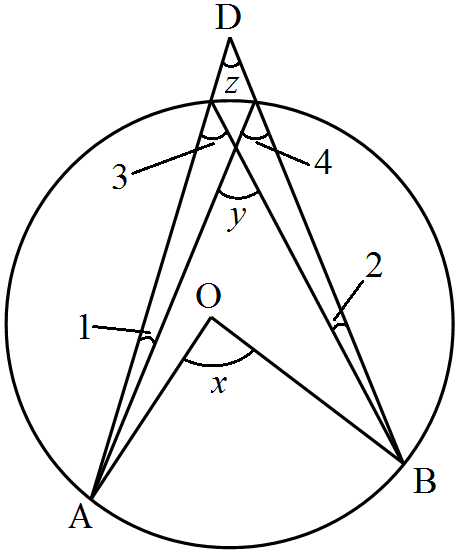
In figure, $O$ is the centre of the circle, then prove that $\angle\text{x}=\angle\text{y}+\angle\text{z}.$
The water bills (in rupees) of $32$ houses in a certain street for the period $1.198$ to $31.398$ are given below: $56, 43, 32, 38, 56, 24, 68, 85, 52, 47, 35, 58, 63, 74, 27, 84, 69, 35, 44, 75, 55, 30, 54, 65, 45, 67, 95, 72, 43, 65, 35, 69.$ Tabulate the data and present the data as a cumulative frequency table using $70 - 79$ as one of the class intervals.
If a pair of opposite sides of a cyclic quadrilateral are equal, prove that its diagonals are also equal.
Two circles with centres $O$ and $O′$ intersect at two points $A$ and $B$. A line $PQ$ is drawn parallel to $OO′$ through A(or B) intersecting the circles at $P$ and $Q$. Prove that $PQ = 2OO′.$
Find the area of the shaded region in fig. below
The median $BE$ and $CF$ of a triangle $ABC$ intersect at $G.$ Prove that the area of $GBC =$ area of the quadrilateral $AFGE.$
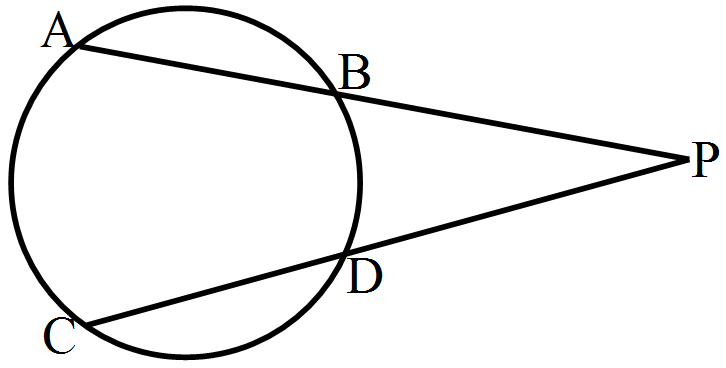
Two chords $AB$ and $CD$ of a circle intersect each other at $P$ outside the circle. If $AB = 6\ cm, BP = 2\ cm$ and $PD = 25\ cm$, find $CD$.
Find the value of the following correct to three place of decimals, it begin that $\sqrt2=1.4142, \sqrt3=1.732,\ \sqrt5=2.2360,\ \sqrt6=2.4495$ and $\sqrt{10}=3.162.$ $\frac{3-\sqrt5}{3+2\sqrt5}$