Question
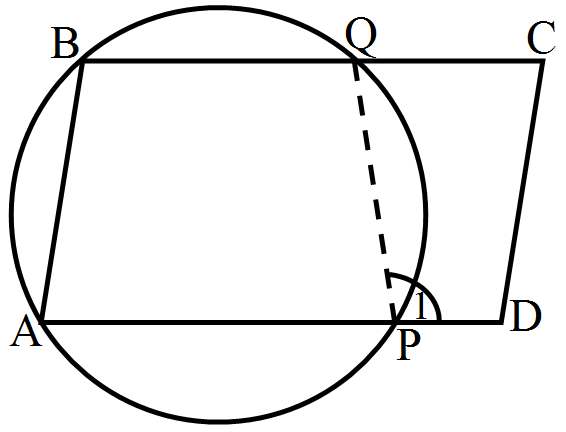
ABCD is a parallelogram. A circle through A, B is so drawn that it intersects AD at P and BC at Q. Prove that P, Q, C and D are concyclic.
Answer

ABCD is a parallelogram. A circle through A, B is so drawn that intersects AD at P and BC at Q. We have to prove that P, Q, C and D are concyclic. Join PQ.

Now, side AP of the cyclic quadrilateral APQB produced to D.
$\therefore\ \text{Ext. }\angle1=\text{int.opp. }\angle\text{B}$
$\because$ BA || CD and BC cuts them
$\therefore\angle\text{B}+\angle\text{C}=180^\circ$
$\because$ sum of int. $\angle\text{s}$ on the same side of the transversal is 180°]
or $\angle1+\angle\text{C}=180^\circ\ [\therefore\angle1=\angle\text{B}\ (\text{proved})]$
$\therefore$ PDCQ is cyclic quadrilateral.
Hence, the point P, Q, and are concyclic.

Need a full question paper?

Generate a complete, print-ready paper with questions like this in minutes — across 16+ boards, with answer keys.

Start Generating Free

Similar questions

Plot the following points on the graph paper:

(-5, -7)

he following data given the weight (in grams) of 30 oranges picked from a basket: 106, 107, 76, 109, 187, 95, 125, 92, 70, 139, 128, 100, 88, 84, 99, 113, 204, 141, 136, 123, 90, 115, 110, 97, 90, 107, 75, 80, Frequency distribution table:
Class IntervalTally marksFrequency
60 - 80
|||
3
80 - 100
|||| ||||
10
100 - 120
|||| ||||
9
120 - 140
||||
5
140 - 160
|
1
160 - 180
-
0
180 - 200
|
1
200 - 220
|
1
Total
30
30
questions:
  1. Class Size of given class data:
  2. Classmark of forth class:
  3. The number of oranges, whose weight is more than 180g:
  4. The number of oranges, whose weight is less than 100g:
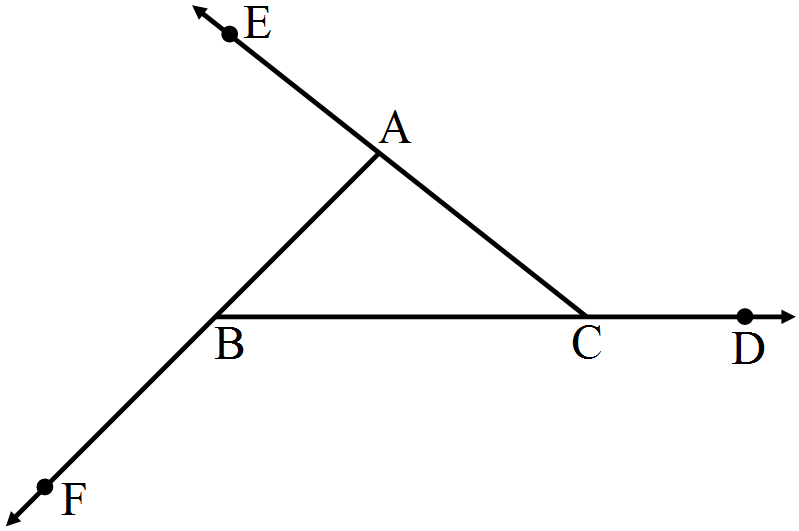
If the sides of a triangle are produced in order, prove that the sum of the exterior angles so formed is equal to four right angles.

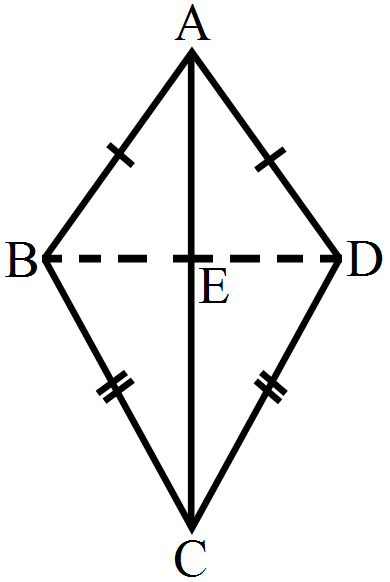
In the given figure, ABCD is a quadrilateral in which AB = AD and BC = DC. Prove that

  1. AC bisects $\angle\text{A}$ and $\angle\text{C},$
  2. BE = DE,
  3. $\angle\text{ABC}=\angle\text{ADC}.$

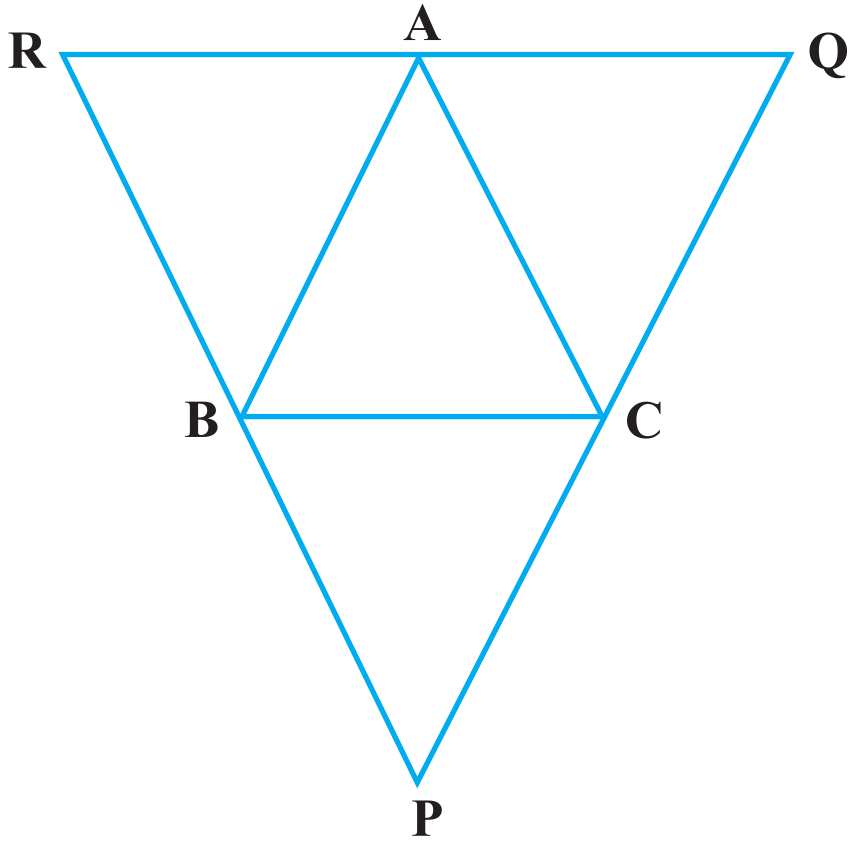
Through A, B and C, lines RQ, PR and QP have been drawn, respectively parallel to sides BC, CA and AB of a $\Delta\text{ABC}$ as shown Show that $\text{BC}=\frac{1}{2}$ QR.

Two chords AB and CD of lengths 5cm and 11cm respectively of a circle are parallel to each other and are opposite side of its centre. If the distance between AB and CD is 6cm, find the radius of the circle.
P, Q, R and S are respectively the mid-points of the sides AB, BC, CD and DA of a quadrilateral ABCD such that$\text{AC}\bot\text{BD}.$ Prove that PQRS is a rectangle.
Draw a line segment of length 8.6cm. Bisect it and measure the length of each part.
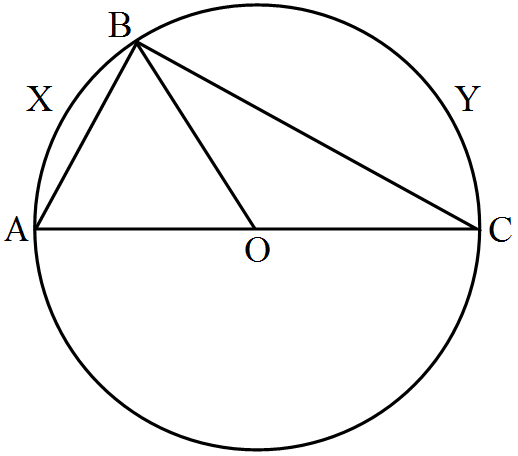
In the given figure, if O is the circumcentre of $\angle\text{ABC},$ then find the value of $\angle\text{OBC} + \angle\text{BAC.}$

ABCD is a kite having AB = AD and BC = CD. Prove that the figure found by joining the mid points of the sides, in order, is a rectangle.