Questions · Page 1 of 3

4 Marks Questions

🎯

Test yourself on this topic

50 questions · timed · auto-graded

Question 14 Marks
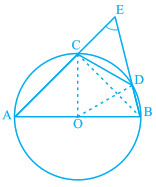
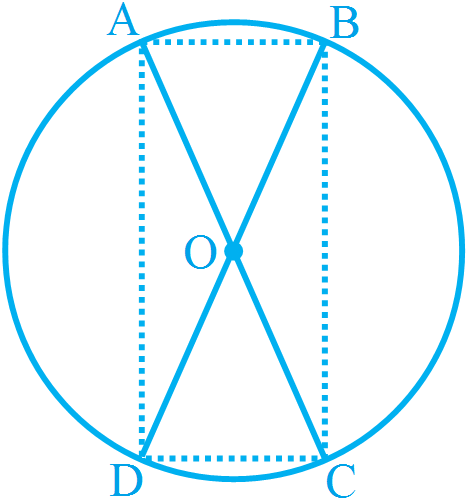
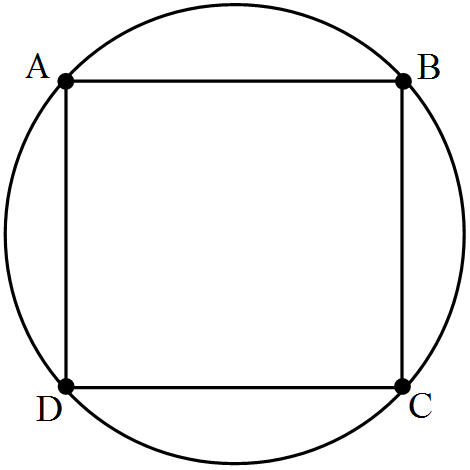
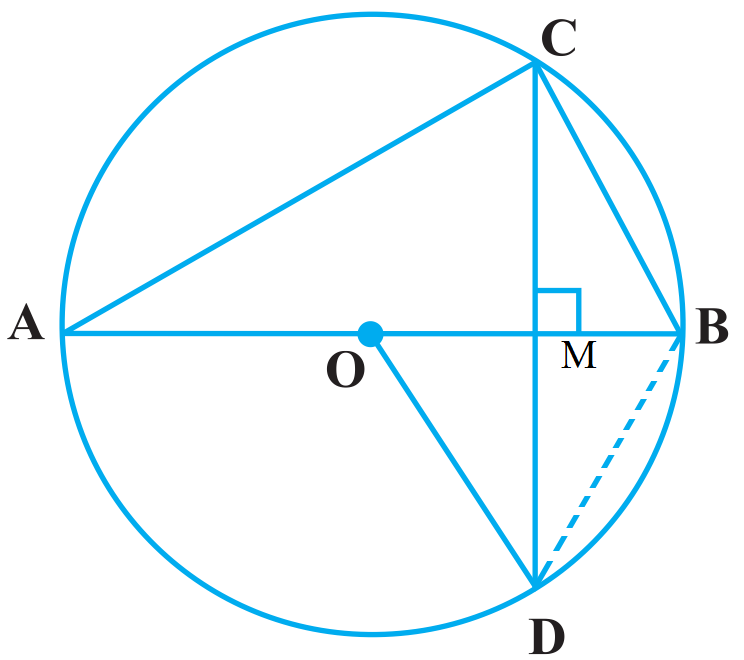
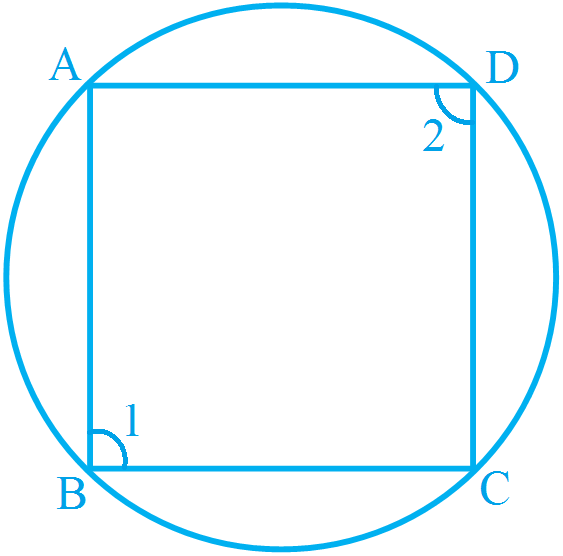
If diagonals of a cyclic quadrilateral are diameters of the circle through the vertices of the quadrilateral, prove that it is a rectangle.
Answer
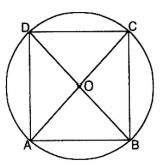

 $\triangle$OAB and  $\triangle$ OCD
OA = OC [Radii of a circle] 
OB = OD |Radii of a circle
 $\angle$AOB = $\angle$COD [Vertically opposite angles]
 $\therefore$ $\triangle$OAB $\cong$ $\triangle$ OCD |SAS rule
 $\therefore$ AB = CD [c.p.c.t]
  $\Rightarrow$ Ar CAB = Ar CCD---- (1)
Similarly, we can show that
 $\Rightarrow$ Arc AD = Arc CB ---- (2)
Adding (1) and (2), we get
Arc AB + Arc AD = Arc CD + Arc CB
 $\Rightarrow$ Ar cBAD = ArcBCD
 $\Rightarrow$BD divides the circle into two equal parts (each a semicircle)
 $\therefore$ $\angle$A = 90o, $\angle$C [Angle of a semi-circle is 90o]
Similarly, we can show that
 $\angle$B = 90o, $\angle$D = 90o 
 $\therefore$  $\angle$A = $\angle$B = $\angle$C = $\angle$D = 90o 
 $\therefore$ABCD is a rectangle.
View full question & answer
Question 24 Marks
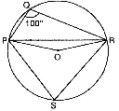
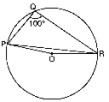
In figure, $\angle \mathrm { PQR } = 100 ^ { \circ }$, where P, Q and R are points on a circle with centre O. Find $\angle O P R$

Answer
Take a point S in the major arc. Join PS and RS.

$\because$ PQRS is a cyclic quadrilateral.
$\therefore \angle \mathrm { PQR } + \angle \mathrm { PSQ } = 180 ^ { \circ }$
|The sum of either pair of opposite angles of a cyclic quadrilateral is 180o
$\Rightarrow 100 ^ { \circ } + \angle P S R = 180 ^ { \circ }$
$\Rightarrow \angle P S R = 180 ^ { \circ } - 100 ^ { \circ }$
$\Rightarrow \angle P S R = 80 ^ { \circ }$ ......... (1)
Now, $\angle \mathrm { POR } = 2 \angle \mathrm { PSR }$
|The angle subtended by an arc at the centre is double the angle subtended by it at any point on the remaining part of the circle
$= 2 \times 80 ^ { \circ } = 160 ^ { \circ }$ ........ (2) |Using (1)
In $\triangle O P R$
$\because O P = O R$ |Radii of a circle
$\therefore \angle \mathrm { OPR } = \angle \mathrm { ORP }$ ....... (3)
|Angles opposite to equal sides of a triangle are equal
In $\triangle O P R$
$\angle O P R + \angle O R P + \angle P O R = 180 ^ { \circ }$ | Sum of all the angles of a triangle is 180o
$\Rightarrow \angle \mathrm { OPR } + \angle \mathrm { OPR } + 160 ^ { \circ } = 180 ^ { \circ }$ |Using (2) and (1)
$\Rightarrow 2 \angle O P R + 160 ^ { \circ } = 180 ^ { \circ }$
$\Rightarrow 2 \angle O P R = 180 ^ { \circ } - 160 ^ { \circ } = 20 ^ { \circ }$
$\Rightarrow \angle \mathrm { OPR } = 10 ^ { \circ }$
View full question & answer
Question 34 Marks
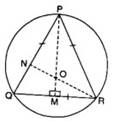
The circular park of radius 20 m is situated in a colony. Three boys Ankur, Syed and David are sitting at equal distance on its boundary each having a toy telephone in his hands to talk each other. Find the length of the string of each phone.
Answer
Construction: Draw PM $\perp$ QR and RN $\perp$ PQ
Determination : PQ = QR = RP
$\therefore$ $\triangle$PQR is equilateral. We know that in an equilateral triangle, the medians and the altitudes are the same. So, PM and RN are median. They intersect at O where O is the centre of the circle.

Also, PO = 2 OM = 20 (medians intersect each other in the ratio 2: 1)
$\Rightarrow$ OM = 10 m  $\Rightarrow$ PM = OP + OM = 20 + 10 = 30 m
Let QM = x
Then, QM = MR = x [$\because$PM bisects QR]
$\therefore$ QM = $\frac {1} {2}$QR $\Rightarrow$ x = $\frac {1} {2}$QR $\Rightarrow$ QR = 2x
Similarly, PQ = 2x
In right triangle PMQ,
PQ2 = PM2 + QM2 |By Pythagoras Theorem
$\Rightarrow$ (2x)2 = (30)2 + x2 
$\Rightarrow$ 4x2 = 900 + x2 
$\Rightarrow$ 4x2 - x2 = 900
$\Rightarrow$ 3x2 = 900 
$\Rightarrow x^{2}=\frac{900}{3}=300$
$\Rightarrow x=\sqrt{300}=10 \sqrt{3}$
$\Rightarrow$ PQ = 2x = 2$(10 \sqrt{3})$
Hence, the length of the string of each phone is $20 \sqrt{3}$ m.
View full question & answer
Question 44 Marks
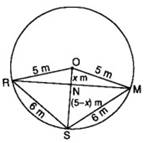
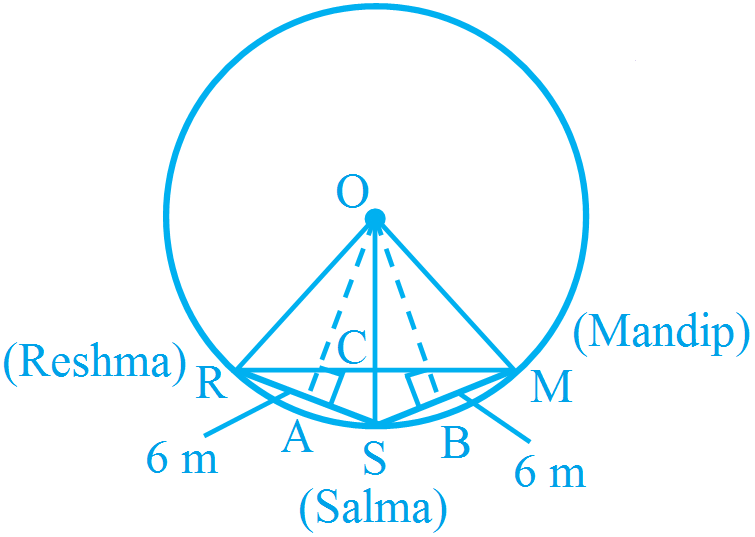
Three girls Reshma, Salma and Mandip are playing a game by standing on a circle of radius 5 m drawn in a park. Reshma throws a ball to Salma. Salma to Mandip, Mandip to Reshma. If the distance between Reshma and Salma and between Salma and Mandip is 6 m each, what is the distance between Reshma and Mandip?
Answer


In $\Delta \mathrm { NOR }$ and $\Delta \mathrm { NOM }$
ON = ON |Common
$\angle \mathrm { NOR } = \angle \mathrm { NOM }$ $| \because$ Equal chords of a circle subtend equal
angle at the centre
OR = OM |Radii of a circle
$\therefore \triangle \mathrm { NOR } \cong \Delta \mathrm { NOM }$ [SAS Rule]
$\therefore \angle O N R = \angle O N M$ [c.p.c.t]
and NR = NM [c.p.c.t.]
But $\angle O N R + \angle O N M = 180 ^ { \circ }$ |Linear Pair Axiom
$\therefore \angle O \mathrm { NR } = \angle \mathrm { O } \mathrm { NM } = 90 ^ { \circ }$
$\triangle$ ON is the perpendicular bisector of RM,
Draw bisector SN of $\angle \mathrm { R } \mathrm { SM }$ to intersect the chord RM in N.
In $\Delta \mathrm { RSN }$ and $\Delta \mathrm { MSN }$
RS = MS (= 6 cm each)
SN = SN [Common]
$\angle R S N = \angle M S N$ [By construction]
$\therefore \Delta R S N \cong \Delta \mathrm { NSN }$ [SAS Rule]
$\therefore \angle R N S = \angle M N S$ [c.p.c.t]
and RN = MN [c.p.c.t]
But $\angle \mathrm { RNS } + \angle \mathrm { MNS } = 180 ^ { \circ }$ |Linear Pair Axion
$\therefore \angle R N S = \angle M N S = 90 ^ { \circ }$
$\therefore \mathrm { SN }$ is the perpendicular bisector of RM and therefore passes through O when produced.
Let ON = x m
Then SN = (5 - x) m
In right triangle ONR,
x2 + RN2 = 52, ------ (1) |By Pythagoras theorem
In right triangle SNR,
(5-x)2 + RN2 = 62 ---- (2) |By Pythagoras theorem
From (1),
RN2 = 52 - x2
From (2),
RN2 = 62 - (5 - x)2
Equating the two values of RN2, we get
52 - x2 = 62 - (5 -x)2
$\Rightarrow 25 - x ^ { 2 } = 36 - ( 25 - 10 x + x ) ^ { 2 }$ $\Rightarrow 25 - x ^ { 2 } = 36 - 25 + 10 x - x ^ { 2 }$
$\Rightarrow 25 - x ^ { 2 } = 11 + 10 x - x ^ { 2 }$$\Rightarrow 25 - 11 = 10 x$
$\Rightarrow$ 14 = 10 x $\Rightarrow$10x = 14
$\Rightarrow x = \frac { 14 } { 10 } = 1.4$
Putting x = 1.4 in (1), we get
(1.4)2 + RN2 = 52
$\Rightarrow R N ^ { 2 } = 5 ^ { 2 } - ( 1.4 ) ^ { 2 }$ $\Rightarrow \mathrm { RN } ^ { 2 } = 25 - 1.96$
$\Rightarrow \mathrm { RN } ^ { 2 } = 23.04 \Rightarrow \mathrm { RN } = \sqrt { 23.04 }$
$\Rightarrow$ RN = 4.8
$\therefore$ RM = 2 RN = $2 \times 4.8 \mathrm { m } = 9.6 \mathrm { m }$
Hence, the distance between Reshma and Mandip is 9.6 m.
View full question & answer
Question 54 Marks
If two equal chords of a circle intersect within a circle, prove that the segments of one chord are equal to corresponding segments of the other chord.
Answer
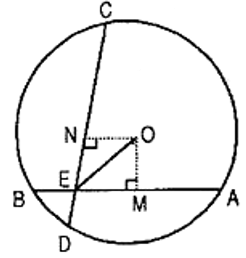
Given: Let AB and CD are two equal chords of a circle of centers
O intersecting each other at point E within the circle.
To prove: (a) AE = CE (b) BE = DE
Construction: Draw OM $\bot $ AB, ON $\bot $ CD. Also join OE.

Proof: In right triangles OME and ONE,
$\angle $OME = $\angle $ONE = 90°
OM = ON
[Equal chords are equidistance from the centre]
OE = OE [Common]
$\therefore$ $\triangle$OME $\cong$ $\triangle$ONE [RHS rule of congruency]
$\therefore$ ME = NE [By CPCT] ...(i)
Now, O is the centre of circle and OM $\bot $ AB
$\therefore$ AM = $\frac{1}{2}$ AB [Perpendicular from the centre bisects the chord] ...(ii)
Similarly, NC = $\frac{1}{2}$ CD ...(iii)
But AB = CD [Given]
From eq. (ii) and (iii), AM = NC ...(iv)
Also MB = DN ...(v)
Adding (i) and (iv), we get,
AM + ME = NC + NE
$\Rightarrow$ AE = CE [Proved part (a)]
Now AB = CD [Given] ...(v)
AE = CE [Proved] ...(vi)
Subtracting eq. (vi) from eq. (v), we have
$\Rightarrow$ AB - AE = CD - CE
$\Rightarrow$ BE = DE [Proved part (b)]
View full question & answer
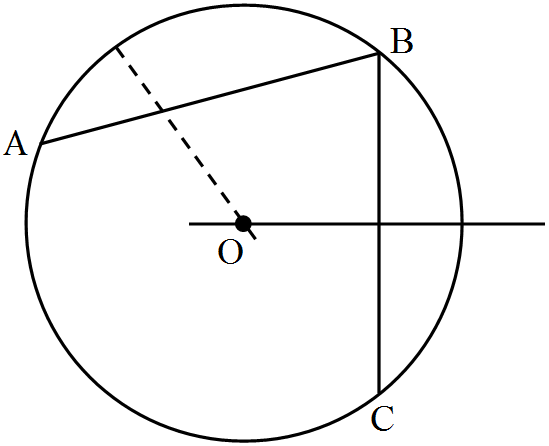
Question 64 Marks
View full question & answer
Question 74 Marks
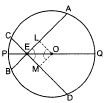
If two intersecting chords of a circle make equal angles with the diameter passing through their point of intersection, prove that the chords are equal.
Answer


Given: AB and CD are two chords of a circle with centre O, intersecting at point E. PQ is a diameter through E, such that $\angle$AEQ = $\angle$DEQ.
To prove: AB = CD
Construction: Draw OL $\perp$ AB and OM $\perp$ CD
Proof: $\angle $LOE + $\angle $LEO + $\angle $OLE = 180° (Angle sum property of a triangle)
$\Rightarrow$ $\angle $LOE + $\angle $LEO + 90° = 180°
$\angle $LOE + $\angle $LEO =90° .........................(i)
Similarly, $\angle $MOE + $\angle $MEO + $\angle $OME = 180°
$\Rightarrow$$\angle $MOE + $\angle $MEO + 90° = 180°
$\angle $MOE + $\angle $MEO = 90° . .........................(ii)
From (i) and (ii) we get
$\angle $LOE + $\angle $LEO = $\angle $MOE + $\angle $MEO ..........(iii)
Also, $\angle $LEO = $\angle $MEO (Given) ...(iv)
From (iii) and (iv) we obtain
$\angle $LOE = $\angle $MOE
Now in triangles OLE and OME
$\angle $LEO = $\angle $MEO (Given)
$\therefore$  $\angle $LOE = $\angle $MOE (Proved above)
EO = EO (Common)
$\therefore$  by ASA congruence criterion we have:
  $\triangle$OLE $\cong$ $\triangle$ OME
$\therefore$ OL = OM ( by CPCT)
Thus, chords AB and CD are equidistant from the centre O of the circle. Since, chords of a circle which are equidistant from the centre are equal.
$\therefore$ AB = CD
View full question & answer
Question 84 Marks
Two new roads, Road E and Road F were constructed between society 4 and 1 and society 1 and 2.
Image
1. What would be the measure of the sum of angles formed by the straight roads at society 1 and society 3?
2. Krish says, “The distance to go from society 4 to society 2 using Road D will be longer that the distance using Road E”
Is Krish correct? Justify your answer with examples.
3. Road G, perpendicular to Road F was constructed to connect the park and Road F.
Which of the following is true for Road G and Road F?
4. Priya said, “Minor arc corresponding to Road B is congruent to minor arc corresponding to Road D.”
Do you agree with Priya? Give reason to support your answer.
Answer
i. C. 180°
ii. Examples to show that in a right triangle the sum of legs is longest for an isosceles right triangle when hypotenuse remains same.
• Take for example the length of diameter (hypotenuse) = 5 units.
Road D and Road B are equal hence (Road D = 3.53 units).
Let Road E be = 1 Chapter, Road F = 4.89 units.
Therefore, length of Road B + Road D is greater than Road E + Road F.
iii. C. Road G divides Road F into two equal parts.
iv. Yes, Priya is correct with valid reasoning.
• Yes, Priya is correct because arc corresponding to two equal roads (chords) are congruent.
View full question & answer
Question 94 Marks
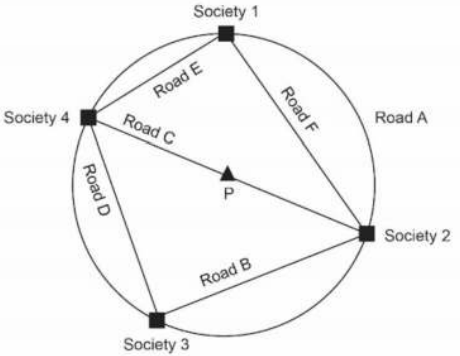
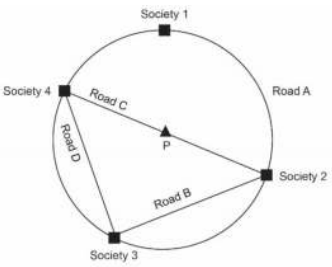
Given below is the map giving the position of four housing societies in a township connected by a circular road A.
Image

Society 2 and 3 are connected by straight road B, society 4 and 2 are connected by straight road C and society 4 and 3 are connected by road D. Point P denotes the position of a park. The park is equidistant to all four societies.
Rubina claims that it is not possible to construct another circular road connecting all four societies.
question:
i. Which of the following options justiies Rubina’s claim?
ii. What is the position of the park P with respect to road A?
iii. The length of Road B is equal to the length of Road D.
Which of the following options can be true for the roads in the township?
iv. Alex says, “The angle made by road B on road D is a right angle.”
Jai and Angad give different justiications to support Alex’s claim.
Jai says, “Angles in the same segment of a circle are equal.”
Angad says, “The angle in a semicircle is a right angle.”
Who has given the correct justiication?
Answer
i. There is a unique circle passing through three non-collinear points.
ii. Centre
iii. Road B and Road D subtend equal angles at society 1.
iv. Angad is correct.
View full question & answer
Question 104 Marks
Answer
(i) Diameter
(ii) 90°
(iii) Minor Segment.
(iv) Major Segment.
View full question & answer
Question 114 Marks
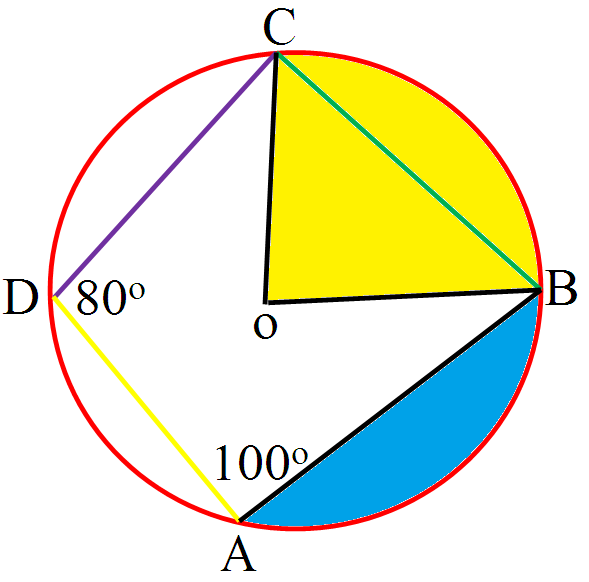
There was a circular park in Defence colony At Delhi. For fencing purpose Poles A, B, C and D were installed at the circumference of the park. Ram tied wires From A to B to C and C to D, He managed to measure the $\angle\text{A}=100^\circ$ and $\angle\text{D}=80^\circ$ The point O in the middle of the park is the center of the circle.


answer the following questions:
  1. What is the value of $\angle\text{B}?$
  2. What is the value of $\angle\text{C}?$
  3. What is the special type of quadrilateral ABCD?
  4. What is the property of cyclic quadrilateral?
Answer
(i) $100^{\circ}$
(ii) $80^{\circ}$
(iii) Cyclic quadrilateral
(iv) Opposite angles are supplementary.
View full question & answer
Question 124 Marks
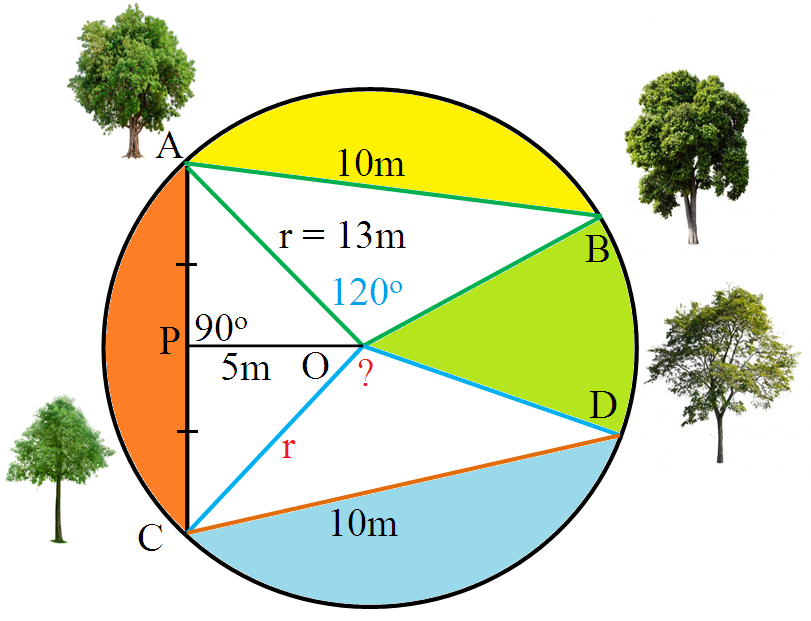
A farmer has a circular garden as shown in the picture above. He has a different type of trees, plants and flower plants in his garden. In the garden, there are two mango trees A and B at a distance of AB = 10m. Similarly, he has two Ashoka trees at the same distance of 10m as shown at C and D. AB subtends $\angle\text{AOB}=120^\circ$ at the center O, The perpendicular distance of AC from center is 5m. The radius of the circle is 13m.


answer the following questions:
  1. What is the value of $\angle\text{COD}?$
  2. What is the distance between mango tree A and Ashok tree C?
  3. What is the value of $\angle\text{OAB}?$
  4. What is the value of $\angle\text{OCD?}$
Answer
(i) $120^{\circ}$
(ii) 24m
(iii)$30^{\circ}$
(iv) $30^{\circ}$
View full question & answer
Question 134 Marks
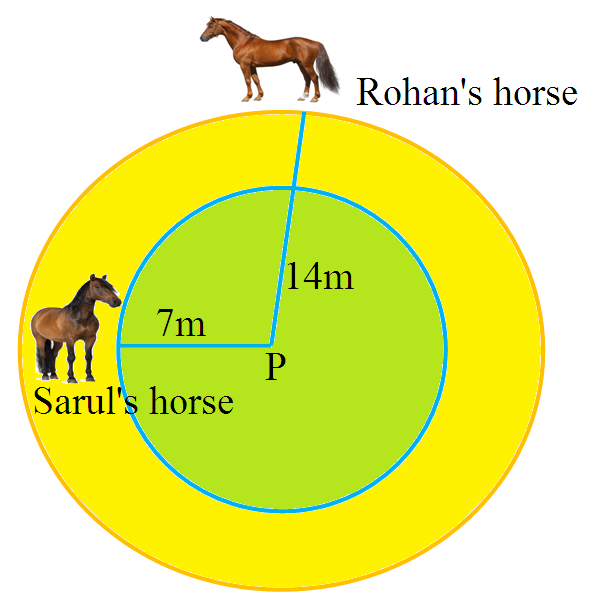
Rohan and Suraj were close friends, One day they were riding horses from Delhi to Faridabad. The names of their horses were Saku and Fareed respectively. The day was very sunny. On the way, they stopped for resting in a park. They tied their horses to a tree in the park. The length of ropes of Rohans's horse is 14m and that of the horse of Suraj is 7m as shown in the figures. Both the friends slept in the park under a green tree for some time. During this period both the horses took 10 rounds along with the tree they were tied.

Answer the following questions :
  1. The ratio of distance walked in 10 rounds by the horses of Rohan and Suraj is:
  2. The ratio of area of the grass the horses of Rohan and Suraj could graze:
  3. What is the distance walked by Rohan's horse in 5 rounds:
  4. What we call the the length of rope in terms of circle?
Answer
(i) 2.1
(ii) 4.1
(iii) 440m
(iv) Radius
View full question & answer
Question 144 Marks
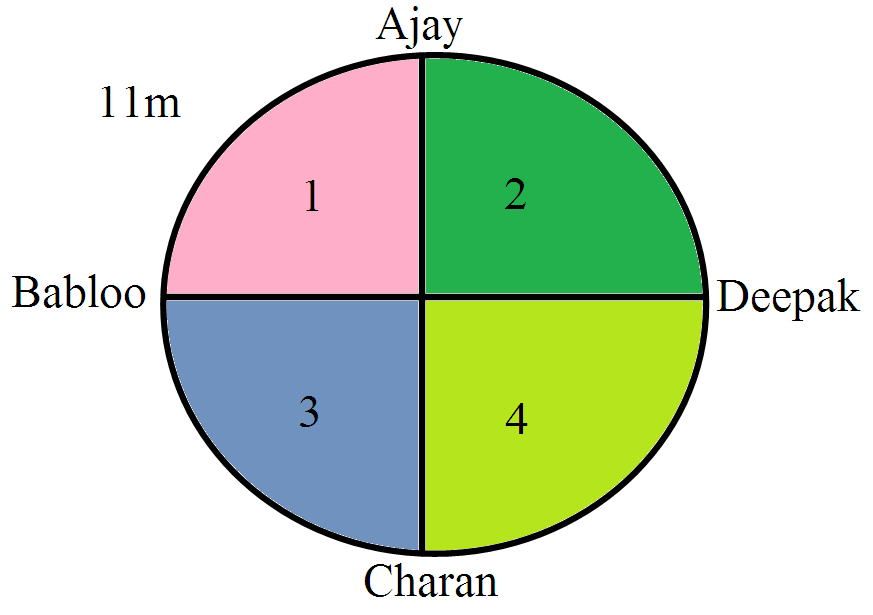
Four students of class IX B with names Ajay, Babloo, Charan and Deepak are playing a game in a circular playground. All four students are holding radios with speaker and mic. These radios are connected by a wire of equal length that is 11m (for each radio). Ajay Asks a question to Babloo. If Babloo gives the correct answer he gets 10 points and asks a new question to Charan, If he can not answer then he passes the same question to Charan and gets no points. These conditions apply to all four players. After 10 rounds who gets maximum points, he becomes the winner.


Read the data carefully and answer the questions that follow.
  1. What is the radius of the field?
  2. What is the area of the field?
  3. What is the area of the part marked with 1 on the field?
  4. What is the circumference of the field?
Answer
(i) 7m
(ii) $154 m^2$
(iii) $38.5 m^2$
(iv) 44m
View full question & answer
Question 154 Marks
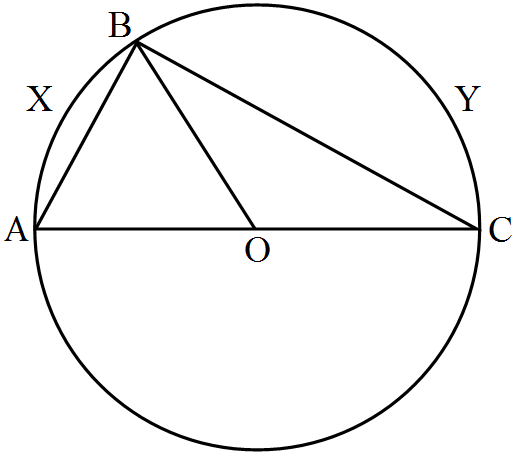
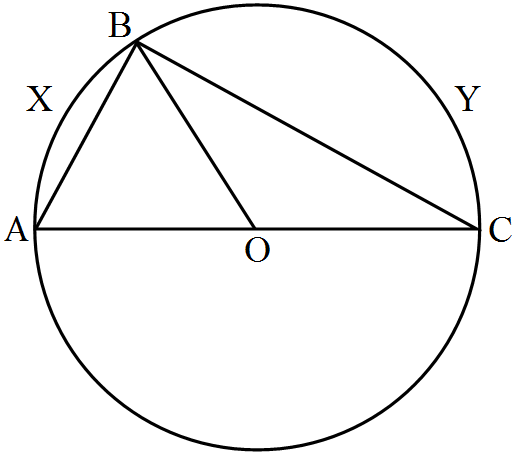
In the given figure, if O is the circumcentre of $\angle\text{ABC},$ then find the value of $\angle\text{OBC} + \angle\text{BAC.}$

Answer

Since, O is the circumcentre of 
$\triangle\text{ABC,}$ So, O would be centre of the circle passing through points A, B and C.

$\angle\text{ABC}=90^\circ$ (Angle in the semicircle is 90°)

$\Rightarrow\angle\text{OAB}+\angle\text{OBC}=90^\circ\dots(1)$

As OA = OB (Radii of the same circle)

$\therefore\angle\text{OAB}=\angle\text{OBA}$ (Angle opposite to equal sides are equal)

or, $\angle\text{BAC}=\angle\text{OBA}$

From (1)

$\angle\text{BAC}+\angle\text{OBC}=90^\circ$

View full question & answer
Question 164 Marks
AC and BD are chords of a circle which bisect each other. Prove that:
  1. AC and BD are diameters,
  2. ABCD is a rectangle.
Answer

Let two chords AB and CD are intersecting each other at point O.

In $\triangle\text{AOB}$ and $\triangle\text{COD},$

OA = OC (Given)

OB = OD (Given)

$\angle\text{AOB}=\angle\text{COD}$ (Vertically opposite angles)

$\triangle\text{AOB}\cong\triangle\text{COD}$ (SAS congruence rule)

AB = CD (By CPCT)

Similarly, it can be proved that $\triangle\text{AOD}\cong\triangle\text{COB}$

$\therefore\text{AD = CB}$ (By CPCT)

Since in quadrilateral ACBD, opposite sides are equal in length, ACBD is a parallelogram.

We know that opposite angles of a parallelogram are equal.

$\therefore\angle\text{A}=\angle\text{C}$

However, $\angle\text{A}+\angle\text{C}=180^\circ$ (ABCD is a cyclic quadrilateral)

$\Rightarrow\angle\text{A}+\angle\text{A}=180^\circ$

$\Rightarrow2\angle\text{A}=180^\circ$

$\Rightarrow\angle\text{A}=90^\circ$

As ACBD is a parallelogram and one of its interior angles is 90°, therefore, it is a rectangle.

$\angle\text{A}$ is the angle subtended by chord BD. And as $\angle\text{A}=90^\circ$ therefore, BD should be the diameter of the circle. Similarly, AC is the diameter of the circle.

View full question & answer
Question 174 Marks
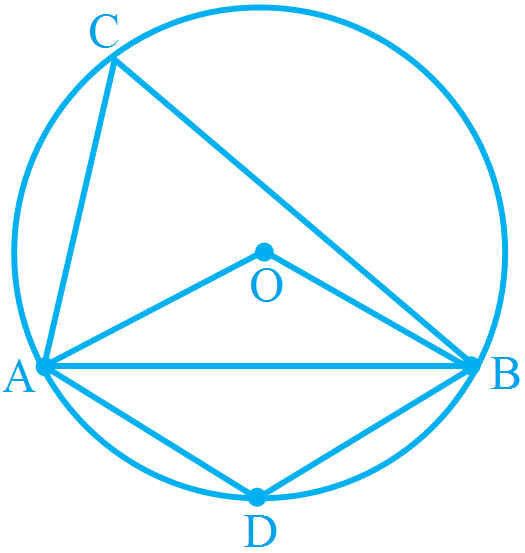
A chord of a circle is equal to the radius of the circle. Find the angle subtended by the chord at a point on the minor arc and also at a point on the major arc.
Answer

Given,

AB is equal to the radius of the circle.

In $\triangle\text{OAB},$

OA = OB = AB = radius of the circle.

Thus, $\triangle\text{OAB}$ is an equilateral triangle.

$\angle\text{AOC}=60^\circ$

also,

$\angle\text{ACE}=\frac{1}{2}\angle\text{AOB}=\frac{1}{2}\times60^\circ=30^\circ$

ACBD is a cyclic quadrilateral,

$\angle\text{ACB}+\angle\text{ADB}=180^\circ$ (Opposite angles of cyclic quadrilateral)

$\Rightarrow\angle\text{ADB}=180^\circ-30^\circ=150^\circ$

Thus, angle subtend by the chord at a point on the minor arc and also at a point on the major arc are 150° and 30° respectively.

View full question & answer
Question 184 Marks
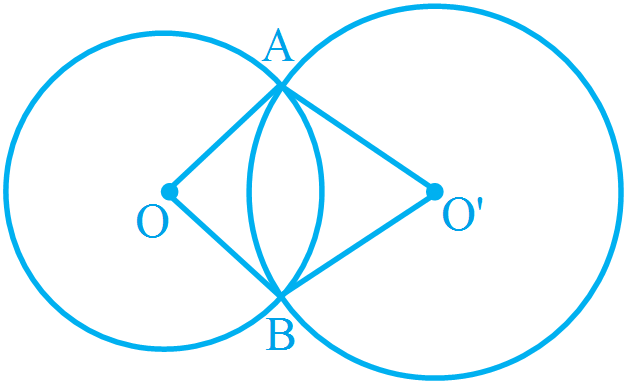
Prove that the line of centres of two intersecting circles subtends equal angles at the two points of intersection.
Answer

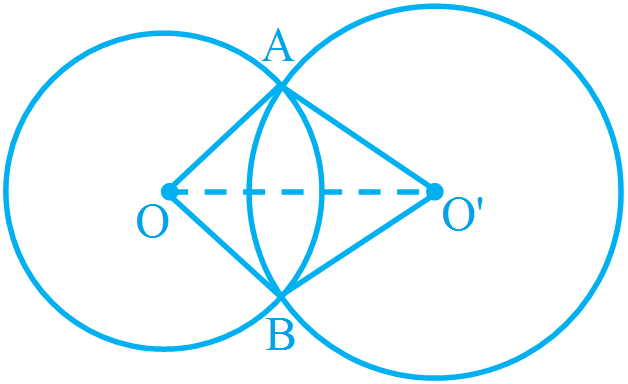
Let two circles having their centers as O and O' intersect each other at point A and B respectively. Let us join OO'.


In $\triangle\text{AO}{\text{O}'}$ and $\triangle\text{BO}{\text{O}'},$

OA = OB (Radius of circle 1)

O'A = O'B (Radius of circle 2)

OO' = OO' (Common)

$\triangle\text{AO}{\text{O}'}\cong\triangle\text{BO}{\text{O}'}$ (By SSS congruence rule)

$\triangle\text{OA}{\text{O}'}=\triangle\text{OB}{\text{O}'}$ (By CPCT)

Therefore, line of centers of two intersecting circles subtends equal angles at the two points of intersection.

View full question & answer
Question 194 Marks
Give a method to find the centre of a given circle.
Answer

Steps of Construction:

  1. Take three points A, B and C on the given circle.
  2. Join AB and BC.
  3. Draw the perpendicular bisectors of the chord AB and BC which intersect each other at O.
  4. Point O will give the required circle because we know that, the Perpendicular bisectors of chord always pass through the centre.
View full question & answer
Question 204 Marks
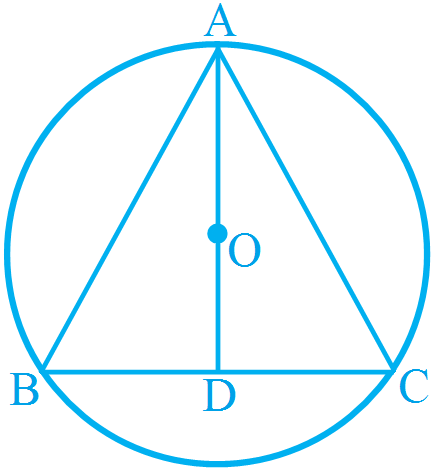
A circular park of radius 20m is situated in a colony. Three boys Ankur, Syed and David are sitting at equal distance on its boundary each having a toy telephone in his hands to talk each other. Find the length of the string of each phone.
Answer

Let A, B and C represents the positions of Ankur, Syed and David respectively. All three boys at equal distances thus ABC is an equilateral triangle.
$\text{AD}\perp\text{BC}$ is drawn. Now, AD is median of $\triangle\text{ABC}$ and it passes through the centre O.
Also, O is the centroid of the $\triangle\text{ABC}.$ OA is the radius of the triangle.

$\text{OA}=\frac{2}{3}\text{AD}$

Let the side of a triangle a meters then $\text{BD}=\frac{\text{a}}{2}\text{m}.$
Applying Pythagoras theorem in $\triangle\text{ABD}.$

$\text{AB}^2=\text{BD}^2+\text{AD}^2$

$\Rightarrow\text{AD}^2=\text{AB}^2-\text{BD}^2$

$\Rightarrow\text{AD}^2=\text{a}^2-\Big(\frac{\text{a}}{2}\Big)^2$

$\Rightarrow\text{AD}^2=\frac{3\text{a}^2}{4}$

$\Rightarrow\text{AD}=\sqrt{\frac{3\text{a}}{2}}$

$\text{OA}=\frac{2}{3}\text{AD}\Rightarrow20\text{m}=\frac{2}{3}\times\sqrt{\frac{3\text{a}}{2}}$

$\Rightarrow\text{a}=20\sqrt{3}\text{m}$

Length of the string is $20\sqrt{3}\text{m}.$

View full question & answer
Question 214 Marks
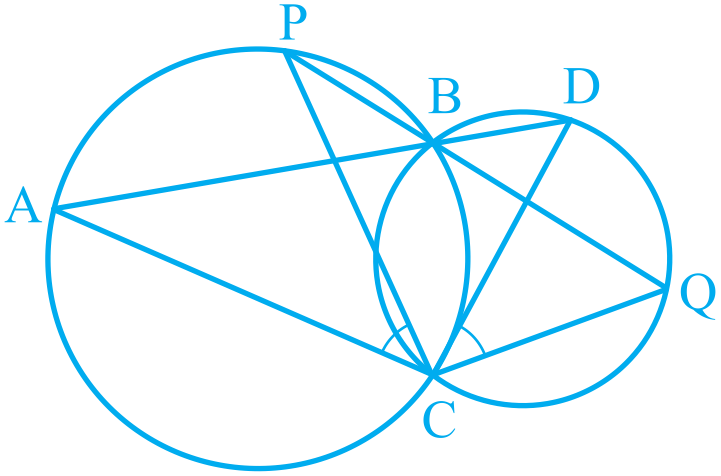
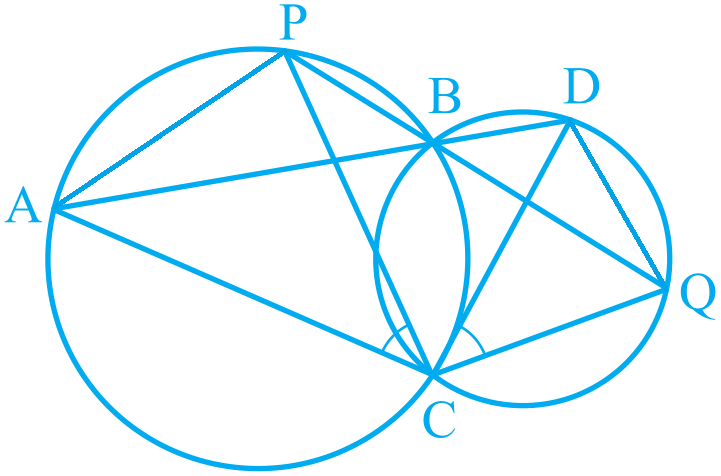
Two circles intersect at two points B and C. Through B, two line segments ABD and PBQ are drawn to intersect the circles at A, D and P, Q respectively Prove that $\angle\text{ACP}=\angle\text{QCD}.$

Answer

Join chords AP and DQ.

For chord AP,

$\angle\text{PBA}=\angle\text{ACP}$ (Angles in the same segment) ...(1)

For chord DQ,

$\angle\text{DBQ}=\angle\text{QCD}$ (Angles in the same segment) ...(2)

ABD and PBQ are line segments intersecting at B.

$\therefore\angle\text{PBA}=\angle\text{DBQ}$ (Vertically opposite angles) ...(3)

From equations (1), (2), and (3), we obtain

$\angle\text{ACP}=\angle\text{QCD}$

View full question & answer
Question 224 Marks
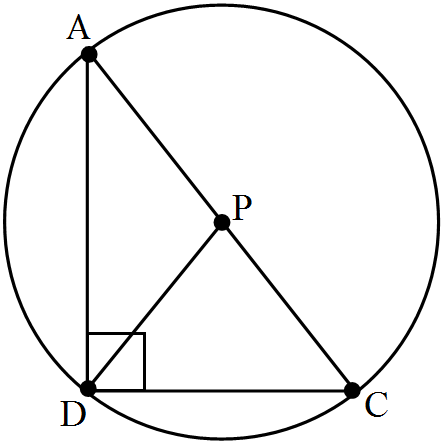
Prove that the line segment joining the mid-point of the hypotenuse of a right triangle to its opposite vertex is half of the hypotenuse.
Answer

Let $\triangle\text{ABC}$ be a right triangle right angled at B. Let P be the mid-point of hypotenuse AC.
Draw a circle with centre at P and AC as a diameter.
Since, $\angle\text{ABC}=90^\circ.$ Therefore, the circle passes through B.
$\therefore$ BP = Radius
Also, AP = CP = Radius
$\therefore$ AP = BP = CP
Hence, $\text{BP}=\frac{1}2{}\text{AC}$
View full question & answer
Question 234 Marks
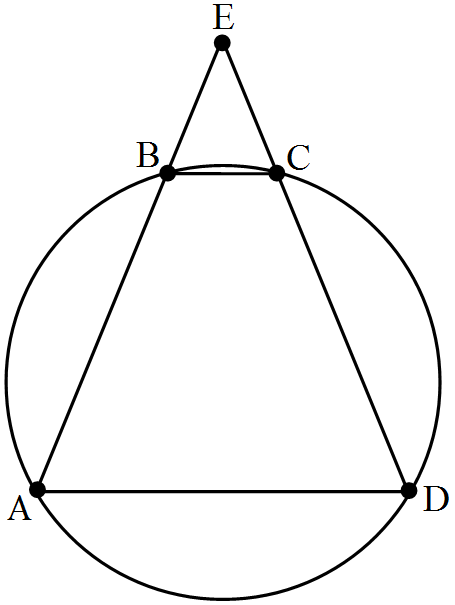
ABCD ia a cyclic quadrilateral in which BA and CD when produced meet in E and EA = ED. Prove that:
  1. AD || BC.
  2. EB = EC.
Answer

Given ABCD is a cyclic quadrilateral in which EA = ED

To prove:

  1. AD || BC.
  2. EB = EC.
Proof:

  1. Since EA = ED

Then, $\angle\text{EAD}=\angle\text{EDA}\dots(1)$ [Oppo. angles to equal sides]

Since, ABCD is a cyclic quadrilateral

Then, $\angle\text{ABC}+\angle\text{ADC}=180^\circ$

But $\angle\text{ABC}+\angle\text{EBC}=180^\circ$ [Linear pair of angles]

Then, $\angle\text{ADC}=\angle\text{EBC}\dots(2)$

Compare equations (1) and (2)

$\angle\text{EAD}=\angle\text{EBC}\dots(3)$

Since, corresponding angles are equal

Then, BC || AD

  1. From equation (3)

$\angle\text{EAD}=\angle\text{EBC}\dots(3)$

Similarly $\angle\text{EDA}=\angle\text{ECB}\dots(4)$

Compare equations (1)(3) and (4)

$\angle\text{EBC}=\angle\text{ECB}$

$\Rightarrow \text{EB}=\text{EC}$ [Opposite angles to equal sides]

View full question & answer
Question 244 Marks
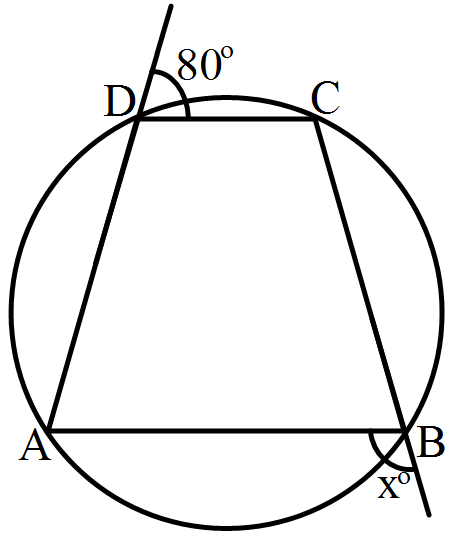
In the given figure, ABCD is a cyclic quadrilateral. Find the value of x.

Answer
$\angle\text{EDC}+\angle\text{CDA}=180^\circ$ [Linear pair of angles]
$\Rightarrow80^\circ+\angle\text{CDA}=180^\circ$
$\Rightarrow\angle\text{CDA}=180^\circ-80^\circ=100^\circ$
Since, ABCD is a cyclic quadrilateral.
$\angle\text{ADC}+\angle\text{ABC}=180^\circ$
$\Rightarrow100^\circ+\angle\text{ABC}=180^\circ$
$\Rightarrow\angle\text{ABC}=180^\circ-100^\circ=80^\circ$
Now, $\angle\text{ABC}+\angle\text{ABF}=180^\circ$ [Linear pair of angles]
$\Rightarrow80^\circ+\text{x}^\circ=180^\circ$
$\Rightarrow\text{x}=180^\circ-80^\circ=100^\circ$
View full question & answer
Question 254 Marks
In a cyclic quadrilateral ABCD if $\text{m}\angle\text{A}=\big(\text{m}\angle\text{C}\big).$ Find $\text{m}\angle\text{A}.$ 
Answer

We have, $\angle\text{A}=3\angle\text{C}$
Let $\angle\text{C}=\text{x}$
Then, $\angle\text{A}=\text{3x}$
$\therefore\angle\text{A}+\angle\text{C}=180^\circ$ [Opposite angles of cyclic quad.]
$\Rightarrow\text{3x}+\text{x}=180^\circ$
$\Rightarrow\text{4x}=180^\circ$
$\Rightarrow\text{x}=\frac{180^\circ}{4}=45^\circ$
$\therefore\angle\text{A}=\text{3x}$
$=3\times45^\circ$
$=135^\circ$
View full question & answer
Question 264 Marks
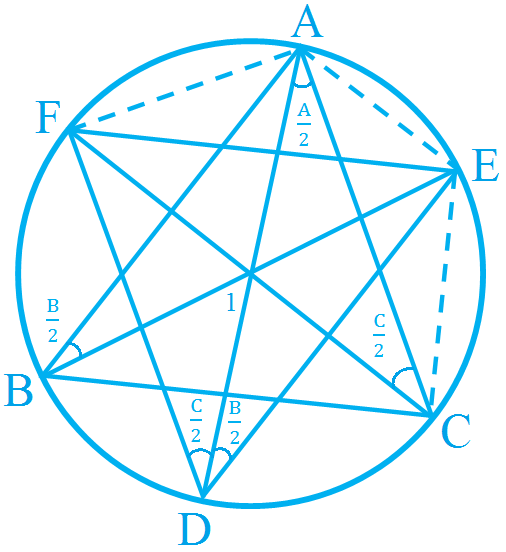
Bisectors of angles A, B and C of a triangle ABC intersect its circumcircle at D, E and F respectively. Prove that the angles of the triangle DEF are $90^\circ-\frac{1}{2}\text{A},90^\circ-\frac{1}{2}\text{B}$ and $90^\circ-\frac{1}{2}\text{C}.$
Answer

It is given that BE is the bisector of $\angle\text{B}.$

$\therefore\angle\text{ABE}=\frac{\angle\text{B}}{2}$

However, $\angle\text{ADE}=\angle\text{ABE}$ (Angles in the same segment for chord AE)

$\Rightarrow\angle\text{ADE}=\frac{\angle\text{B}}{2}$

Similarly, $\angle\text{ACF}=\angle\text{ADF}=\frac{\angle\text{C}}{2}$ (Angle in the same segment for chord AF)

$\angle\text{D}=\angle\text{ADE}+\angle\text{ADF}$

$=\frac{\angle\text{B}}{2}+\frac{\angle\text{C}}{2}$

$=\frac{1}{2}(\angle\text{B}+\angle\text{C})$

$=\frac{1}{2}(180^\circ-\angle\text{A})$

$=90^\circ-\frac{1}{2}\angle\text{A}$

Similarly, it can be proved that

$\angle\text{E}=90^\circ-\frac{1}{2}\angle\text{B}$

$\angle\text{F}=90^\circ-\frac{1}{2}\angle\text{C}$

View full question & answer
Question 274 Marks
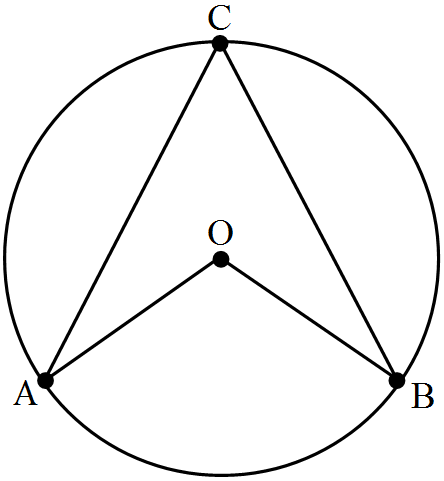
Prove that the angle in a segment greater than a semi-circle is less than a right angle.
Answer

Given: $\angle\text{ACB}$ is an angle in minor segment.

To prove: $\angle\text{ACB}<90^\circ$

Proof: By degree measure theorem

$\angle\text{AOB}=2\angle\text{ACB}$

And $\angle\text{AOB}<180^\circ$

Then, $2\angle\text{ACB}<180^\circ$

$\Rightarrow\angle\text{ACB}<\frac{180^\circ}{2}$

$\Rightarrow\angle\text{ACB}<90^\circ$

View full question & answer
Question 284 Marks
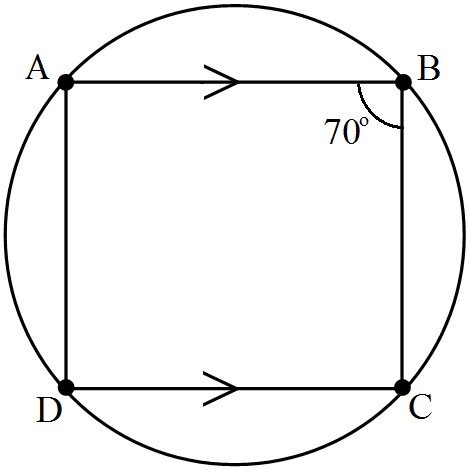
In a cyclic quadrilateral ABCD if AB || CD and $\angle\text{B}=70^\circ,$ find the remaining angles.
Answer

We have, $\angle\text{B}=70^\circ$

Since, ABCD is a cyclic quadrilateral

Then, $​​\angle\text{B}+\angle\text{D}=180^\circ$

$\Rightarrow70^\circ+\angle\text{D}=180^\circ$

$\Rightarrow\angle\text{D}=180^\circ-70^\circ=110^\circ$

Since, AB || DC

Then, $\angle\text{B}+\angle\text{C}=180^\circ$ [Co-interior angles]

$\Rightarrow70^\circ+\angle\text{C}=180^\circ$

$\Rightarrow\angle\text{C}=180^\circ-70^\circ=110^\circ$

Now, $\angle\text{A} +\angle\text{C}=180^\circ$ [Opposite angles of cyclic quad.]

$\Rightarrow\angle\text{A}+110^\circ=180^\circ$

$\Rightarrow\angle\text{A}=180^\circ-110^\circ=70^\circ$

View full question & answer
Question 294 Marks
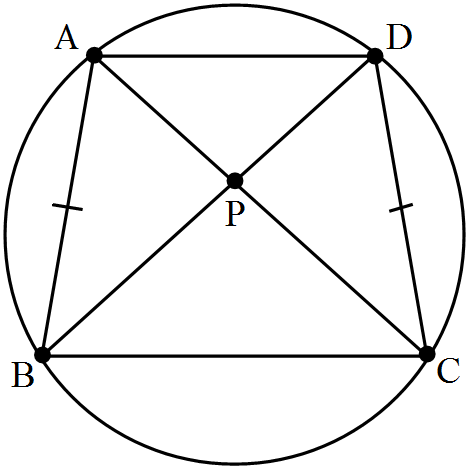
If the two sides of a pair of opposite sides of a cyclic quadrilateral ae equal, prove that its diagonals are equal.
Answer

Given ABCD is a cyclic quadrilateral in which AB = DC
To prove AC = BD
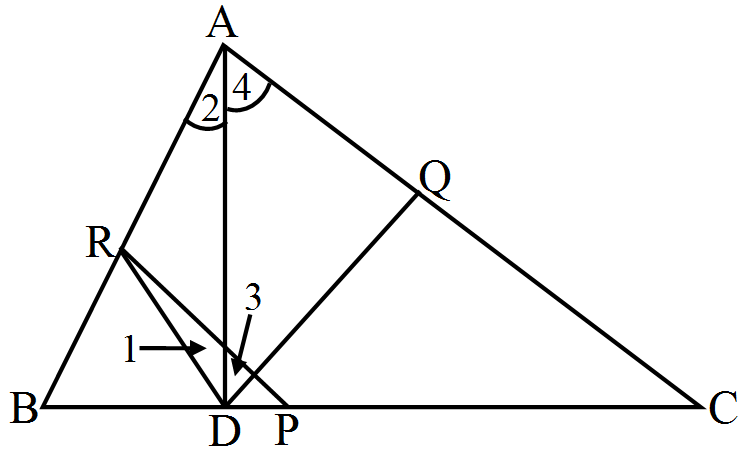
Proof In $\triangle\text{PAB}$ and $\triangle\text{PDC}$
$\text{AB}=\text{DC}$ [Given]
$\angle\text{BAP}=\angle\text{CDP}$ [Angles in the same segment]
$\angle\text{PBA}=\angle\text{PCD}$ [Angles in same segment]
Then, $\triangle\text{PAB}\cong\triangle\text{PDC}$ [By ASA condition]
$\therefore\text{PA}=\text{PD}\dots(1)$ [C.P.C.T.]
and $\text{PC}=\text{PB}\dots(2)$ [C.P.C.T.]
Add equation (1) and (2)
PA + PC = PD + PB
⇒ AC = BD
View full question & answer
Question 304 Marks
In figure, O is the centre of the circle. If $\angle\text{APB}=50^\circ,$ find $\angle\text{AOB}$ and $\angle\text{OAB}.$
Answer
$\angle\text{APB}=50^\circ$

By degree measure theorem

$\angle\text{AOB}=2\angle\text{APB}$

$\Rightarrow\angle\text{APB}=2\times50^\circ=100^\circ$ since OA = OB [Radius of circle]

Then $\angle\text{OAB}=\angle\text{OBA}$ [Angles opposite toequalsides]

Let $\angle\text{OAB}=\text{x}$

In $\triangle\text{OAB},$ by angle sum property

$\angle\text{OAB}+\angle\text{OBA}+\angle\text{AOB}=180^\circ$

$\Rightarrow\text{x}+\text{x}+100^\circ=180^\circ$

$\Rightarrow\text{2x}=180^\circ-100^\circ$

$\Rightarrow\text{2x}=80^\circ$

$\Rightarrow\text{x}=40^\circ$

$\angle\text{OAB}=\angle\text{OBA}=40^\circ$

View full question & answer
Question 314 Marks
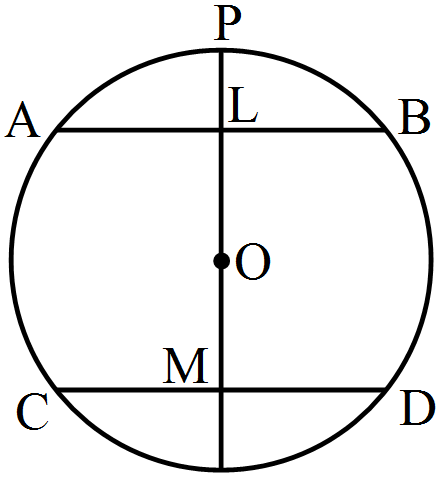
If a diameter of a circle bisects each of the two chords of a circle then prove that the chords are parallel.
Answer
Given: AB and CD are two chords of a circle with centre O. Diameter POQ bisects them at points L and M.
To prove: AB || CD
ProofAB and CD are two chords of a circle with centre O. Diameter POQ bisects them at L and M.

Then $\text{OL}\perp\text{AB}$
Also, $\text{OM}\perp\text{CD}$
$\therefore\ \angle\text{ALM}=\angle\text{LMD}=90^\circ$
Since alternate angles are equal, we have:
AB || CD
View full question & answer
Question 324 Marks
Three girls Reshma, Salma and Mandip are playing a game by standing on a circle of radius 5m drawn in a park. Reshma throws a ball to Salma, Salma to Mandip, Mandip to Reshma. If the distance between Reshma and Salma and between Salma and Mandip is 6m each, what is the distance between Reshma and Mandip?
Answer
Draw perpendiculars OA and OB on RS and SM respectively.

OR = OS = OM = 5m. (Radii of the circle)

In $\triangle\text{OAR},$

OA2 + AR2 = OR2

OA2 + (3m)2 = (5m)2

OA2 = (25 − 9)m2 = 16m2

OA = 4m

ORSM will be a kite (OR = OM and RS = SM). We know that the diagonals of a kite are perpendicular and the diagonal common to both the isosceles triangles is bisected by another diagonal.

$\therefore\angle\text{RCS}$ will be of 90° and RC = CM

$\text{Area of }\triangle\text{ORS}=\frac{1}{2}\times\text{OA}\times\text{RS}$

$\frac{1}{2}\times\text{RS}\times\text{OS}=\frac{1}{2}\times4\times6$

$\text{RS}\times5=24$

$\text{RC}=4.8$

$\text{RM}=2\text{RC}=2(4.8)=9.6$

Therefore, the distance between Reshma and Mandip is 9.6m.

View full question & answer
Question 334 Marks
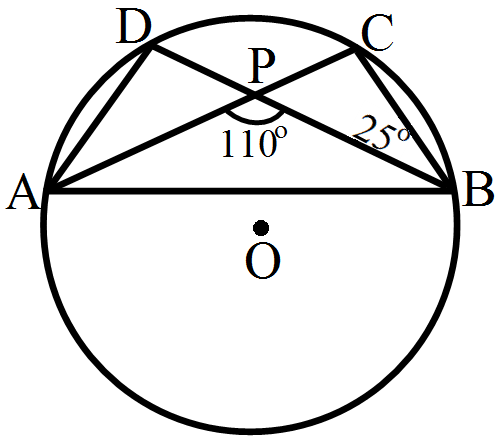
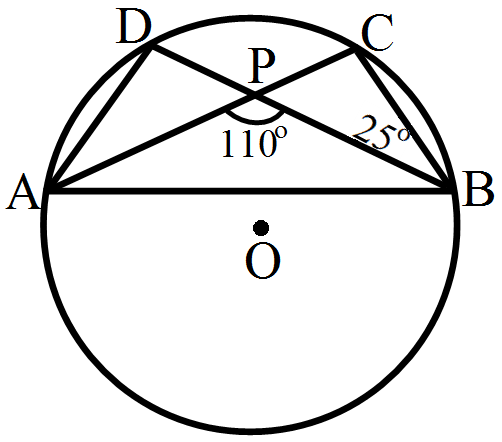
In the given figure, O is the centre of the circle. if $\angle\text{PBC}=25^\circ$ and $\angle\text{APB}=110^\circ,$find the value of $\angle\text{ADB}.$

Answer
From the given diagram, we have:

$\angle\text{ACB}=\angle\text{PCB}$
$\angle\text{BPC}=(180^\circ-110^\circ)=70^\circ$ [Linear pair]
Considering $\triangle\text{PCB},$ we have:
$\angle\text{PCB}+\angle\text{BPC}+\angle\text{PBC}=180^\circ$ [Angle sum property]
$\Rightarrow\ \angle\text{PCB}+70^\circ+25^\circ=180^\circ$
$\Rightarrow\ \angle\text{PCB}=(180^\circ-95^\circ)=85^\circ$
$\Rightarrow\ \angle\text{ACB}=\angle\text{PCB}=85^\circ$
We know that the angles in the same segment of a circle are equal.
$\therefore\ \angle\text{ADB}=\angle\text{ACB}=85^\circ$
View full question & answer
Question 344 Marks
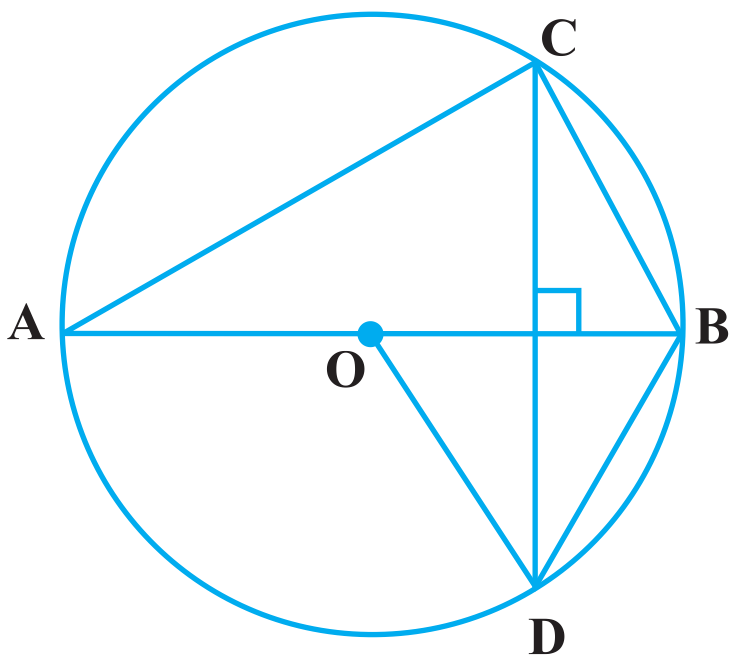
In Fig. O is the centre of the circle, BD = OD and $\text{CD}\bot\text{AB}.$ Find $\angle\text{CAB}.$

Answer
Given, in the figure $\text{BD}=\text{OD},\ \text{CD}\bot\text{AB}$

In $\triangle\text{OBD},\ \ \ \text{BD}=\text{OD}$ [given]
$\text{OD}=\text{OB}$ [both are the radius of circle]
$\therefore\text{OB}=\text{OD}=\text{BD}$
Thus, $\triangle\text{ODB}$ is an equilateral triangle.
$\therefore\angle\text{BOD}=\angle\text{OBD}=\angle\text{ODB}=60^\circ$
In $\triangle\text{MBC}$ and $\triangle\text{MBD},\ \ \text{MB}=\text{MB}$ [common side]
$\angle\text{CMB}=\angle\text{BMD}=90^\circ$
and CM = MD [in a circle, any perpendicular draw on a chord also bisects the chord]
$\therefore\triangle\text{MBC}=\triangle\text{MBD}$ [by SAS congruence rile]
$\therefore\angle\text{MBC}=\angle\text{MBD}$ [by CPCT]
$\Rightarrow\angle\text{MBC}=\angle\text{OBD}=60^\circ\ \ \ [\because\angle\text{OBD}=60^\circ]$
Since, AB is a diameter of the circle,
$\therefore\angle\text{ACB}=90^\circ$
In $\triangle\text{ACB},\ \ \ \angle\text{CAB}+\angle\text{CBA}+\angle\text{ACB}=180^\circ$ [by angle sum property of triangle]
$\Rightarrow\angle\text{CAB}+60^\circ+90^\circ=180^\circ$
$\Rightarrow\angle\text{CAB}=180^\circ-(60^\circ+90^\circ)=30^\circ$
View full question & answer
Question 354 Marks
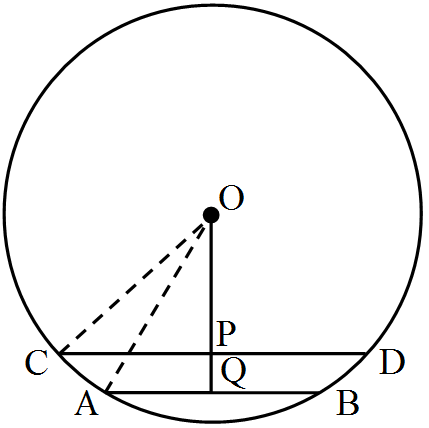
Two chords AB, CD of lengths 5cm, 11cm respectively of a circle are parallel. If the distance between AB and CD is 3cm, find the radius of the circle.
Answer
Let AB and CD be two parallel chord of the circle with center o such that AB = 5cm and CD = 11cm.let the radius of the circle be r cm.

Draw $\text{OP}\perp\text{AB}$ and $\text{OQ}\perp\text{CD}$ as well as point O, Q and P are collinear.
Clearly, PQ = 3cm
Let OQ = x then OP = x + 3
In $\triangle\text{OAP}$ and $\triangle\text{OCQ}$ we have
$\text{OA}^2=\text{OP}^2+\text{AP}^2$
$\Rightarrow\text{r}^2=(\text{x}+3)^2+\Big(\frac{5}{2}\Big)^2\dots(1)$
And
$\text{OC}^2=\text{OQ}^2+\text{CQ}^2$
$\Rightarrow\text{r}^2=\text{x}^2+\Big(\frac{11}{2}\Big)^2\dots(2)$
From (1) and (2) we get
$(\text{x}+3)^2+\Big(\frac{5}{2}\Big)^2=\text{x}^2+\Big(\frac{11}{2}\Big)^2$
$\Rightarrow\text{x}^2+\text{6x}+9+\frac{25}{4}=\text{x}^2+\frac{121}{4}$
$\Rightarrow\text{6x}+\frac{61}{4}=\frac{121}{4}$
$\Rightarrow\text{6x}=\frac{121-61}{4}$
$\Rightarrow\text{6x}=\frac{60}{4}$
$\Rightarrow\text{x}=\frac{5}{2}$
Putting the value of x in (2) we get,
$\text{r}^2=\Big(\frac{5}{2}\Big)^2+\Big(\frac{11}{2}\Big)^2$
$=\frac{25}{4}+\frac{121}{4}$
$=\frac{146}{4}$
$\Rightarrow\text{r}=\sqrt{\frac{146}{4}}$
$\text{r}=\sqrt{\frac{146}{4}}\text{cm}$
View full question & answer
Question 364 Marks
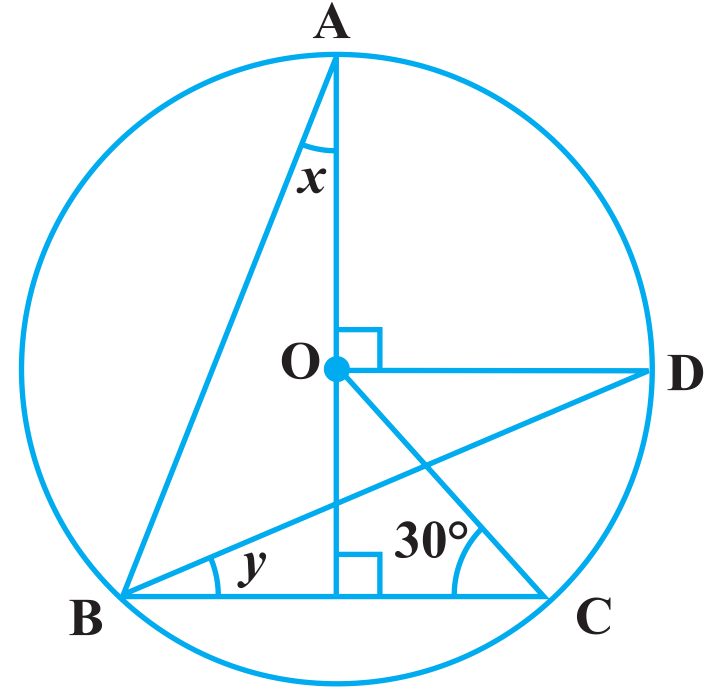
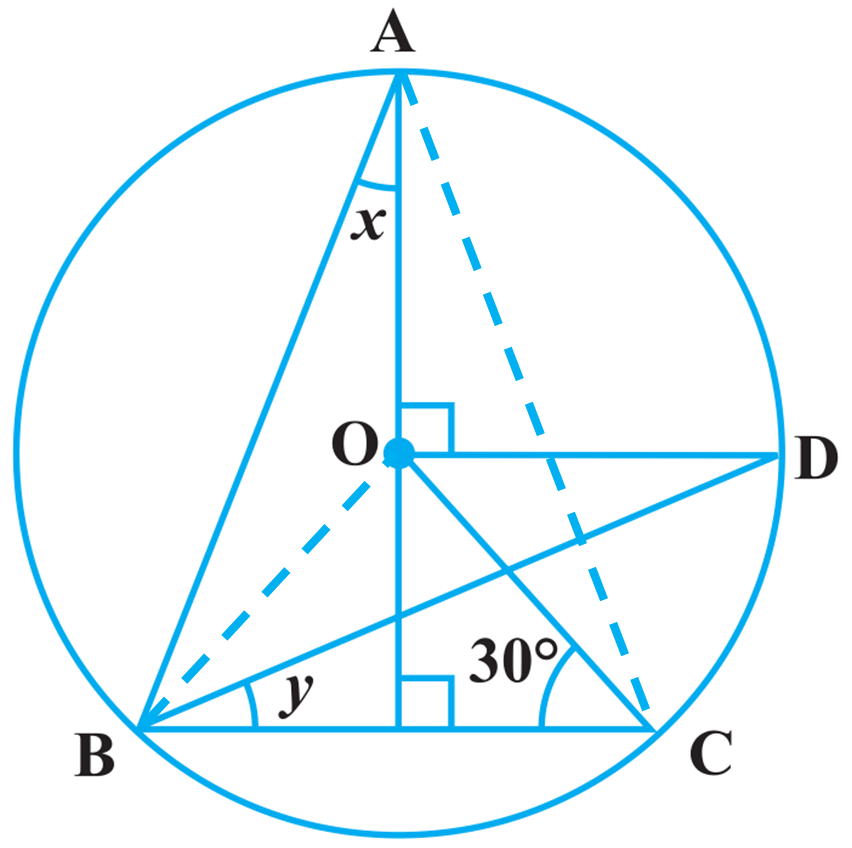
In Fig. O is the centre of the circle, $\angle\text{BCO}=30^\circ.$ Find x and y.

Answer
Given, Ois the centre of the circle and $\angle\text{BCO}=30^\circ.$ In the given figure join OB and AC.

In $\triangle\text{BOC},\ \ \ \text{CO}=\text{BO}$ [both are the radius of circle]
$\therefore\angle\text{OBC}=\angle\text{OCB}=30^\circ$ [angles opposite to equal sides are equal]
$\therefore\angle\text{BOC}=180^\circ-(\angle\text{OBC}+\angle\text{OCE})$ [by angle sum property of a triangle]
$=180^\circ-(30^\circ+30^\circ)=120^\circ$
$\angle\text{BOC}=2\angle\text{BAC}$
We know that, in a circle, the angle subtended by an arc at the centre is twice the angle subtended by it at the remaining part of the circle.
$\therefore\angle\text{BAC}=\frac{120^\circ}{2}=60^\circ$
Also, $\angle\text{BAE}=\angle\text{CAE}=30^\circ$ [AE is an angle bisector of angle A]
$\Rightarrow\angle\text{BAE}=\text{x}=30^\circ$
In $\triangle\text{ABE},\ \ \ \angle\text{BAE}+\angle\text{EBA}+\angle\text{AEB}=180^\circ$ [by angle sum property of triangle]
$\Rightarrow30^\circ+\angle\text{EBA}+90^\circ=180^\circ$
$\therefore\angle\text{EBA}=180^\circ-(90^\circ+30^\circ)=180^\circ-120^\circ=60^\circ$
Now, $\angle\text{EBA}=60^\circ$
$\Rightarrow\angle\text{ABD}+\text{y}=60^\circ$
$\Rightarrow\frac{1}{2}\times\angle\text{AOD}+\text{y}=60^\circ$
[in a circle, the angle subtended by an arc at the centre is twice the angle subtended by it at the remaining part of the circle]
$\Rightarrow\frac{90^\circ}{2}+\text{y}=60^\circ$ $[\because\angle\text{AOD}=90^\circ,\text{ given}]$
$\Rightarrow45^\circ+\text{y}=60^\circ$
$\Rightarrow\text{y}=60^\circ-45^\circ$
$\therefore\text{y}=15^\circ$
View full question & answer
Question 374 Marks
Prove that a cyclic parallelogram is a rectangle.
Answer
Given,

ABCD is a cyclic parallelogram.

To prove,

ABCD is rectangle.

Proof:

$\angle1+\angle2=180^\circ$ (Opposite angles of a cyclic parallelogram)

also, Opposite angles of a cyclic parallelogram are equal.

Thus,

$\angle1=\angle2$

$\Rightarrow\angle1+\angle1=180^\circ$

$\Rightarrow\angle1=90^\circ$

One of the interior angle of the parallelogram is right angled. Thus, ABCD is a rectangle.
View full question & answer
Question 384 Marks
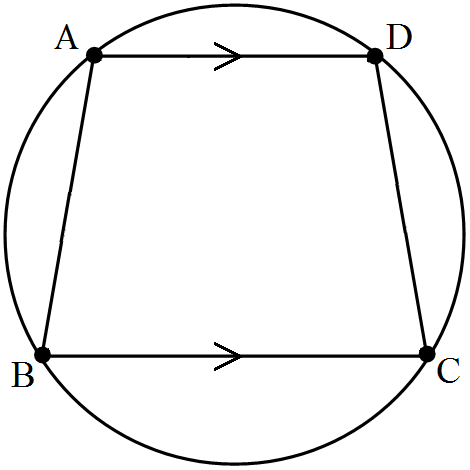
ABCD is a cyclic trapezium with AD || BC. If $\angle\text{B}=70^\circ,$determine other three angles of the trapezium.
Answer

We have 
ABCD is a cyclic trapezium with AD || BC and $\angle\text{B}=70^\circ.$
Since, ABCD is a cyclic quadrilateral
Then, $\angle\text{B}+\angle\text{D}=180^\circ$
$\Rightarrow70^\circ+\angle\text{D}=180^\circ$
$\Rightarrow\angle\text{D}=180^\circ-70^\circ=110^\circ$
Since, AD || BC
Then, $\angle\text{A}+\angle\text{B}=180^\circ$ [Co-interior angles]
$\Rightarrow\angle\text{A}+70^\circ=180^\circ$
$\Rightarrow\angle\text{A}=180^\circ-70^\circ=110^\circ$
Since, ABCD is a cyclic quadrilateral
Then, $\angle\text{A}+\angle\text{C}=180^\circ$
$\Rightarrow110^\circ+\angle\text{C}=180^\circ$
View full question & answer
Question 394 Marks
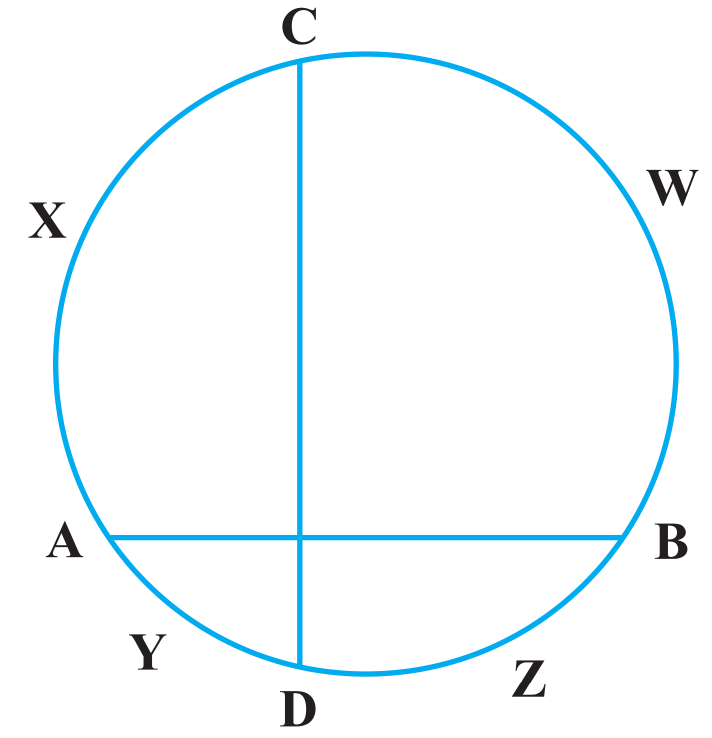
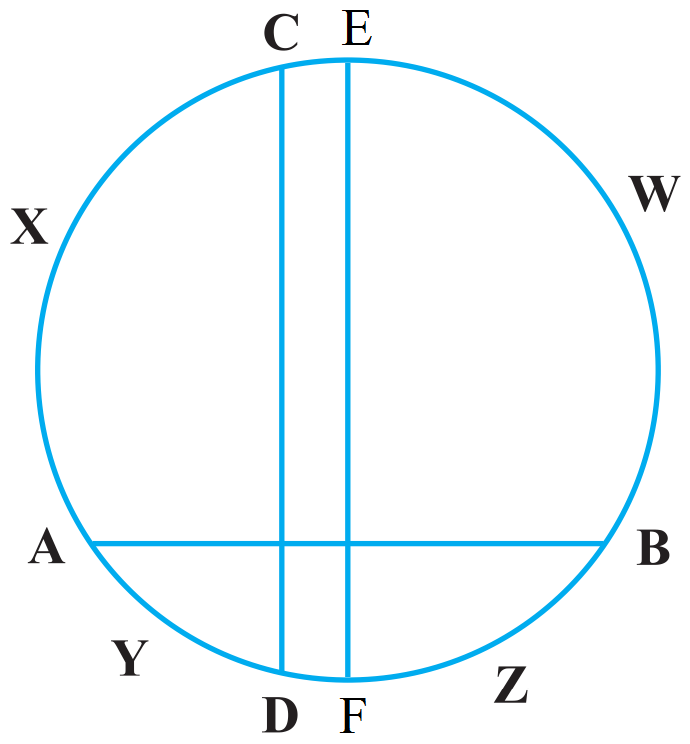
If two chords AB and CD of a circle AYDZBWCX intersect at right angles (see Fig.), prove that arc CXA + arc DZB = arc AYD + arc BWC = semi-circle.

Answer
Given: In a circle AYDZBWCX, two chords AB and CD intersect at right angles.
To prove: arc CXA + arc DZB = arc AYD + arc BWC = Semi-circle
Construction: Draw a diameter EF parallel to CD having centre M.
Proof: Since, CD || EF
arc EC = arc PD …(i)
arc ECXA = arc EWB [symmetrical about diameter of a circle] arc AF = arc BF …(ii)
We know that, arc ECXAYDF = semi-circle

arc EA + arc AF = semi-circle
⇒ arc EC + arc CXA + arc FB = semi-circle [from Eq. (ii)]
⇒ arc DF + arc CXA + arc FB = semi-circle [from Eq. (i)]
⇒ arc DF + arc FB + arc CXA = semi-circle
⇒ arc DZB + arc C × A = semi-circle
We know that, circle divides itself in two semi-circles, therefore the remaining portion of the circle is also equal to the semi-circle.
$\therefore$ arc AYD + arc BEC = semi-ciecle
Hence proved.
View full question & answer
Question 404 Marks
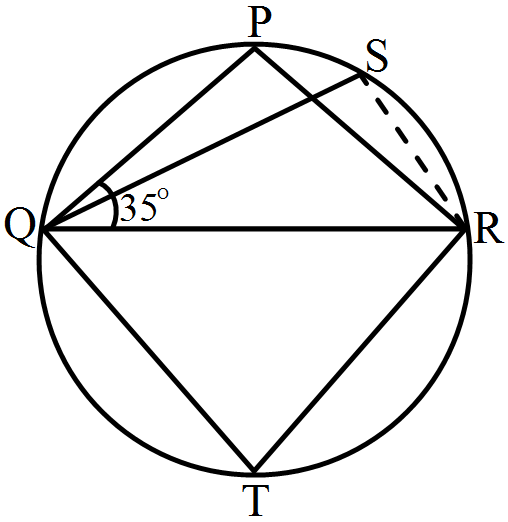
In the given figure, $\triangle\text{PQR}$ is an isosceles triangle with PQ = PR and $\text{m}\angle\text{PQR}=35^\circ.$ Find $\text{m}\angle\text{QSR}$ and $\text{m}\angle\text{QTR}.$

Answer
We have, $\angle\text{PQR}=35^\circ$
Since, $\triangle\text{PQR}$ is an isosceles triangle with PQ = PR.
Then, $\angle\text{PQR}=\angle\text{PRQ}=35^\circ$
In $\triangle\text{PQR},$ by angle sum property
$\angle\text{p}+\angle\text{PQR}+\angle\text{PRQ}=180^\circ$
$\Rightarrow\angle\text{p}+35^\circ+35^\circ=180^\circ$
$\Rightarrow\angle\text{p}=180^\circ-35^\circ-35^\circ=110^\circ$
$\therefore\angle\text{QSR}=\angle\text{p}=110^\circ$ [Angles in same segment]
Now, $\angle\text{QSR}+\angle\text{QTR}=180^\circ$ [Opposite angles of cyclic quad.]
$\Rightarrow110^\circ+\angle\text{QTR}=180^\circ$
$\Rightarrow\angle\text{QTR}=180^\circ-110^\circ=70^\circ$
View full question & answer
Question 414 Marks
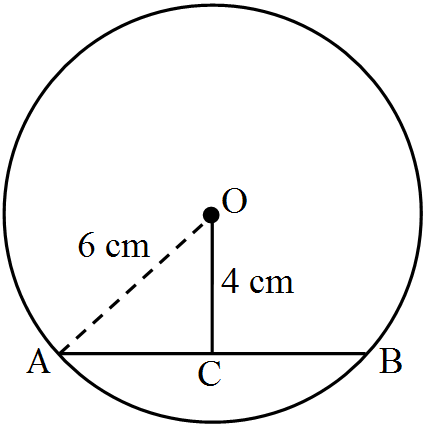
Find the length of a chord which is at a distance of 4cm from the centre of a circle of radius 6cm.
Answer
Given that,

Distance (OC) = 4cm

Radius of the circle (OA) = 6cm

In $\triangle\text{OCA,}$ by Pythagoras theorem

AC+ OC= OA2

⇒ AC2 +  42 = 62

⇒ AC2 =  36 - 16

⇒ AC2 = 20

$\Rightarrow\text{AC}=\sqrt{20}$

⇒ AC = 4.47cm

We know that the perpendicular distance from centre to chord bisects the chord.

AC = BC = 4.47cm

Then AB = 4.47 + 4.47

= 8.94cm

View full question & answer
Question 424 Marks
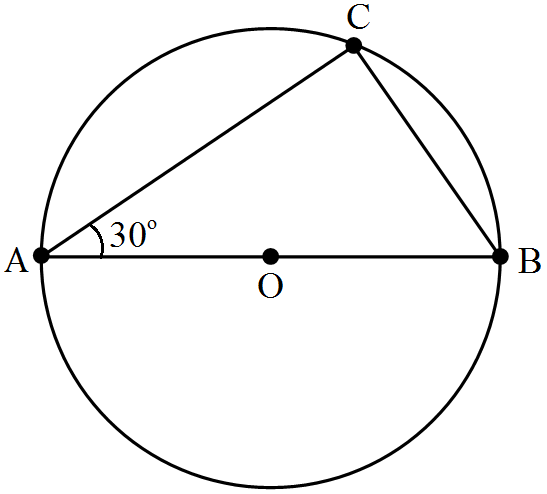
On a semi-circle with AB as diameter, a point C is taken, so that $\text{m}\big(\angle\text{CAB}\big)=30^\circ.$ Find $\text{m}\big(\angle\text{ACB}\big)$ and $\text{m}\big(\angle\text{ABC}\big).$
Answer

We have, $\angle\text{CAB}=30^\circ$
$\therefore\angle\text{ACB}=90^\circ$ [Angle in semicircle]
In $\triangle\text{ABC},$ by angle sum property
$\angle\text{CAB}+\angle\text{ACB}+\angle\text{ABC}=180^\circ$
$\Rightarrow30^\circ+90^\circ+\angle\text{ABC}=180^\circ$
$\Rightarrow\angle\text{ABC}=180^\circ-90^\circ-30^\circ=60^\circ$
View full question & answer
Question 434 Marks
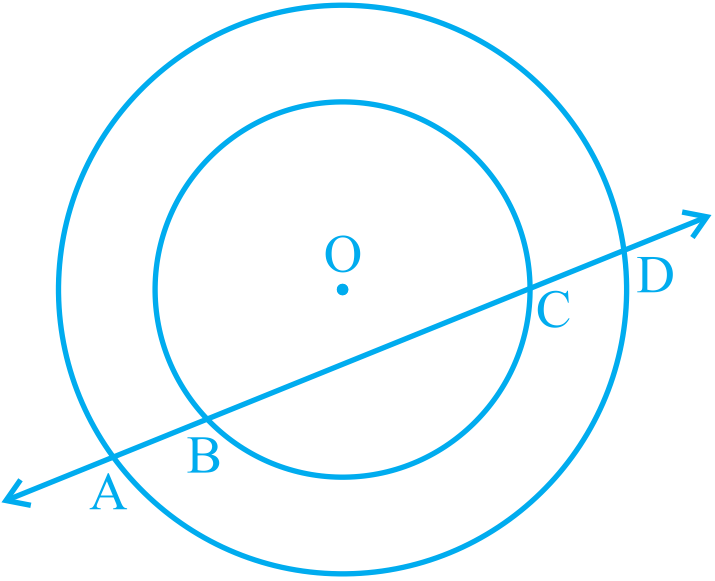
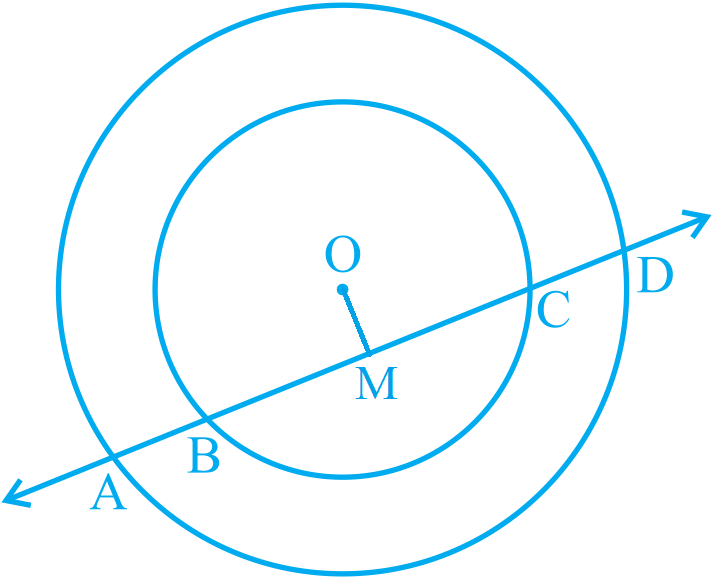
If a line intersects two concentric circles (circles with the same centre) with centre O at A, B, C and D, prove that AB = CD

Answer
Let us draw a perpendicular OM on line AD.

It can be observed that BC is the chord of the smaller circle and AD is the chord of the bigger circle.

We know that perpendicular drawn from the centre of the circle bisects the chord.

$\therefore$ BM = MC ...(1)

And, AM = MD ...(2)

On subtracting equation (2) from (1), we obtain

AM − BM = MD − MC

⇒ AB = CD

View full question & answer
Question 444 Marks
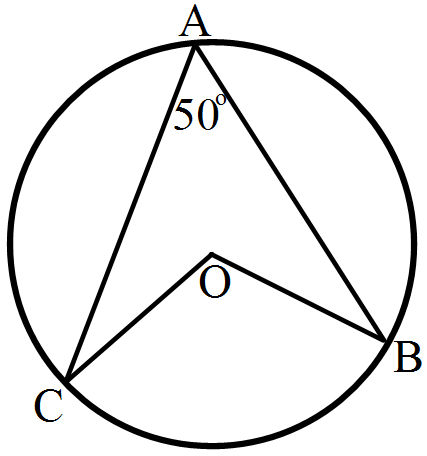
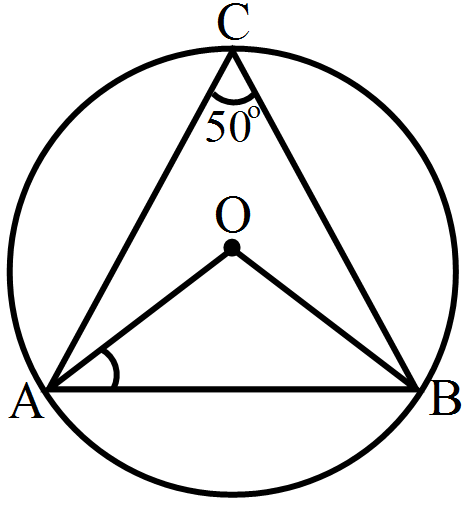
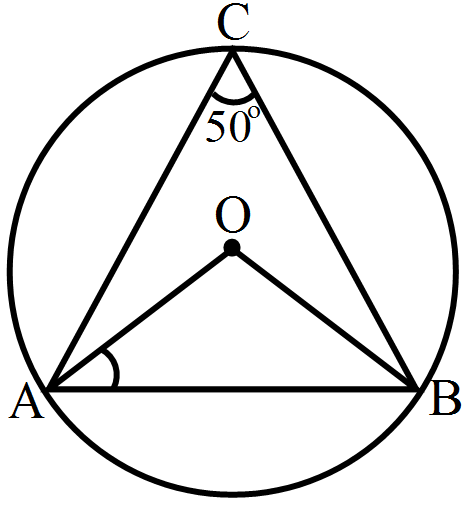
In the given figure, O is the centre of the circle. If $\angle\text{ACB}=50^\circ,$ find $\angle\text{OAB}.$

Answer
We know that the angle subtended by an arc of a circle at the centre is double the angle subtended by the arc at any point on the circumference.
$\angle\text{AOB}=2\angle\text{ACB}$
$=2\times50^\circ$ [Given]
$\angle\text{AOB}=100^\circ\dots(\text{i})$
Let us consider the triangle $\triangle\text{OAB}.$
$\text{OA}=\text{OB}$ (Radii of a circle)
Thus, $\angle\text{OAB}=\angle\text{OBA}$
In $\triangle\text{OAB},$ we have:
$\angle\text{AOB}+\angle\text{OAB}+\angle\text{OBA}=180^\circ$
$\Rightarrow\ 100^\circ+\angle\text{OAB}+\angle\text{OBA}=180^\circ$
$\Rightarrow\ 100^\circ+2\angle\text{OAB}=180^\circ$
$\Rightarrow\ 2\angle\text{OAB}=180^\circ-100^\circ=80^\circ$
$\Rightarrow\ \angle\text{OAB}=40^\circ$
Hence, $\angle\text{OAB}=40^\circ$
View full question & answer
Question 454 Marks
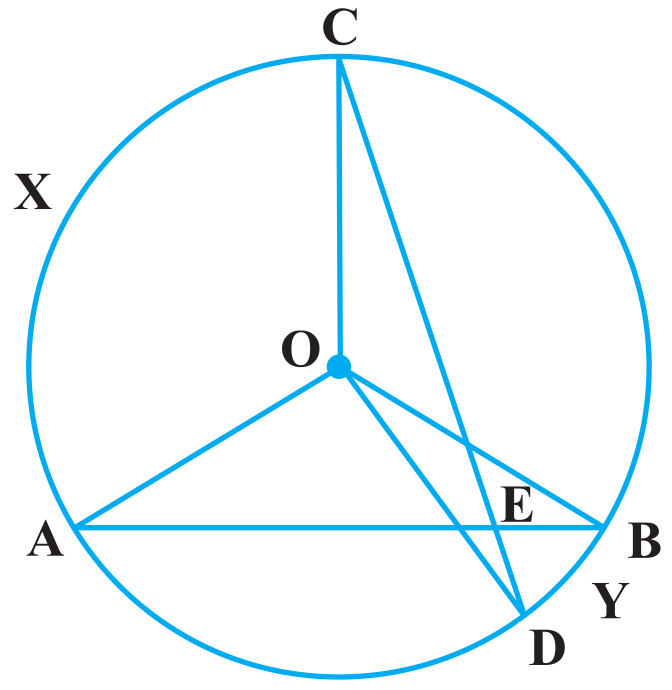
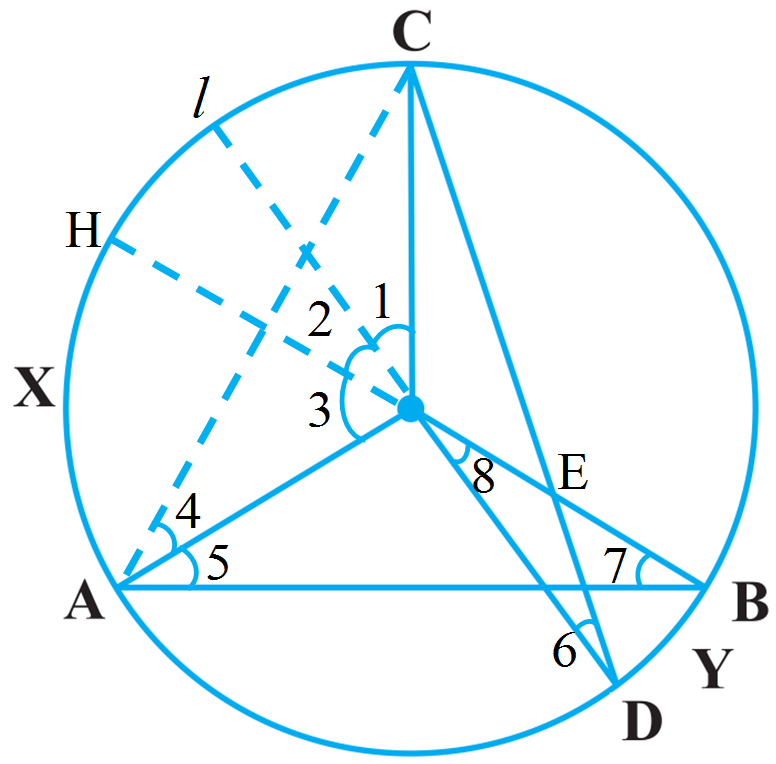
In Fig. AB and CD are two chords of a circle intersecting each other at point E. Prove that $\angle\text{AEC}=\frac{1}{2}$ (Angle subtended by arc CXA at centre + angle subtended by arc DYB at the centre).

Answer
Given: In a figure, two chords AB and CD intersecting each other at point E.
To prove: $\angle\text{AEC}=\frac{1}{2}$ [angle subtended by arc C × A at centre + angle subtended by arc DYB at the centre]

Construction: Extend the line DO and BO at the points l and H on the circle. Also, join AC.
Proof: We know that, in a circle, the angle subtended by an arc at the centre is twice the angle subtended by it at the remaining part of the circle.
$\therefore\angle1=2\angle6\ \ ...(\text{i})$
and $\angle3=2\angle7\ \ ...(\text{ii)}$
In $\triangle\text{AOC},\ \ \text{OC}=\text{OA}$ [both are the radius of circle]
$\angle\text{OCA}=\angle4$ [angles opposite to equal sides are equal]
Also, $\angle\text{AOC}+\angle\text{OCA}+\angle4=180^\circ$ [by angle sum property of triangle]
$\Rightarrow\angle\text{AOC}+\angle4+\angle4=180^\circ$
$\Rightarrow\angle\text{AOC}=180^\circ-2\angle4\ \ \ ...(\text{iii})$
Now, in $\triangle\text{AEC},\ \ \ \angle\text{AEC}+\angle\text{ECA}+\angle\text{CAE}=180^\circ$ [by angle property sum of a triangle]
$\Rightarrow\angle\text{AEC}=180^\circ-(\angle\text{ECA}+\angle\text{CAE})$
$\Rightarrow\angle\text{AEC}=180^\circ-[(\angle\text{ECO}+\angle\text{OCA})+\angle\text{CAO}+\angle\text{OAE}]$
$=180^\circ-(\angle6+\angle4+\angle4+\angle5)$ $\big[$In $\triangle\text{OCD},\angle6=\angle\text{ECO}$ angles opposite to equal sides are equal$\big]$
$=180^\circ-(2\angle4+\angle5+\angle6)$
$=180^\circ-(180^\circ-\angle\text{AOC}+\angle7+\angle6)$
[From Eq. (iii) and in $\triangle\text{AOB}.\angle5=\angle7,$ as (angles opposite to equal sides are equal)]
$=\angle\text{AOC}-\frac{\angle3}{2}-\frac{\angle1}{2}$ [from Eqs. (i) and (ii)]
$=\angle\text{AOC}-\frac{\angle1}{2}-\frac{\angle2}{2}-\frac{\angle3}{2}+\frac{\angle2}{2}$ [adding and subtracting $\frac{\angle2}{2}$]
$=\angle\text{AOC}-\frac{1}{2}(\angle1+\angle2+\angle3)+\frac{\angle8}{2}$ [$\because\angle2=\angle8$ (vertically opposite angles)]
$=\angle\text{AOC}=\frac{\angle\text{AOC}}{2}+\frac{\angle\text{DOB}}{2}$
$\Rightarrow\angle\text{AEC}=\frac{1}{2}(\angle\text{AOC}+\angle\text{DOB})$
$=\frac{1}{2}$ [angle subtended by arc CXA at the centre + angle subtended by arc DYB at the centre]
View full question & answer
Question 464 Marks
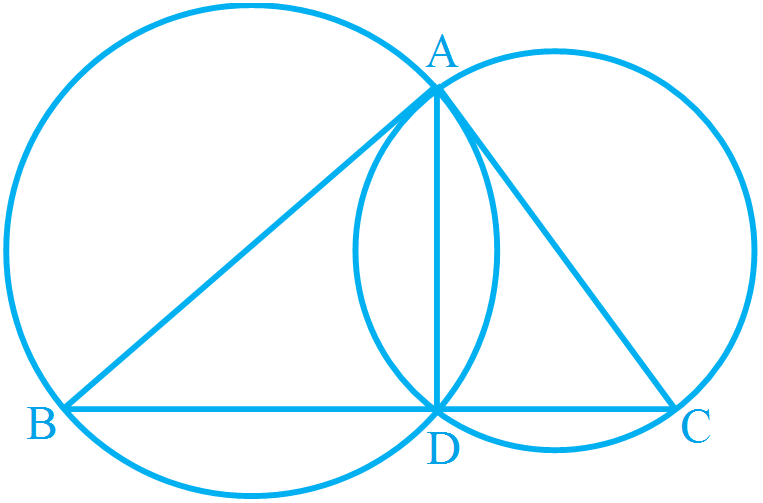
If circles are drawn taking two sides of a triangle as diameters, prove that the point of intersection of these circles lie on the third side.
Answer
Given,

Two circles are drawn on the sides AB and AC of the triangle ΔABC as diameters. The circles intersected at D.

Construction,

AD is joined.

To prove,

D lies on BC. We have to prove that BDC is a straight line.

Proof:

$\angle\text{ADB}=\angle\text{ADC}=90^\circ$ (Angle in the semi circle)

Now,

$\angle\text{ADB}+\angle\text{ADC}=180^\circ$

$\Rightarrow\angle\text{BCD}$ 

is straight line.

Thus, D lies on the BC.

View full question & answer
Question 474 Marks
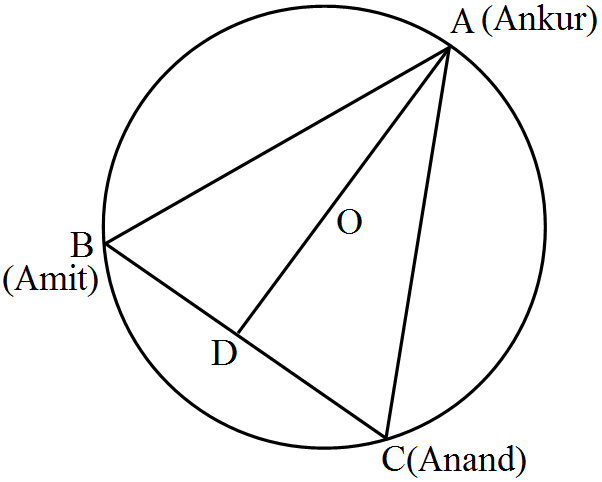
A circular park of radius 40m is situated in a colony. Three boys Ankur, Amit and Anand are sitting at equal distance on its boundary each having a toy telephone in his hands to talk to each other. Find the length of the string of each phone.
Answer
Given that AB = BC = CA

So, ABC is an equilateral triangle

OA (radius) = 40m

Medians of equilateral triangle pass through the circum centre (O) of the equilateral triangle ABC.

We also know that median intersect each other at the ratio 2 : 1

As AD is the median of equilateral triangle ABC, we can write:
$\frac{\text{OA}}{\text{OD}}=\frac{2}{1}$

$\Rightarrow\frac{\text{4OM}}{\text{OD}}=\frac{2}{1}$

$\Rightarrow\text{OD}=20\text{m}$

Therefore, AD = OA + OD = (40 + 20)m

= 60m

In $\triangle\text{ADC}$

By using Pythagoras theorem

$\text{AC}^2 = \text{AD}^2 + \text{DC}^2$

$\text{AC}^2=60^2+\big(\text{AC}^2\big)^2$

$\text{AC}^2=3600+\frac{\text{AC}^2}{4}$

$\Rightarrow\frac{3}{4}\text{AC}^2=3600$

$\Rightarrow\text{AC}^2=4800$

$\Rightarrow\text{AC}=40\sqrt{3}\text{m}$

So, length of string of each phone will be $40\sqrt{3}\text{m}.$

View full question & answer
Question 484 Marks
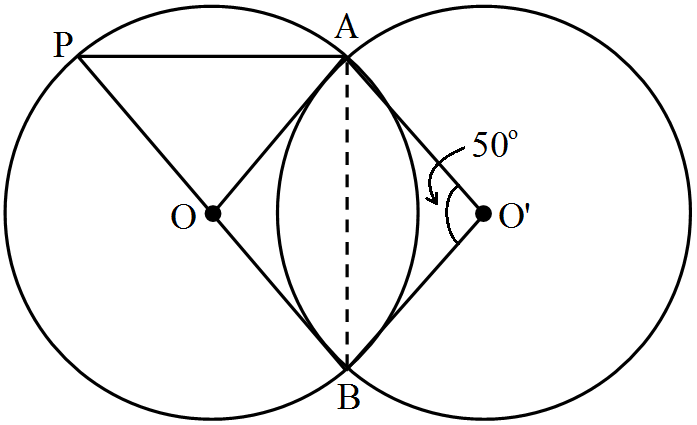
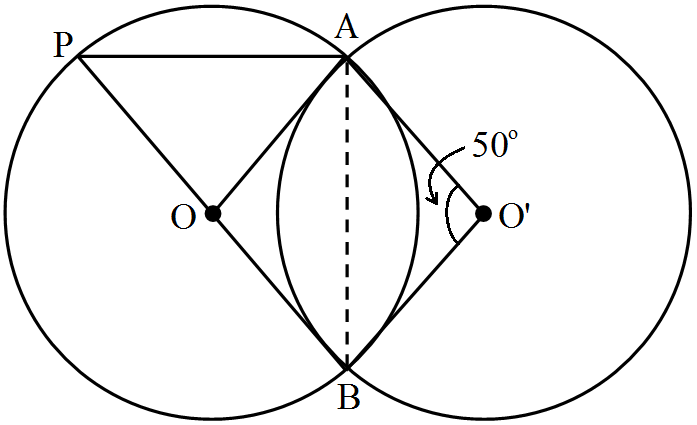
In the given figure, two congruent circles with centres O and O' intersect at A and B. If $\angle\text{AOB} = 50^\circ,$ then find $\angle\text{APB.}$

Answer
Since both the circles are congruent, they will have equal radii. Let their radii be ‘r’
So, from the given figure we have,
OA = OB = O'A = O'B = r

Now, since all the sides of the quadrilateral OBO’A are equal it has to be a rhombus.
One of the properties of a rhombus is that the opposite angles are equal to each other.
So, since it is given that $\angle\text{AO}'\text{B}=50^\circ$ we can say that the angle opposite it, that is to say that $\angle\text{AO}\text{B}$ should also have the same value.
Hence we get $\angle\text{AO}\text{B}=50^\circ$
Now, consider the first circle with the centre ‘O’ alone. ‘AB’ forms a chord and it subtends an angle of 50° with its centre, that is $\angle\text{AO}\text{B}=50^\circ.$
A property of a circle is that the angle subtended by an arc at the centre of the circle is double the angle subtended by the arc in the remaining part of the circle.
This means that,
$\angle\text{APB}=\frac{\angle\text{AOB}}{2}$
$=\frac{50^\circ}{2}$
$=25^\circ$
Hence the measure of $\angle\text{APB}$ is 25°.
View full question & answer
Question 494 Marks
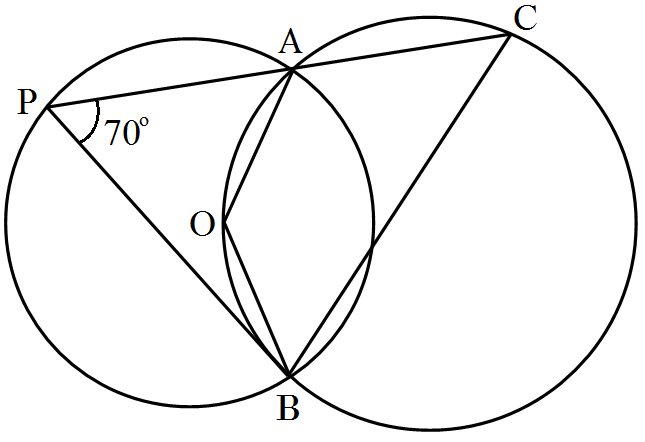
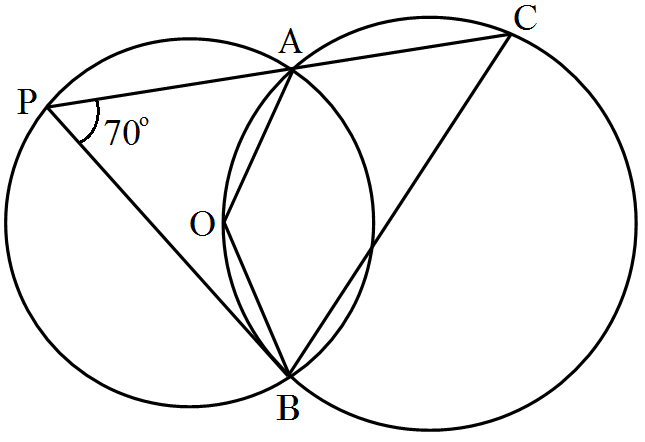
In the given figure, two circles intersect at A and B. The centre of the smaller circle is O and it lies on the circumference of the larger circle. If $\angle\text{APB} = 70^\circ,$ find $\angle\text{ACB.}$

Answer
Consider the smaller circle whose centre is given as ‘O’.
The angle subtended by an arc at the centre of the circle is double the angle subtended by the arc in the remaining part of the circle.

So, here we have
$\angle\text{AOB}=2\angle\text{APB}$
$=2(70^\circ)$
$\angle\text{AOB}=140^\circ$
Now consider the larger circle and the points ‘A’, ‘C’, ‘B’ and ‘O’ along its circumference. ‘ACBO’ form a cyclic quadrilateral.
In a cyclic quadrilateral it is known that the opposite angles are supplementary, meaning that the opposite angles add up to 180°.
$\angle\text{AOB}+\angle\text{ACB}=180^\circ$
$\angle\text{ACB}=180^\circ-\angle\text{AOB}$
$=180^\circ-140^\circ$
$\angle\text{ACB}=40^\circ$
Hence ,the measure of $\angle\text{ACB}$ is $40^\circ.$
View full question & answer
Question 504 Marks
If P, Q and R are the mid-points of the sides BC, CA and AB of a triangle and AD is the perpendicular from A on BC, prove that P, Q, R and D are concyclic.
Answer
We have to prove that R, D, P and Q are concyclic.

Join RD, QD, PR and PQ.
$\because$ RP joints R and P, the mid-point of AB and BC.
$\therefore$ RP || AC [Mid-point theorem]
Similarly, PQ || AB.
$\therefore$ ARPQ is a || gm
$\angle\text{RAQ}=\angle\text{RPQ}$ [opposite angle of a || gm] .... (1)
$\because$ ABD is a rt. $\angle\text{D}\triangle$ and DR is a median,
$\therefore$ RA = DR and $\angle1=\angle2\ ....(2)$
Similarly $\angle3=\angle4\ ....(3)$
Adding (2) and (3), we get
$\angle1+\angle3=\angle2+\angle4$
$\Rightarrow\angle\text{RDQ}=\angle\text{RAQ}$
$\angle\text{RPQ}$ [Proved above]
Hence, R, D, P and Q are concyclic.
[$\because\angle\text{D}$ and $\angle\text{P}$ are subtended by RQ on the same side of it.]
View full question & answer
4 Marks Questions - Maths STD 9 Questions - Vidyadip