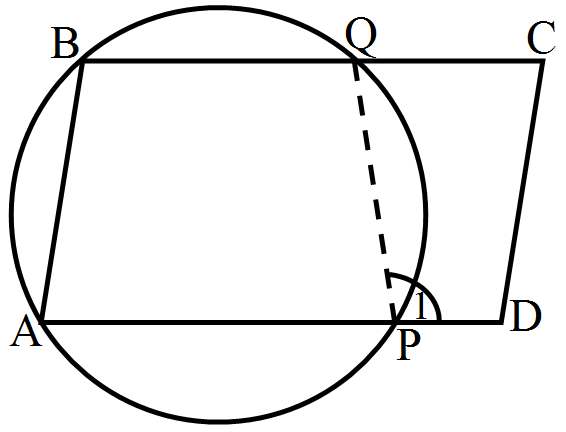
Question
ABCD is a parallelogram. A circle through A, B is so drawn that it intersects AD at P and BC at Q. Prove that P, Q, C and D are concyclic.

Need a full question paper?

Generate a complete, print-ready paper with questions like this in minutes — across 16+ boards, with answer keys.

Start Generating Free

Similar questions

Find the missing frequencies in the following frequency distribution if it is known that the mean of the distribution is $50$
x:
$10$
$30$
$50$
$70$
$90$
f:
$17$
$f_1$
$32$
$f_2$
$19$
$ABC$ is a triangle and through $A, B, C$ lines are drawn parallel to $BC, CA$ and $AB$ respectively intersecting at $P, Q$ and $R.$ Prove that the perimeter of $\triangle\text{PQR}$ is double the perimeter of $\triangle\text{ABC}.$
$30$ circular plates, each of radius $14\ cm$ and thickness $3\ cm$ are placed one above the another to form a cylindrical solid. Find:
$i.$ The total surface area.
$ii.$ Volume of the cylinder so formed.


Construct a triangle whose perimeter is $6.4\ cm$, and angles at the base are $60^\circ$ $45^\circ$.
The height of a right circular cylinder is $10.5\ m$. Three times the sum of the areas of its two circular faces is twice the area of the curved surface. Find the volume of the cylinder.
A bus stop is barricated from the remaining part of the road by using $50$ hollow cones made of recycled cardboard. Each one has a base diameter of $40\ cm$ and height $1\ m$. If the outer side of each of the cones is to be painted and the cost of painting is $₹ 25$ per $m^2$, what will be the cost of painting all these cones? $\big(\text{Use}\ \pi=3.14\ \text{and}\ \sqrt{1.04}=1.02\big)$
Rationalise the denominator of the following:
$\frac{1}{\sqrt{7}+\sqrt{6}-\sqrt{13}}$
If the side $BC$ of $\triangle\text{ABC}$ is produced on both sides, then write the difference between the sum of the exterior angles so formed and $\angle\text{A}.$
Construct the angles of the following measurements$: \ 135^\circ$
The marks scored by $55$ students in a test are given below:
Marks
$0-5$
$5-10$
$10-15$
$15-20$
$20-25$
$25-30$
$30-35$
No. of students
$2$
$6$
$13$
$17$
$11$
$4$
$2$
Prepare a cumulative frequency table.