Question 14 Marks
View full question & answer→Questions · Page 1 of 2
4 Marks Questions
🎯
Test yourself on this topic
50 questions · timed · auto-graded
Question 24 Marks
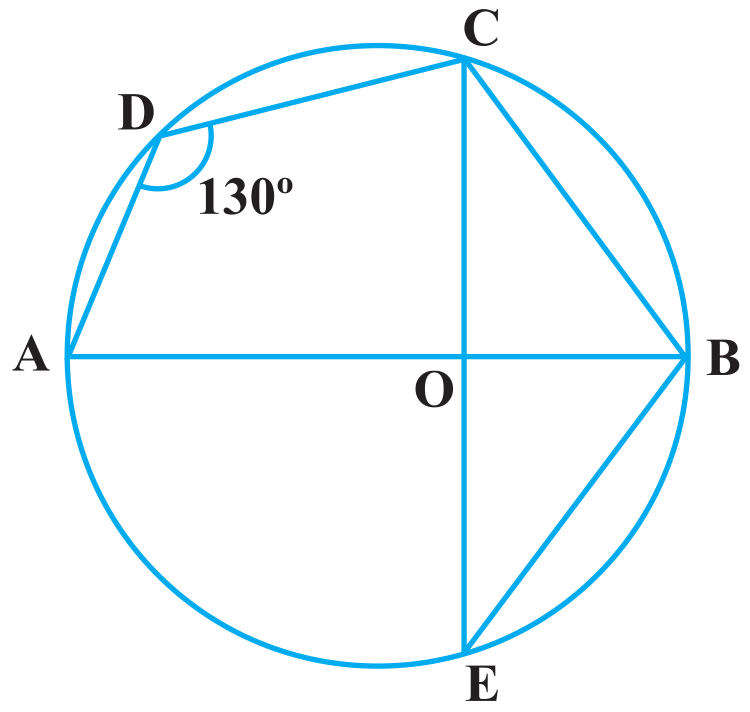
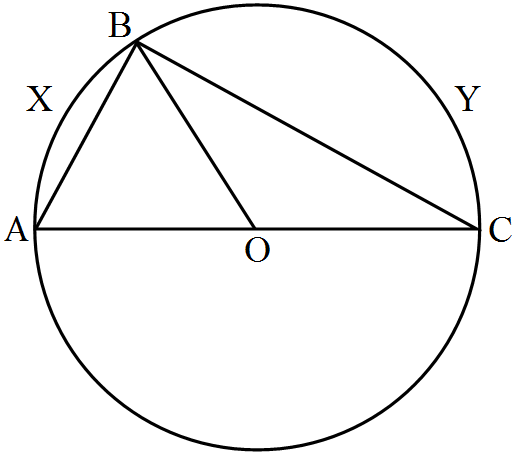
A quadrilateral ABCD is inscribed in a circle such that AB is a diameter and $\angle\text{ADC}=130^\circ.$ Find $\angle\text{BAC}.$
View full question & answer→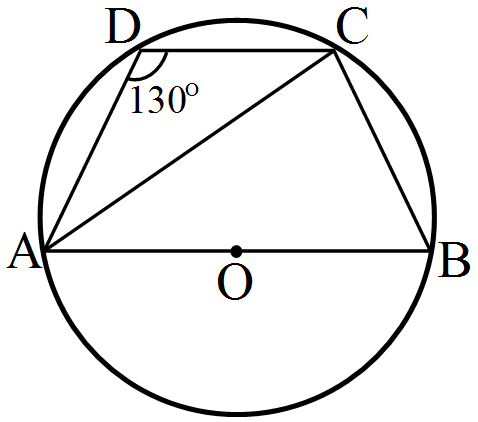
Question 34 Marks
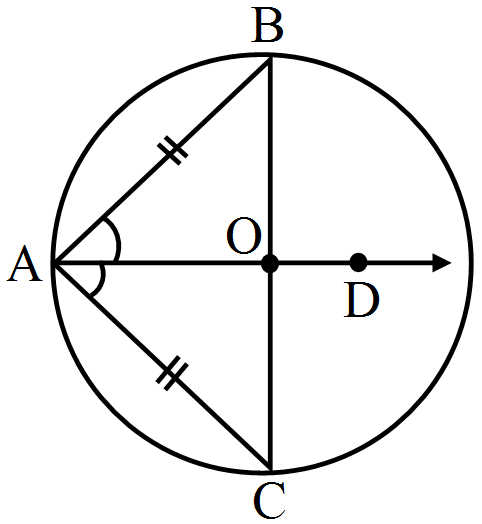
AB and AC are two equal chords of a circle. Prove that the bisector of the angle BAC passes through the centre of the circle.
Question 44 Marks
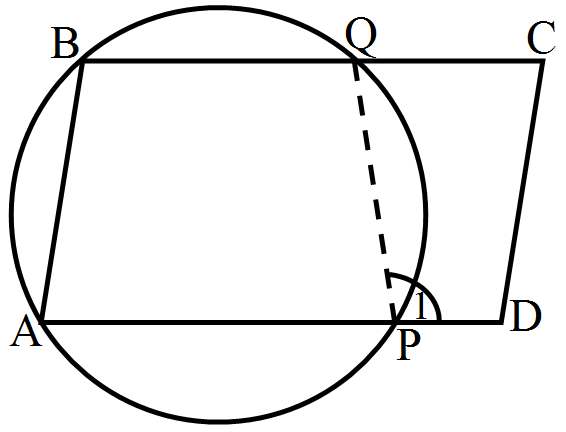
ABCD is a parallelogram. A circle through A, B is so drawn that it intersects AD at P and BC at Q. Prove that P, Q, C and D are concyclic.
Question 54 Marks
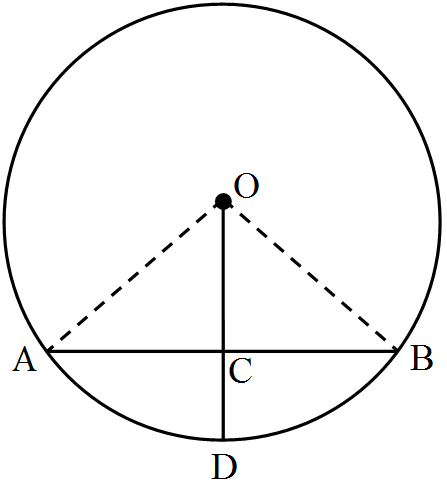
Prove that the line joining the mid-point of a chord to the centre of the circle passes through the mid-point of the corresponding minor arc.
Question 64 Marks
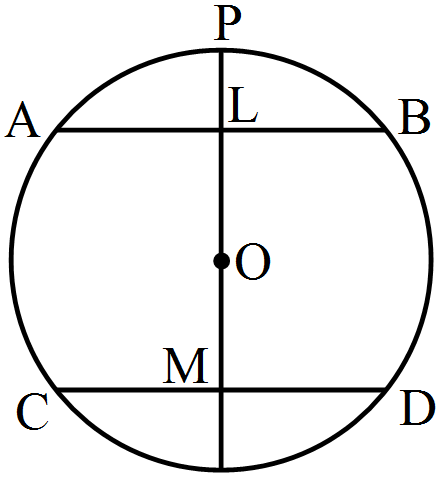
If a diameter of a circle bisects each of the two chords of a circle then prove that the chords are parallel.
Question 74 Marks
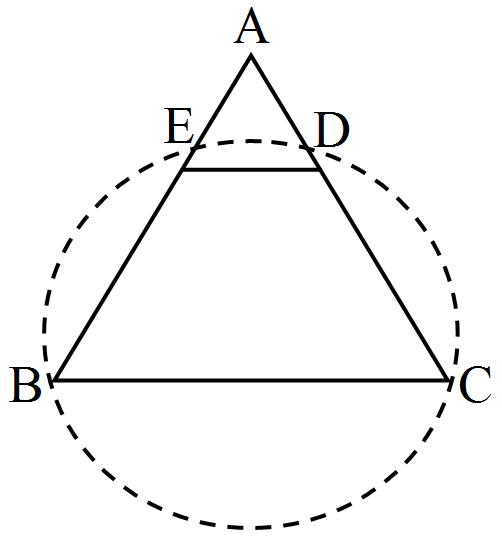
If a line is drawn parallel to the base of an isosceles triangle to intersect its equal sides, prove that the quadrilateral so formed is cyclic.
Question 84 Marks
View full question & answer→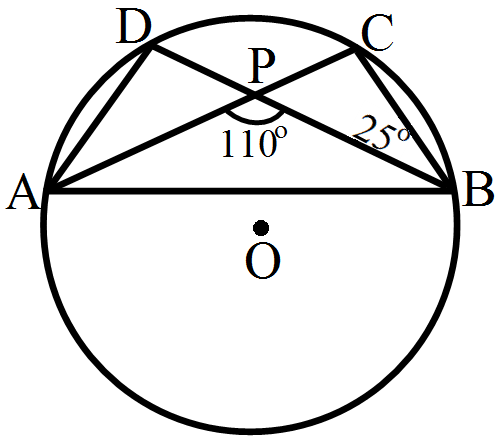
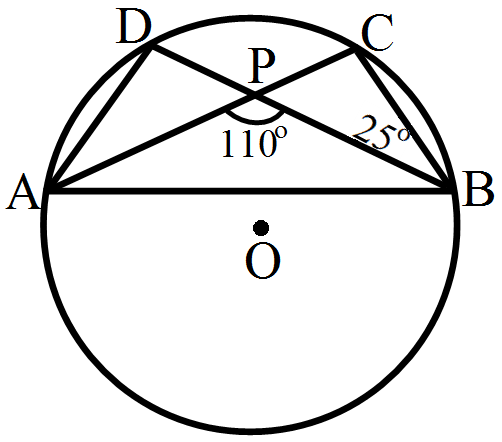
Question 94 Marks
View full question & answer→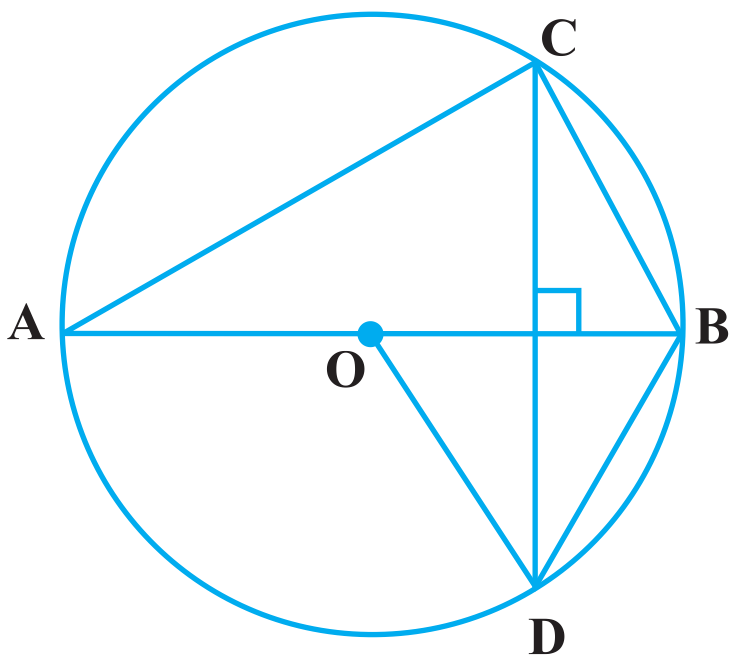
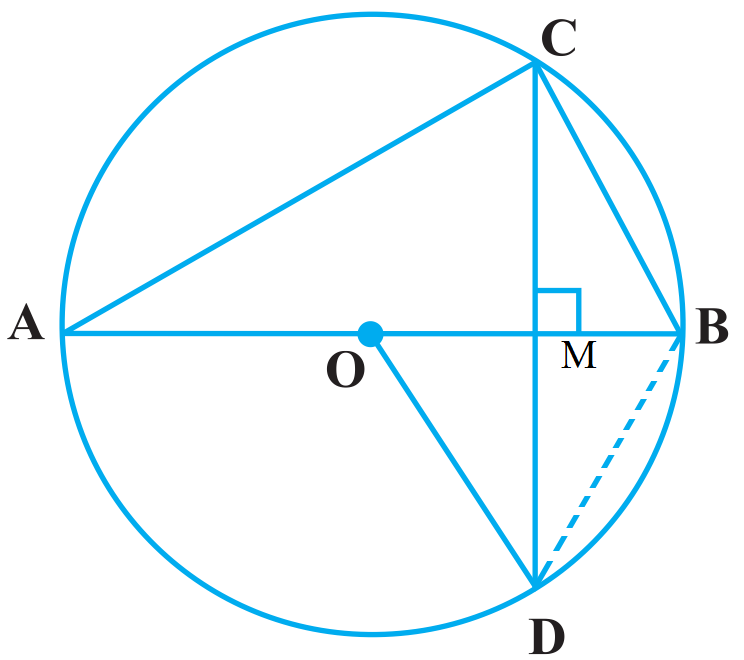
Question 104 Marks
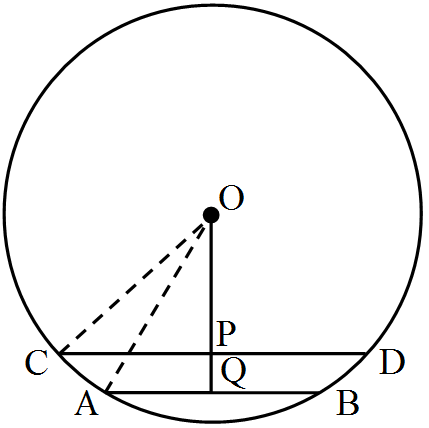
Two chords AB, CD of lengths 5cm, 11cm respectively of a circle are parallel. If the distance between AB and CD is 3cm, find the radius of the circle.
Question 114 Marks
View full question & answer→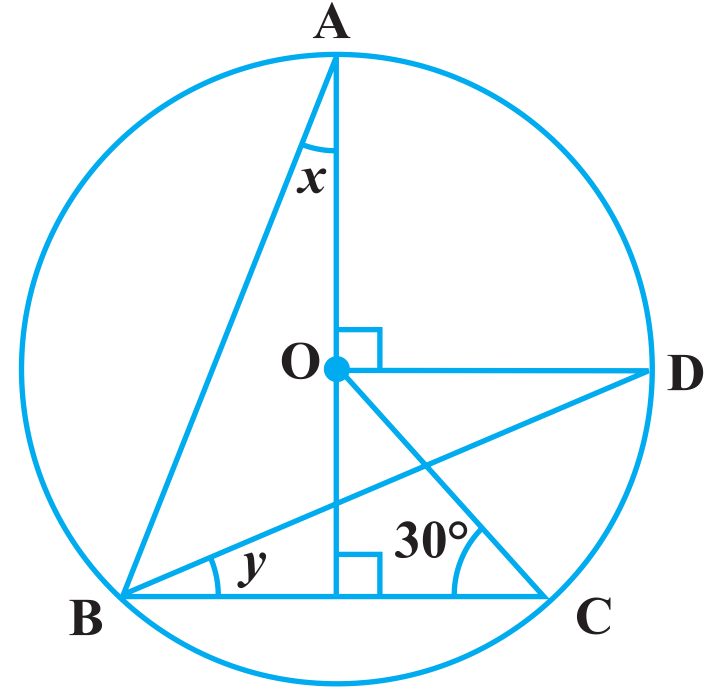
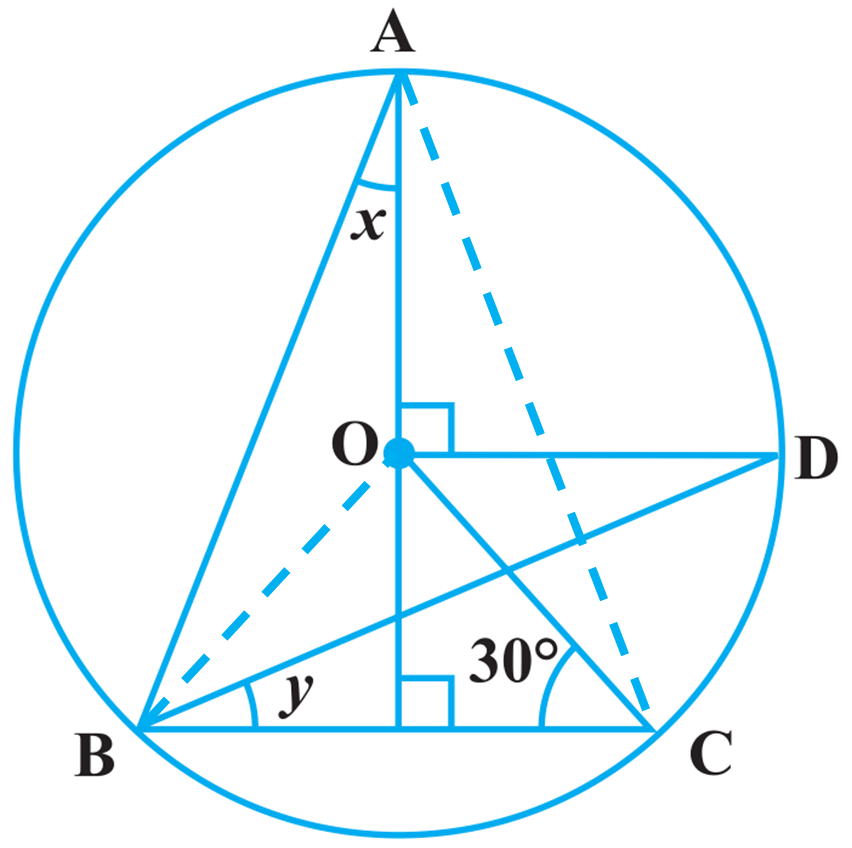
Question 124 Marks
In a cyclic quadrilateral ABCD, if $\angle\text{A}-\angle\text{C}=60^\circ,$ prove that the smaller of two is 60º
Answer
View full question & answer→We have
$\angle\text{A}-\angle\text{C}=60^\circ\dots(1)$
Since, ABCD is a cyclic quadrilateral
Then $\angle\text{A}+\angle\text{C}=180^\circ\dots(2)$
Add equations (1) and (2)
$\angle\text{A}-\angle\text{C}+\angle\text{A}+\angle\text{C}=60^\circ+180^\circ$
$\Rightarrow2\angle\text{A}=240^\circ$
$\Rightarrow\angle\text{A}=\frac{240^\circ}{2}=120^\circ$
Put value of $\angle\text{A}$ in equation (2)
$120^\circ+\angle\text{C}=180^\circ$
$\Rightarrow\angle\text{C}=180^\circ-120^\circ=60^\circ$
$\angle\text{A}-\angle\text{C}=60^\circ\dots(1)$
Since, ABCD is a cyclic quadrilateral
Then $\angle\text{A}+\angle\text{C}=180^\circ\dots(2)$
Add equations (1) and (2)
$\angle\text{A}-\angle\text{C}+\angle\text{A}+\angle\text{C}=60^\circ+180^\circ$
$\Rightarrow2\angle\text{A}=240^\circ$
$\Rightarrow\angle\text{A}=\frac{240^\circ}{2}=120^\circ$
Put value of $\angle\text{A}$ in equation (2)
$120^\circ+\angle\text{C}=180^\circ$
$\Rightarrow\angle\text{C}=180^\circ-120^\circ=60^\circ$
Question 134 Marks
Answer
View full question & answer→In the given figure, we have $\angle\text{ADC}=130^\circ$ and chord BC = BE. We have to find $\angle\text{CBE}.$ Since ABCD is a cyclic quadrilateral and the opposite angles of a cyclic quadrilateral are supplementary.
$\therefore\angle\text{D}+\angle\text{ABC}=180^\circ$
$\Rightarrow130^\circ+\angle\text{ABC}=180^\circ$
$\Rightarrow\angle\text{ABC}=180^\circ-130^\circ=50^\circ$
$\Rightarrow\angle\text{OBC}=50^\circ....(1)$
In $\triangle\text{OBC}$ and $\triangle\text{OBE},$ we have
BC = BE [Given]
OC = OE [Radii of same circle]
OB = OB [Common side]
$\therefore\triangle\text{OBC}\cong\triangle\text{OBE}$ [By SSS cong. Rule]
$\angle\text{OBC}+\angle\text{OBE}=50^\circ$ $\big[$By C.P.C.T. and by (1) $\angle\text{OBC}=50^\circ\big]$
$\therefore\angle\text{OBC}+\angle\text{OBE}=50^\circ+50^\circ=100^\circ$
Hence, $\angle\text{CBE}=100^\circ$
$\therefore\angle\text{D}+\angle\text{ABC}=180^\circ$
$\Rightarrow130^\circ+\angle\text{ABC}=180^\circ$
$\Rightarrow\angle\text{ABC}=180^\circ-130^\circ=50^\circ$
$\Rightarrow\angle\text{OBC}=50^\circ....(1)$
In $\triangle\text{OBC}$ and $\triangle\text{OBE},$ we have
BC = BE [Given]
OC = OE [Radii of same circle]
OB = OB [Common side]
$\therefore\triangle\text{OBC}\cong\triangle\text{OBE}$ [By SSS cong. Rule]
$\angle\text{OBC}+\angle\text{OBE}=50^\circ$ $\big[$By C.P.C.T. and by (1) $\angle\text{OBC}=50^\circ\big]$
$\therefore\angle\text{OBC}+\angle\text{OBE}=50^\circ+50^\circ=100^\circ$
Hence, $\angle\text{CBE}=100^\circ$
Question 144 Marks
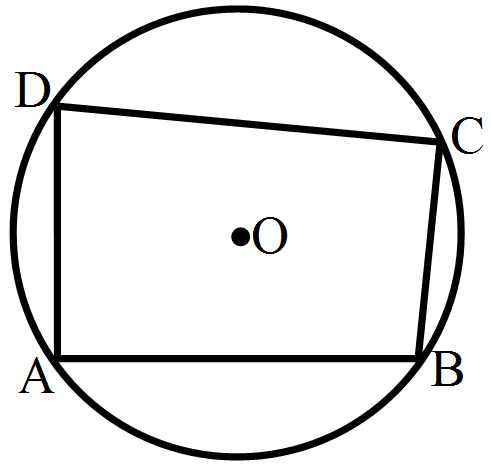
Prove that the perpendicular bisectors of the sides of a cyclic quadrilateral are concurrent.
Question 154 Marks
View full question & answer→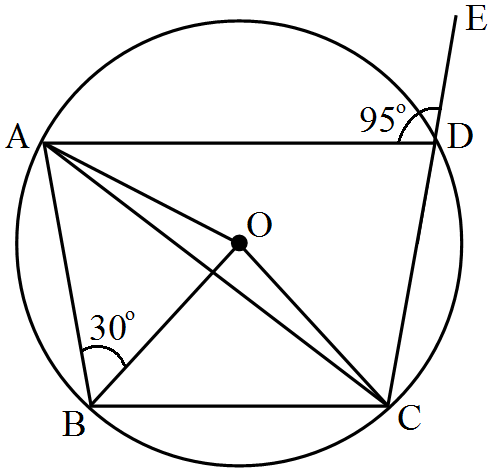
Question 164 Marks
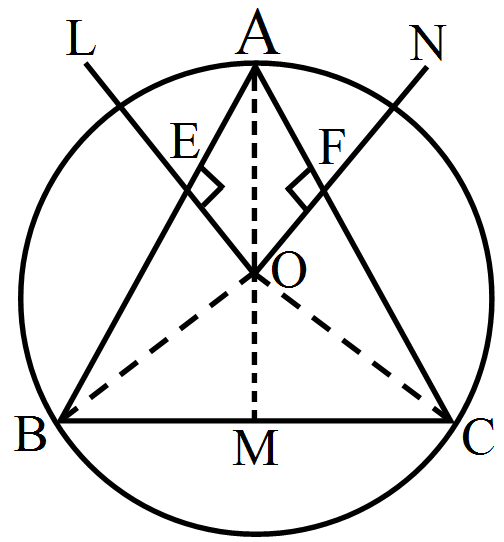
A, B and C are three points on a circle. Prove that the perpendicular bisectors of AB, BC and CA are concurrent.
Question 174 Marks
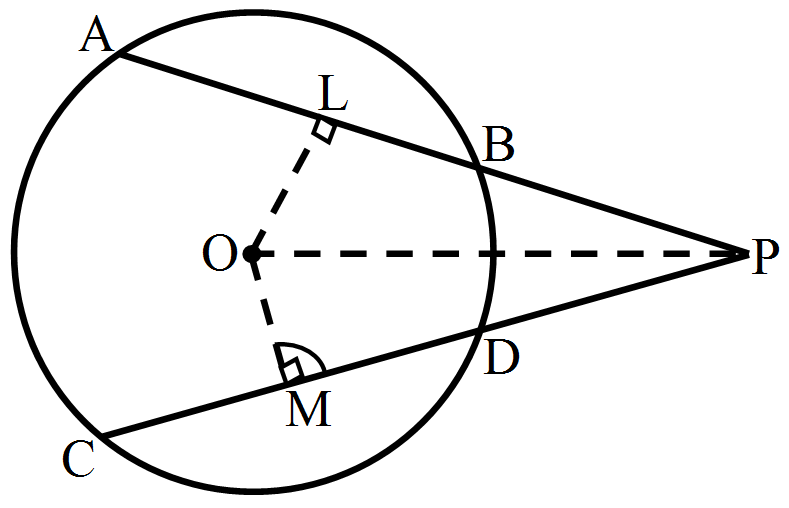
Two equal chords AB and CD of a circle when produced intersect at a point P. Prove that PB = PD
Question 184 Marks
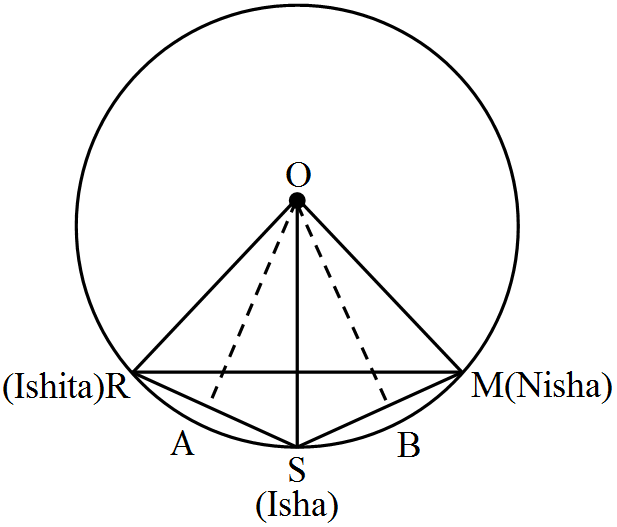
Three girls Ishita, Isha and Nisha are playing a game by standing on a circle of radius 20m drawn in a park. Ishita throws a ball to Isha, Isha to Nisha and Nisha to Ishita. If the distance between Ishita and Isha and between Isha and Nisha is 24m each, what is the distance between Ishita and Nisha.
Question 194 Marks
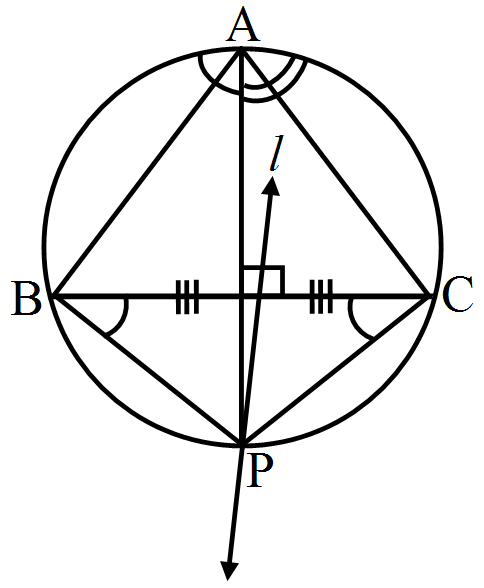
Prove that angle bisector of any angle of a triangle and perpendicular bisector of the opposite side if intersect, they will intersect on the circumcircle of the triangle.
Question 204 Marks
If non-parallel sides of a trapezium are equal, prove that it is cyclic.
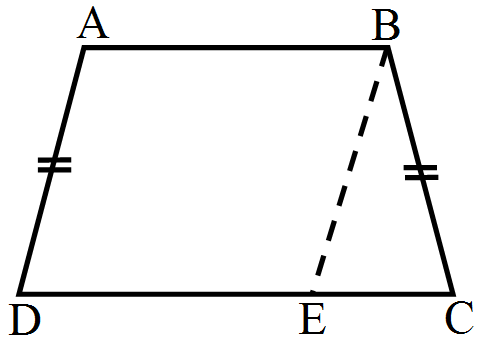
Question 214 Marks
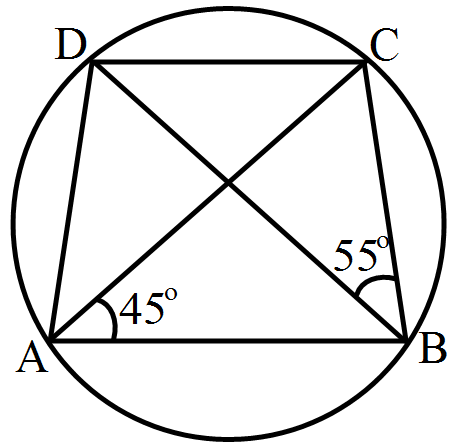
Answer
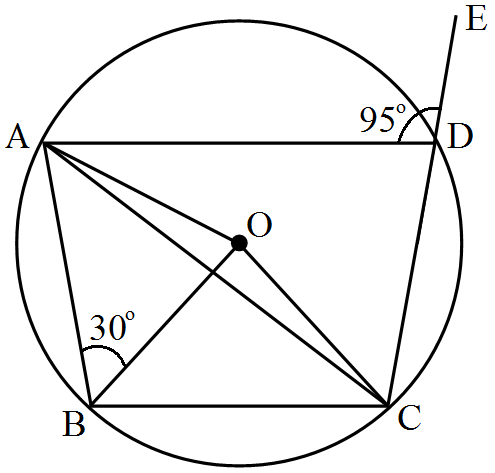
View full question & answer→Since angles in the same segment of a circle are equal.
$\therefore\angle\text{CAD}=\angle\text{DBC}=55^\circ$
$\therefore\angle\text{DAB}=\angle\text{CAD} +\angle\text{BAC}=55^\circ +45^\circ=100^\circ$
But, $\angle\text{DAB}+\angle\text{BCD}=180^\circ$ [Opposite angles of a cyclic quadrilateral]
$\therefore\angle\text{BCD}=180^\circ-100^\circ=80^\circ$
$\therefore\angle\text{CAD}=\angle\text{DBC}=55^\circ$
$\therefore\angle\text{DAB}=\angle\text{CAD} +\angle\text{BAC}=55^\circ +45^\circ=100^\circ$
But, $\angle\text{DAB}+\angle\text{BCD}=180^\circ$ [Opposite angles of a cyclic quadrilateral]
$\therefore\angle\text{BCD}=180^\circ-100^\circ=80^\circ$
Question 224 Marks
In a cyclic quadrilateral ABCD, if $(\angle\text{B}-\angle\text{D})=60^\circ,$ show that the smaller of the two is 60°
Answer
View full question & answer→ABCD is a cyclic quadrilateral
$\angle\text{B}-\angle\text{D}=60^\circ\dots(\text{i})$
And
$\angle\text{B}+\angle\text{D}=180^\circ\dots(\text{ii})$
Adding (i) and (ii) we get,
$2\angle\text{B}=240^\circ$
$\therefore\ \angle\text{B}=\frac{240}{2}=120^\circ$
Substituting the value of $\angle\text{B}=120^\circ$ in (i) we get
$120^\circ-\angle\text{D}=60^\circ$
$\Rightarrow\ \angle\text{D}=120^\circ-60^\circ=60^\circ$
The smaller of the two angles i.e. $\angle\text{D}=60^\circ.$
$\angle\text{B}-\angle\text{D}=60^\circ\dots(\text{i})$
And
$\angle\text{B}+\angle\text{D}=180^\circ\dots(\text{ii})$
Adding (i) and (ii) we get,
$2\angle\text{B}=240^\circ$
$\therefore\ \angle\text{B}=\frac{240}{2}=120^\circ$
Substituting the value of $\angle\text{B}=120^\circ$ in (i) we get
$120^\circ-\angle\text{D}=60^\circ$
$\Rightarrow\ \angle\text{D}=120^\circ-60^\circ=60^\circ$
The smaller of the two angles i.e. $\angle\text{D}=60^\circ.$
Question 234 Marks
Prove that the line segment joining the mid-point of the hypotenuse of a right triangle to its opposite vertex is half of the hypotenuse.
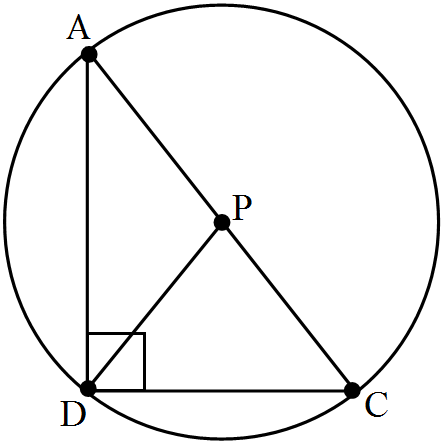
Question 244 Marks
ABCD is a cyclic qudrilateral in which:
$\text{BC}\parallel\text{AD},\ \angle\text{ADC}=110^\circ$ and $\angle\text{BAC}=50^\circ.$ Find $\angle\text{DAC}.$
View full question & answer→$\text{BC}\parallel\text{AD},\ \angle\text{ADC}=110^\circ$ and $\angle\text{BAC}=50^\circ.$ Find $\angle\text{DAC}.$
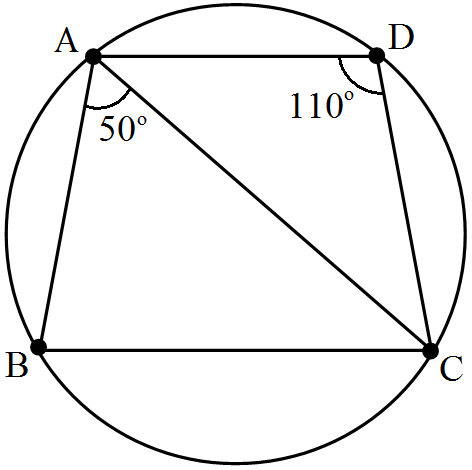
Question 254 Marks
View full question & answer→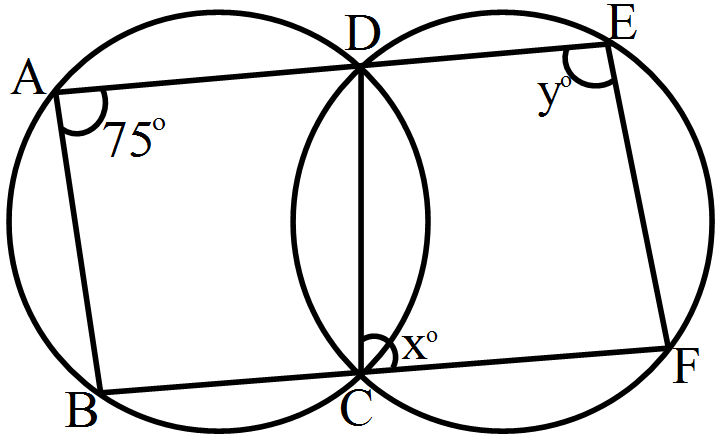
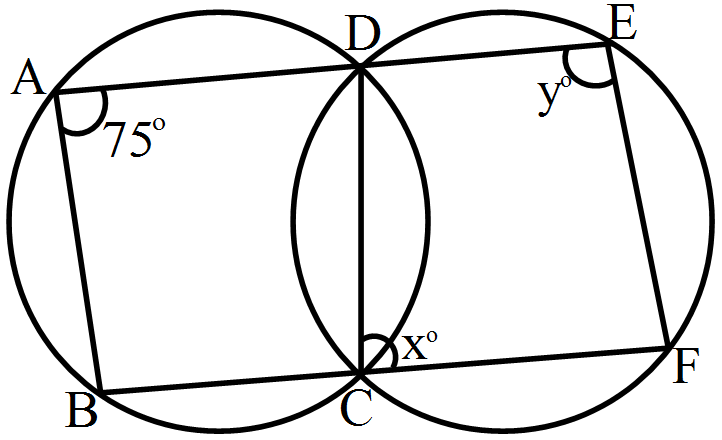
Question 264 Marks
Answer
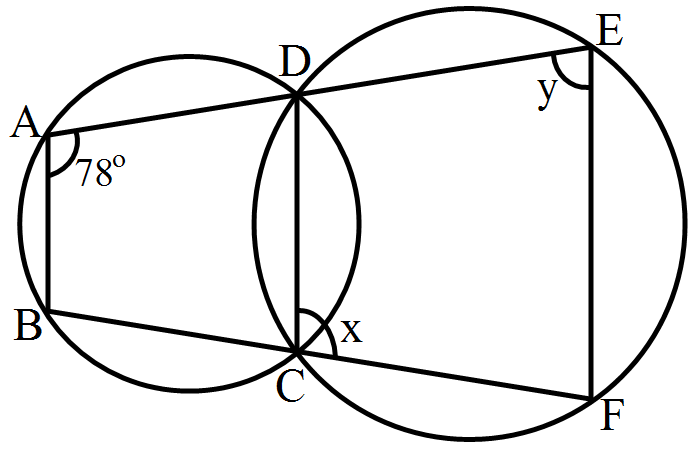
View full question & answer→We have, $\angle\text{BAD}=78^\circ,\angle\text{DCF}=\text{x}^\circ$ and $\angle\text{DEF}=\text{y}^\circ.$
Since, ABCD is a cyclic quadrilateral.
Then, $\angle\text{BAD}+\angle\text{BCD}=180^\circ$
$\Rightarrow78^\circ+\angle\text{BCD}=180^\circ$
$\Rightarrow\angle\text{BCD}=180^\circ-78^\circ=102^\circ$
Now, $\angle\text{BCD}+\angle\text{DCF}=180^\circ$ [Linear pair of angles]
$\Rightarrow102^\circ=\text{x}^\circ=180^\circ$
$\Rightarrow\text{x}=180^\circ-102^\circ=78^\circ$
Since, DCEF is a cyclic quadrilateral
Then, x + y = 180º
⇒ 78º + y = 180º
⇒ y = 180º - 78º = 102º
Since, ABCD is a cyclic quadrilateral.
Then, $\angle\text{BAD}+\angle\text{BCD}=180^\circ$
$\Rightarrow78^\circ+\angle\text{BCD}=180^\circ$
$\Rightarrow\angle\text{BCD}=180^\circ-78^\circ=102^\circ$
Now, $\angle\text{BCD}+\angle\text{DCF}=180^\circ$ [Linear pair of angles]
$\Rightarrow102^\circ=\text{x}^\circ=180^\circ$
$\Rightarrow\text{x}=180^\circ-102^\circ=78^\circ$
Since, DCEF is a cyclic quadrilateral
Then, x + y = 180º
⇒ 78º + y = 180º
⇒ y = 180º - 78º = 102º
Question 274 Marks
View full question & answer→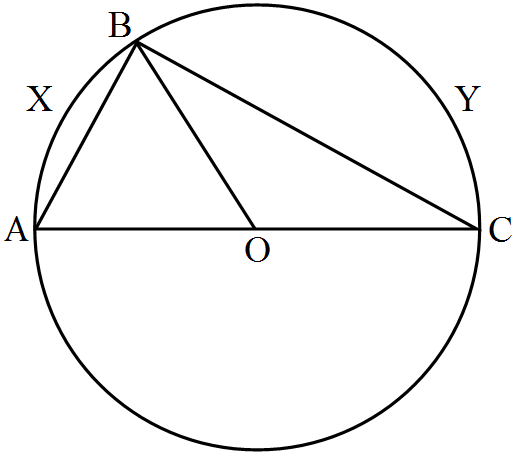
Question 284 Marks
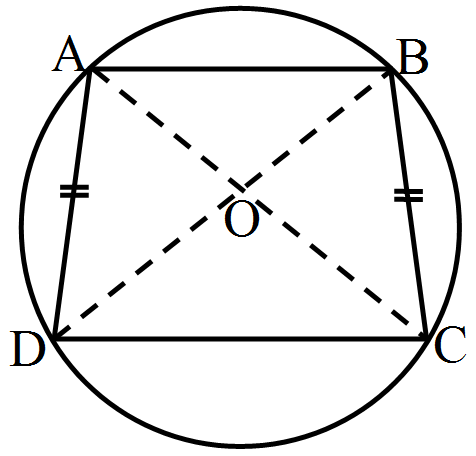
If a pair of opposite sides of a cyclic quadrilateral are equal, prove that its diagonals are also equal.
Question 294 Marks
If ABC is an equilateral triangle inscribed in a circle and P be any point on the minor arc BC which does not coincide with B or C, prove that PA is angle bisector of $\angle\text{BPC}.$
View full question & answer→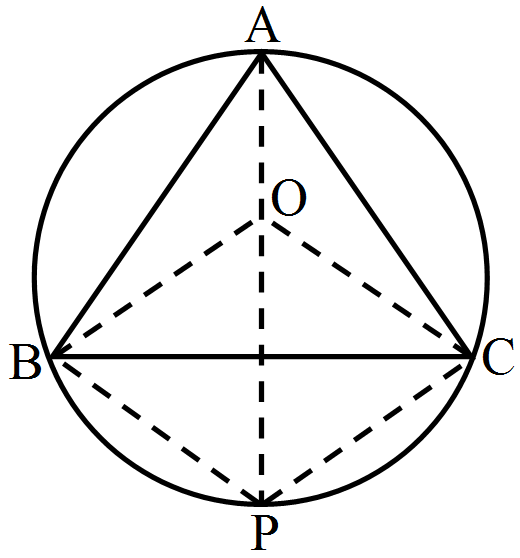
Question 304 Marks
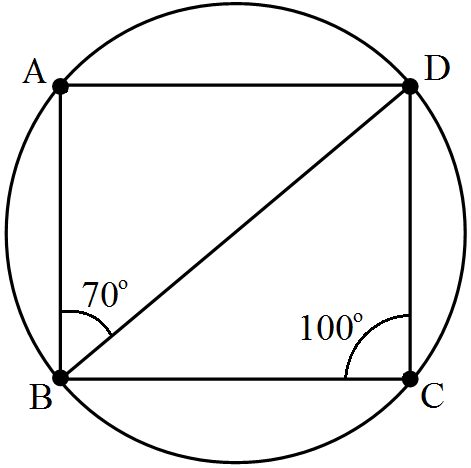
ABCD is a cyclic qudrilateral in which:
$\angle\text{BCD}=100^\circ$ and $\angle\text{ABD}=70^\circ$ find $\angle\text{ADB}.$
View full question & answer→$\angle\text{BCD}=100^\circ$ and $\angle\text{ABD}=70^\circ$ find $\angle\text{ADB}.$
Question 314 Marks
A line segment AB is of length 5cm. Draw a circle of radius 4cm passing through A and B. Can you draw a circle of radius 2cm passing through A and B? Give reason in support of your answer.
Answer
View full question & answer→- Draw a line segment AB of 5cm.
- Draw the perpendicular bisectors of AB.
- With centre A and radius of 4cm, draw an arc which intersects the perpendicular bisector at point O. The point O will be the required centre.
- Join OA.
- With centre O and radius OA, draw a circle.
No, we cannot draw a circle of radius 2cm passing through A and B because when we draw an arc of radius 2cm with centre A, the arc will not intersect the perpendicular bisector and we will not find the centre.
Question 324 Marks
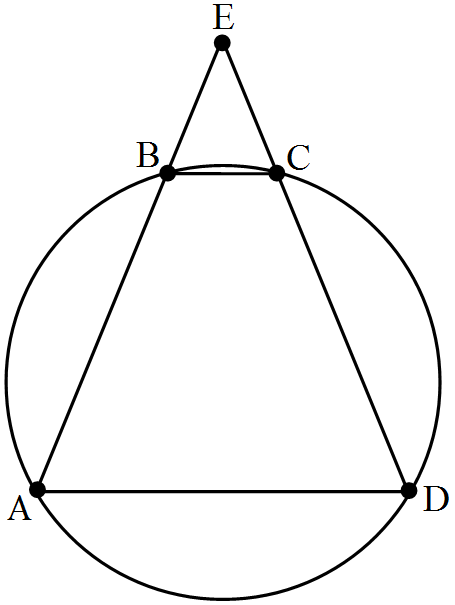
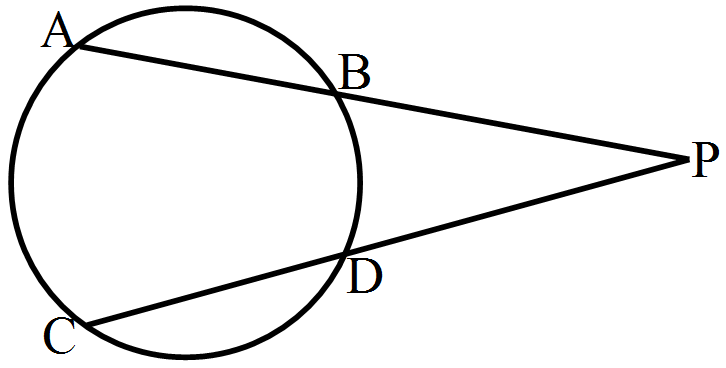
ABCD ia a cyclic quadrilateral in which BA and CD when produced meet in E and EA = ED. Prove that:
- AD || BC.
- EB = EC.
Question 334 Marks
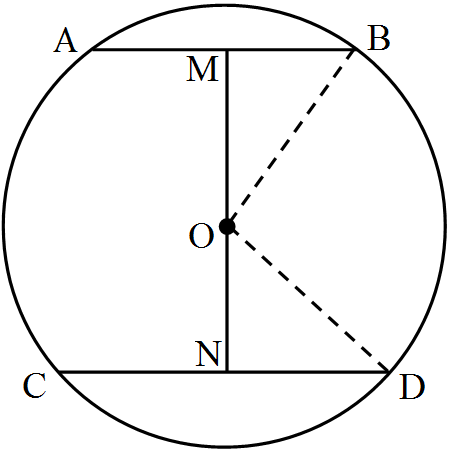
Two chords AB and CD of lengths 5cm and 11cm respectively of a circle are parallel to each other and are opposite side of its centre. If the distance between AB and CD is 6cm, find the radius of the circle.
Question 344 Marks
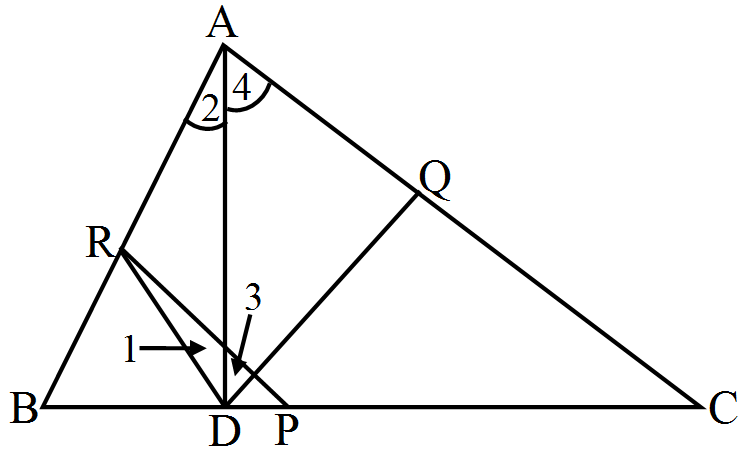
If P, Q and R are the mid-points of the sides BC, CA and AB of a triangle and AD is the perpendicular from A on BC, prove that P, Q, R and D are concyclic.
Question 354 Marks
O is the circumcentre of the triangle ABC and D is the mid-point of the base BC. Prove that $\angle\text{BOD}=\angle\text{A}.$
View full question & answer→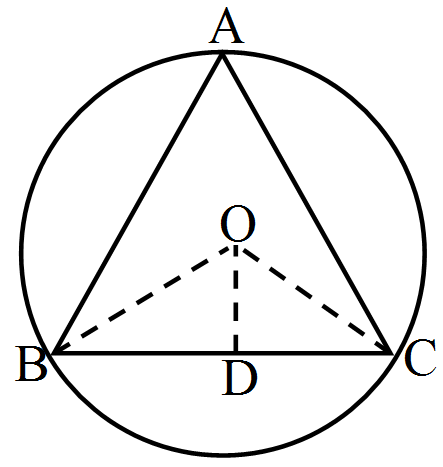
Question 364 Marks
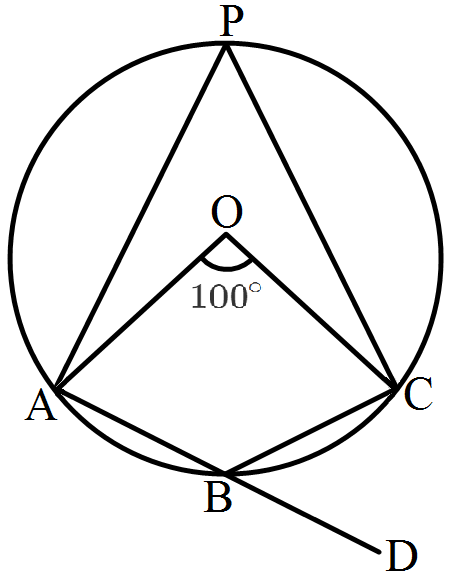
Answer
View full question & answer→We have, $\angle\text{AOC}=100^\circ$
By degree measure theorem
$\angle\text{AOC}=2\angle\text{APC}$
$\Rightarrow100^\circ=2\angle\text{APC}$
$\Rightarrow\angle\text{APC}=\frac{100^\circ}{2}=50^\circ$
$\therefore\angle\text{APC}+\angle\text{ABC}=180^\circ$ [Opposite angles of cyclic quad.]
$\Rightarrow50^\circ+\angle\text{ABC}=180^\circ$
$\Rightarrow\angle\text{ABC}=180^\circ-50^\circ=130^\circ$
$\therefore\angle\text{ABC}+\angle\text{CBD}=180^\circ$ [Linear pair of angles]
$\Rightarrow130^\circ+\angle\text{CBD}=180^\circ$
$\Rightarrow\angle\text{CBD}=180^\circ-130^\circ=50^\circ$
By degree measure theorem
$\angle\text{AOC}=2\angle\text{APC}$
$\Rightarrow100^\circ=2\angle\text{APC}$
$\Rightarrow\angle\text{APC}=\frac{100^\circ}{2}=50^\circ$
$\therefore\angle\text{APC}+\angle\text{ABC}=180^\circ$ [Opposite angles of cyclic quad.]
$\Rightarrow50^\circ+\angle\text{ABC}=180^\circ$
$\Rightarrow\angle\text{ABC}=180^\circ-50^\circ=130^\circ$
$\therefore\angle\text{ABC}+\angle\text{CBD}=180^\circ$ [Linear pair of angles]
$\Rightarrow130^\circ+\angle\text{CBD}=180^\circ$
$\Rightarrow\angle\text{CBD}=180^\circ-130^\circ=50^\circ$
Question 374 Marks
View full question & answer→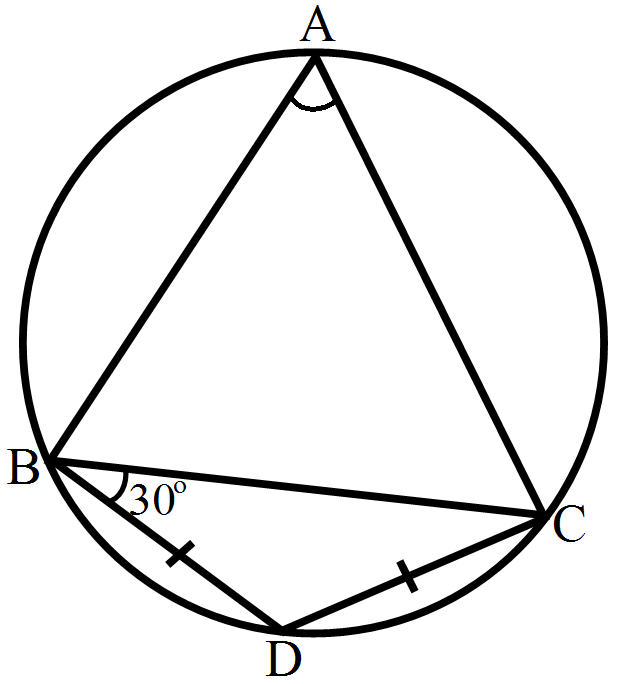
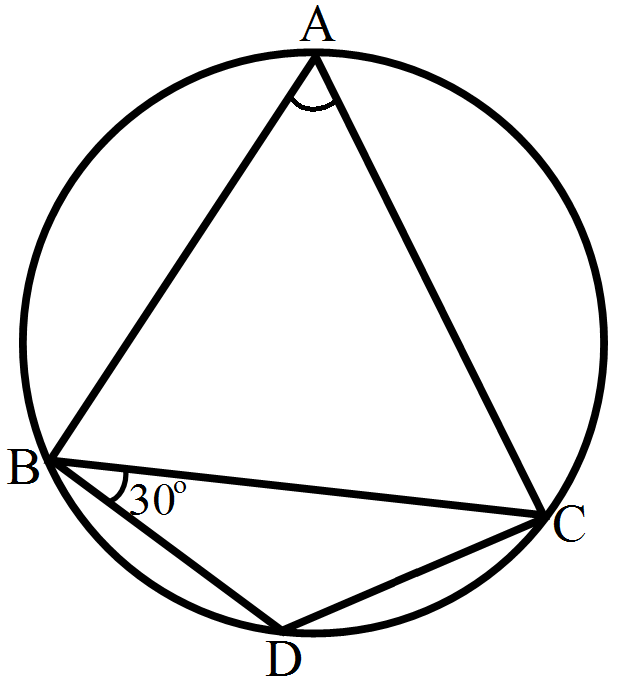
Question 384 Marks
View full question & answer→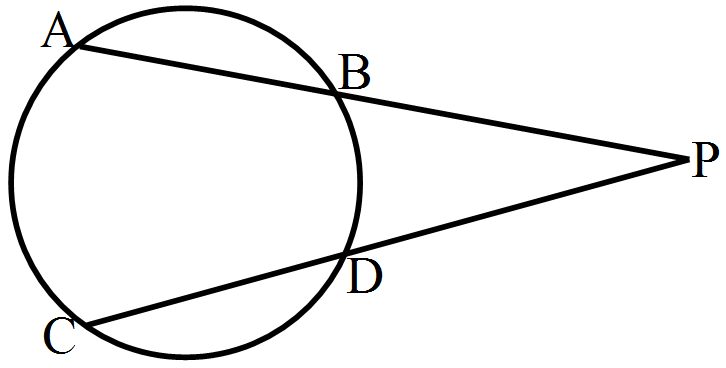
Question 394 Marks
ABCD is a cyclic trapezium with AD || BC. If $\angle\text{B}=70^\circ,$determine other three angles of the trapezium.
View full question & answer→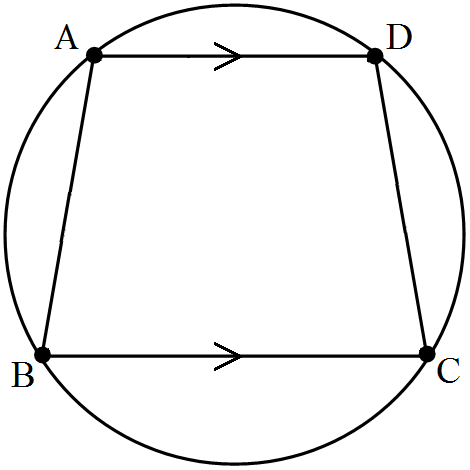
Question 404 Marks
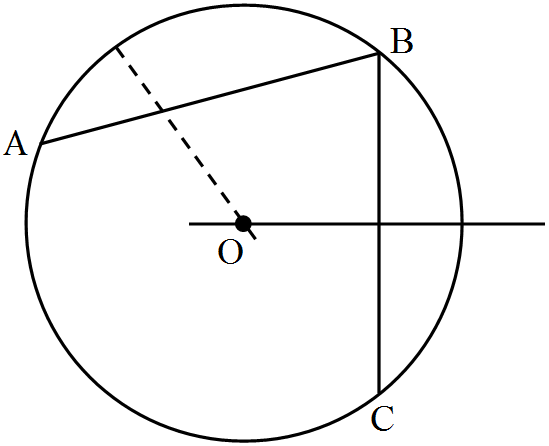
Give a method to find the centre of a given circle.
Question 414 Marks
View full question & answer→
Question 424 Marks
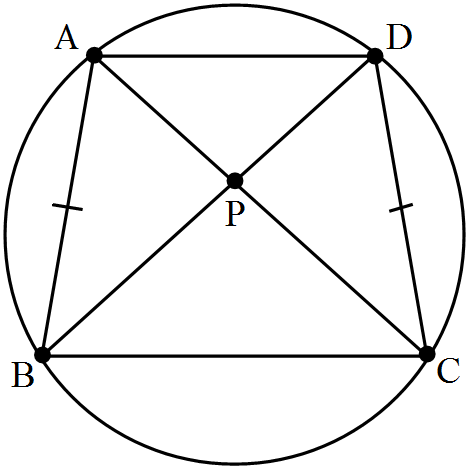
If the two sides of a pair of opposite sides of a cyclic quadrilateral ae equal, prove that its diagonals are equal.
Question 434 Marks
In a cyclic quadrilateral ABCD if $\text{m}\angle\text{A}=\big(\text{m}\angle\text{C}\big).$ Find $\text{m}\angle\text{A}.$
View full question & answer→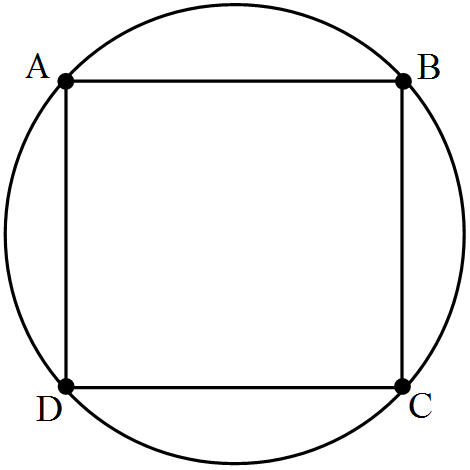
Question 444 Marks
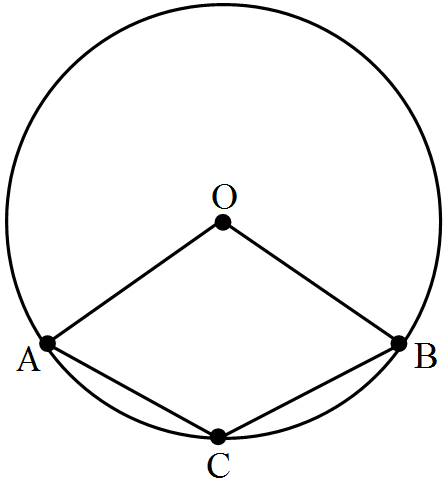
Prove that the angle in a segment shorter than a semicircle is greater than a right angle.
Question 454 Marks
View full question & answer→
Question 464 Marks
Answer
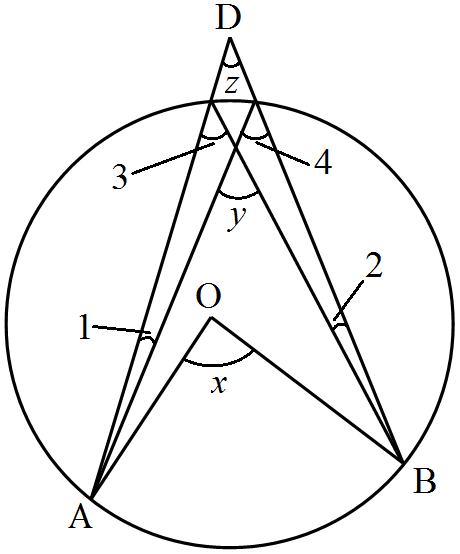
View full question & answer→We have,
$\angle3=\angle4$ [Angles in same segment]
$\therefore\angle\text{x}=2\angle3$ [By degree measure theorem]
$\Rightarrow\angle\text{X}=\angle3+\angle3$
$\Rightarrow\angle\text{X}=\angle3+\angle4\dots(\text{i})$ $[\angle3=\angle4]$
But $\angle\text{y}=\angle3+\angle1$ [By exterior angle property]
$\Rightarrow\angle3=\angle\text{y}-\angle1\dots(\text{ii})$
From (i) and (ii)
$\angle\text{x}=\angle\text{y}-\angle1+\angle4$
$\Rightarrow\angle\text{x}=\angle\text{y}+\angle4-\angle1$
$\Rightarrow\angle\text{x}=\angle\text{y}+\angle\text{z}+\angle1-\angle1$ [By exterior angle property]
$\Rightarrow\angle\text{x}=\angle\text{y}+\angle\text{z}$
$\angle3=\angle4$ [Angles in same segment]
$\therefore\angle\text{x}=2\angle3$ [By degree measure theorem]
$\Rightarrow\angle\text{X}=\angle3+\angle3$
$\Rightarrow\angle\text{X}=\angle3+\angle4\dots(\text{i})$ $[\angle3=\angle4]$
But $\angle\text{y}=\angle3+\angle1$ [By exterior angle property]
$\Rightarrow\angle3=\angle\text{y}-\angle1\dots(\text{ii})$
From (i) and (ii)
$\angle\text{x}=\angle\text{y}-\angle1+\angle4$
$\Rightarrow\angle\text{x}=\angle\text{y}+\angle4-\angle1$
$\Rightarrow\angle\text{x}=\angle\text{y}+\angle\text{z}+\angle1-\angle1$ [By exterior angle property]
$\Rightarrow\angle\text{x}=\angle\text{y}+\angle\text{z}$
Question 474 Marks
Answer
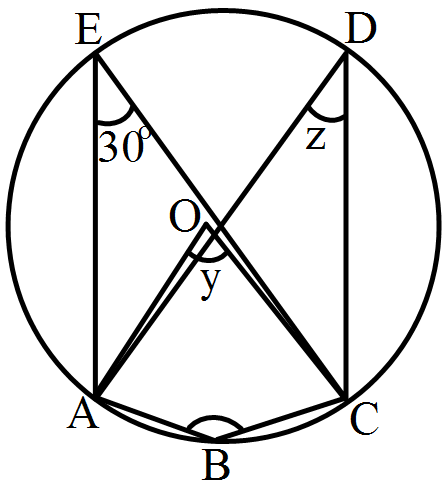
View full question & answer→We have, $\angle\text{CEA}=30^\circ$
Since, quad. ABCE is a cyclic quadrilateral.
Then, $\angle\text{ABC}+\angle\text{CEA}=180^\circ$
$\Rightarrow\text{x}+30^\circ=180^\circ$
$\Rightarrow\text{x}=180^\circ-30^\circ=150^\circ$
By degree measure theorem
$\angle\text{AOC}=2\angle\text{CEA}$
$\Rightarrow\text{y}=2\times30^\circ=60^\circ$
$\therefore\angle\text{ADC}=\angle\text{CEA}$ [Angle in same segment]
$\Rightarrow\text{z}=30^\circ$
Since, quad. ABCE is a cyclic quadrilateral.
Then, $\angle\text{ABC}+\angle\text{CEA}=180^\circ$
$\Rightarrow\text{x}+30^\circ=180^\circ$
$\Rightarrow\text{x}=180^\circ-30^\circ=150^\circ$
By degree measure theorem
$\angle\text{AOC}=2\angle\text{CEA}$
$\Rightarrow\text{y}=2\times30^\circ=60^\circ$
$\therefore\angle\text{ADC}=\angle\text{CEA}$ [Angle in same segment]
$\Rightarrow\text{z}=30^\circ$
Question 484 Marks
Answer
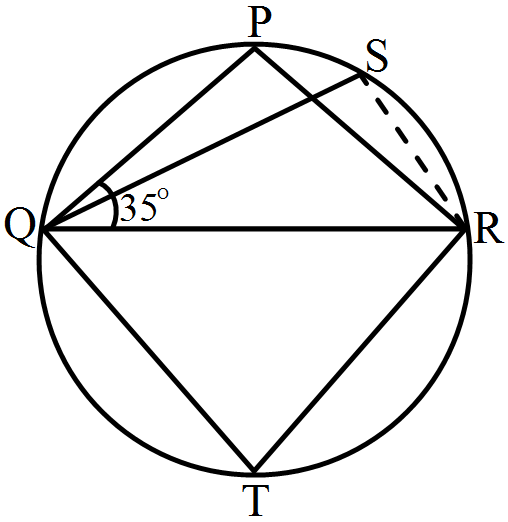
View full question & answer→We have, $\angle\text{PQR}=35^\circ$
Since, $\triangle\text{PQR}$ is an isosceles triangle with PQ = PR.
Then, $\angle\text{PQR}=\angle\text{PRQ}=35^\circ$
In $\triangle\text{PQR},$ by angle sum property
$\angle\text{p}+\angle\text{PQR}+\angle\text{PRQ}=180^\circ$
$\Rightarrow\angle\text{p}+35^\circ+35^\circ=180^\circ$
$\Rightarrow\angle\text{p}=180^\circ-35^\circ-35^\circ=110^\circ$
$\therefore\angle\text{QSR}=\angle\text{p}=110^\circ$ [Angles in same segment]
Now, $\angle\text{QSR}+\angle\text{QTR}=180^\circ$ [Opposite angles of cyclic quad.]
$\Rightarrow110^\circ+\angle\text{QTR}=180^\circ$
$\Rightarrow\angle\text{QTR}=180^\circ-110^\circ=70^\circ$
Since, $\triangle\text{PQR}$ is an isosceles triangle with PQ = PR.
Then, $\angle\text{PQR}=\angle\text{PRQ}=35^\circ$
In $\triangle\text{PQR},$ by angle sum property
$\angle\text{p}+\angle\text{PQR}+\angle\text{PRQ}=180^\circ$
$\Rightarrow\angle\text{p}+35^\circ+35^\circ=180^\circ$
$\Rightarrow\angle\text{p}=180^\circ-35^\circ-35^\circ=110^\circ$
$\therefore\angle\text{QSR}=\angle\text{p}=110^\circ$ [Angles in same segment]
Now, $\angle\text{QSR}+\angle\text{QTR}=180^\circ$ [Opposite angles of cyclic quad.]
$\Rightarrow110^\circ+\angle\text{QTR}=180^\circ$
$\Rightarrow\angle\text{QTR}=180^\circ-110^\circ=70^\circ$
Question 494 Marks
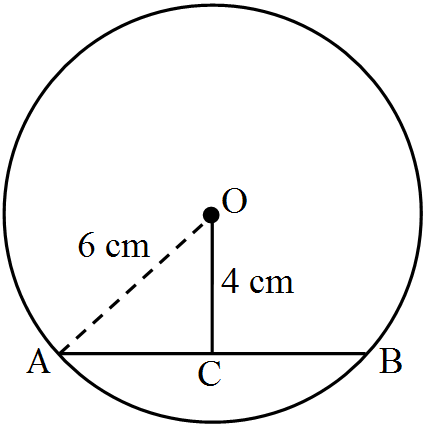
Find the length of a chord which is at a distance of 4cm from the centre of a circle of radius 6cm.
Question 504 Marks
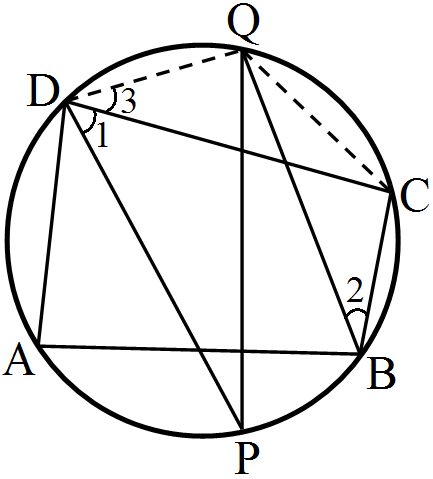
If bisectors of opposite angles of a cyclic quadrilateral ABCD intersect the circle, circumscribing it at the points P and Q, prove that PQ is a diameter of the circle.