Question
ABCD is a parallelogram whose diagonals intersect at O .If P is any point on BO, prove that:
  1. $\text{ar}(\triangle\text{ADO})=\text{ar}(\triangle\text{CDO})$
  2. $\text{ar}(\triangle\text{ABP})=\text{ar}(\triangle\text{CBP})$
Answer

Given that ABCD is the parallelogram To Prove:
  1. $\text{ar}(\triangle\text{ADO})=\text{ar}(\triangle\text{CDO}).$
  2. $\text{ar}(\triangle\text{ABP})=\text{ar}(\triangle\text{CBP}).$
Proof: we know that diagonals of parallelogram bisect each other $\therefore$ AO = OC and BO = OD
  1. In $\triangle\text{DAC},$ since DO is a median.
Then $\text{ar}(\triangle\text{ADO})=\text{ar}(\triangle\text{CDO}).$
  1. In $\triangle\text{BAC},$ since BO is a median.
Then $\text{ar}(\triangle\text{BAO})=\text{ar}(\triangle\text{BCO})\ ....(1)$
In $\triangle\text{PAC},$ since PO is a median.
Then $\text{ar}(\triangle\text{PAO})=\text{ar}(\triangle\text{PCO})\ .....(2)$
Subtract equation 2 from 1.
$\Rightarrow\text{ar}(\triangle\text{BAO})−\text{ar}(\triangle\text{PAO})\\ \ =\text{ar}(\triangle\text{BCO})−\text{ar}(\triangle\text{PCO})$
$\Rightarrow\text{ar}(\triangle\text{ABP})=2\text{ar}(\triangle\text{CBP}).$

Need a full question paper?

Generate a complete, print-ready paper with questions like this in minutes — across 16+ boards, with answer keys.

Start Generating Free

Similar questions

Prove that in a triangle, other than an equilateral triangle, angle opposite the longest side is greater than $\frac{2}{3}$ of a right angle.
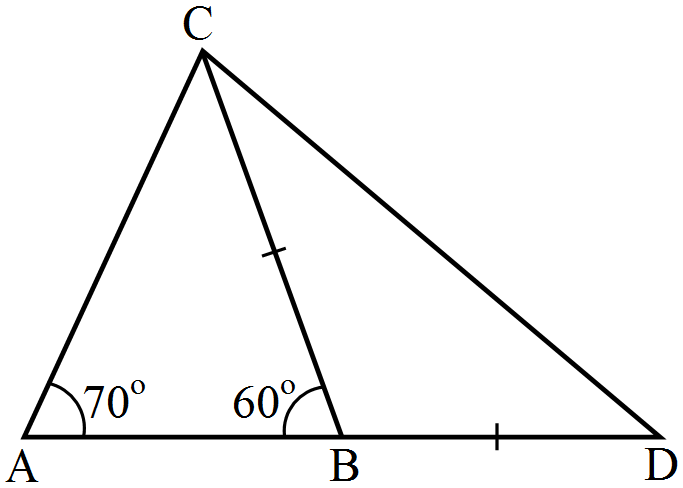
In $\triangle\text{ABC,}$ side AB is produced to D such that BD = BC. If $\angle\text{B}=60^{\circ},$ and $\angle\text{B}=60^{\circ},$ prove that:
  1. AD > CD and
  2. AD > AC.
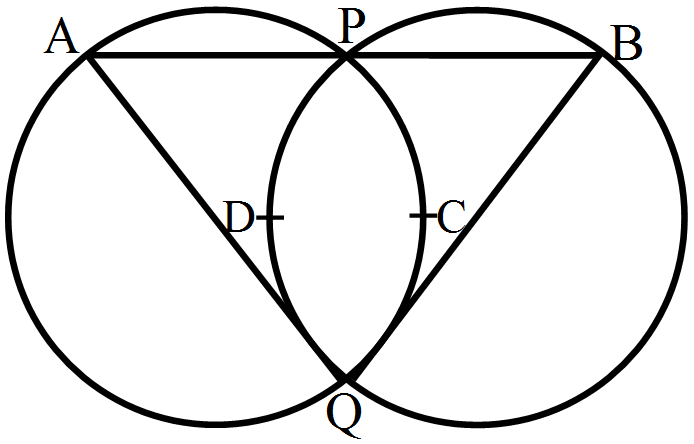
Two equal circles intersect in P and Q. A straight line through P meets the circles in A and B. Prove that QA = QB.
A chord of length $16\ cm$ is drawn in a circle of radius $10\ cm.$ Find the distance of the chord from the centre of the circle.
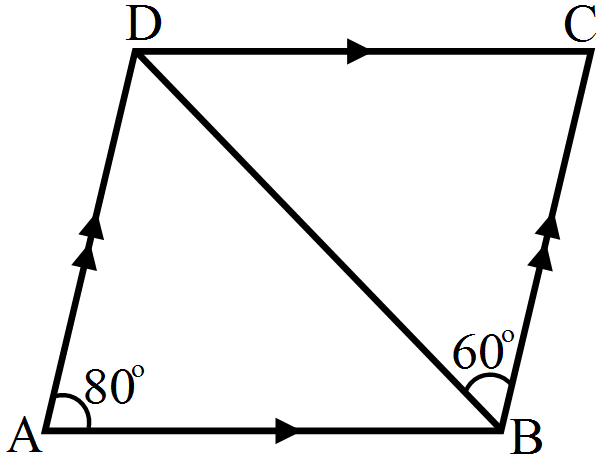
In the adjoining figure, ABCD is a parallelogram in which $\angle\text{DAB}=80^{\circ}$ and $\angle\text{DBC}=60^{\circ}.$ Calculate $\angle\text{CDB}$ and $\angle\text{ADB}.$
Divide $p(x)$ by $g(x),$ where $p(x) = x + 3x^2 – 1$ and $g(x) = 1 + x$
In a circle of radius $5\ cm, AB$ and $CD$ are two parallel chords of lengths $8\ cm$ and $6\ cm$ respectively. Calculate the distance between the chords if they are:
  1. On the same side of the centre.
  2. On the opposite sides of the centre.
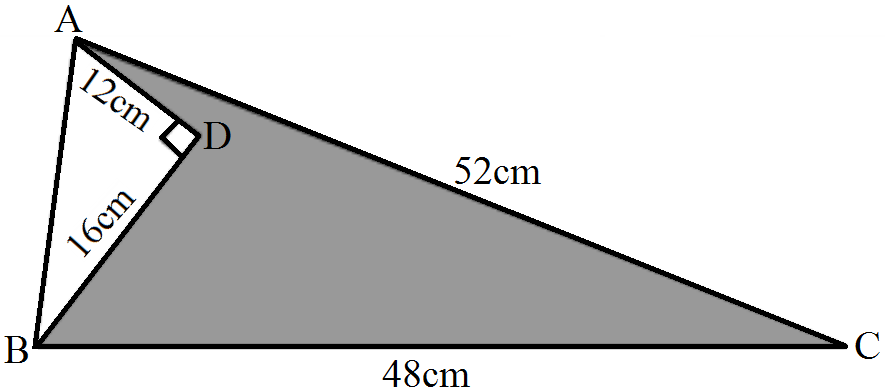
Find the area of the shaded region in the figure given below.
A triangle ABC is right angled at A. L is a point on BC such that AL $\perp$ BC. Prove that $\angle\text{BAL}=\angle\text{ACB}.$
ABCD is a rectangle in which diagonal AC bisects $\angle\text{A}$ as well as $\angle\text{C}.$ Show that:
  1. ABCD is a square
  2. diagonal BD bisects $\angle\text{B}$ as well as $\angle\text{D}.$​​​​​​​