Question
Prove that in a triangle, other than an equilateral triangle, angle opposite the longest side is greater than $\frac{2}{3}$ of a right angle.
Answer


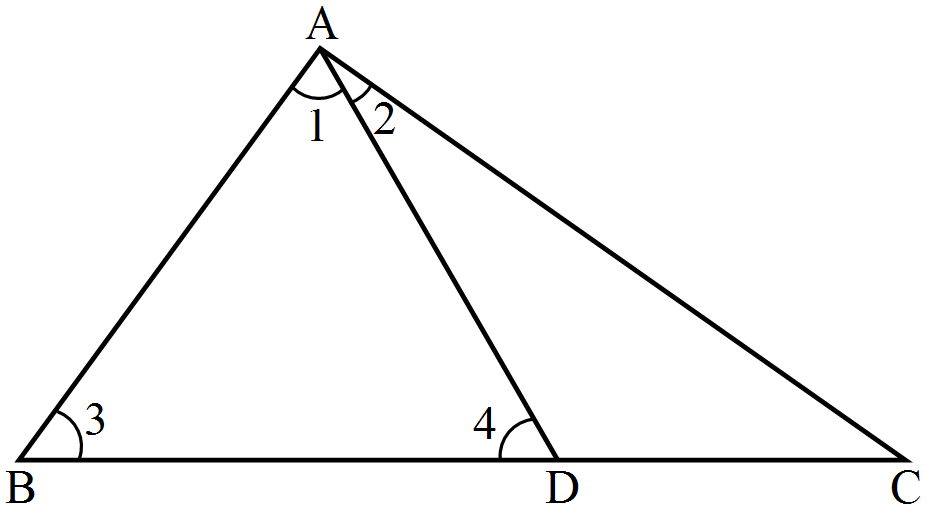
Given: In $\triangle\text{ABC, BC}$ is the longest side.
To prove: $\angle\text{BAC}>\frac{2}{3}$ of a right angle, i.e., $\angle\text{BAC}>60^{\circ}$
Construct: Mark a point D on side AC such that AD = AB = BD.
Proof:
In $\triangle\text{ABD,}$
$\because\text{AD = AB = BD}$ (By construction)
$\therefore\angle1=\angle3=\angle4=60^{\circ}$
Now,
$\angle\text{BAC}=\angle1+\angle2=60^{\circ}+\angle2$
but $60^{\circ}=\frac{2}{3}$ of a right angle
So, $\angle\text{BAC}=\frac{2}{3}$ of a right angle + $\angle2$
Hence, $\angle\text{BAC}>\frac{2}{3}$ of a right angle.

Need a full question paper?

Generate a complete, print-ready paper with questions like this in minutes — across 16+ boards, with answer keys.
Start Generating Free

Similar questions

The factors of $8a^3 + b^3 - 6ab + 1$ are:
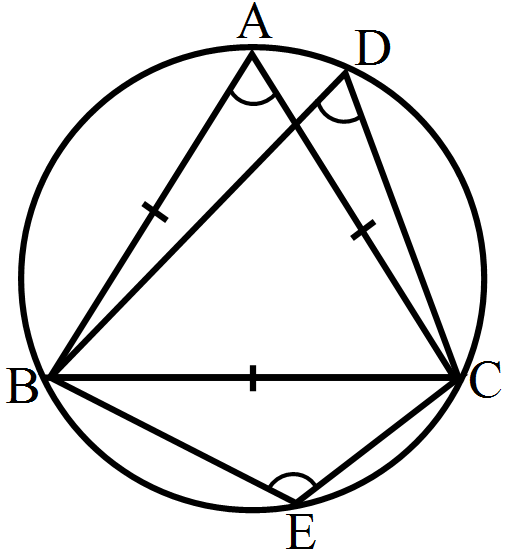
In the given figure, $\triangle\text{ABC}$ is equilateral. Find 
  1. $\angle\text{BDC}$
  2. $\angle\text{BEC}$
If two straight lines intersect in such a way that one of the angles formed measures 90°, show that each of the remaining angles measures 90°.
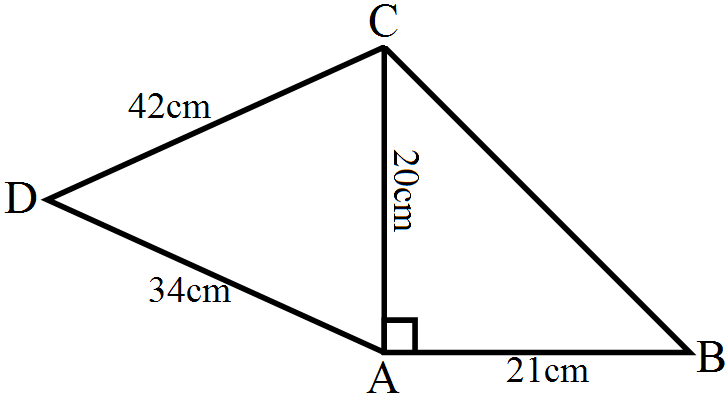
Find the perimeter and area of a qudrilateral $\text{ABCD}$ in which$ AB = 21\ cm,\angle\text{BAC}=90^\circ, AC = 20\ cm, CD = 42\ cm,$ and $AD = 34\ cm.$
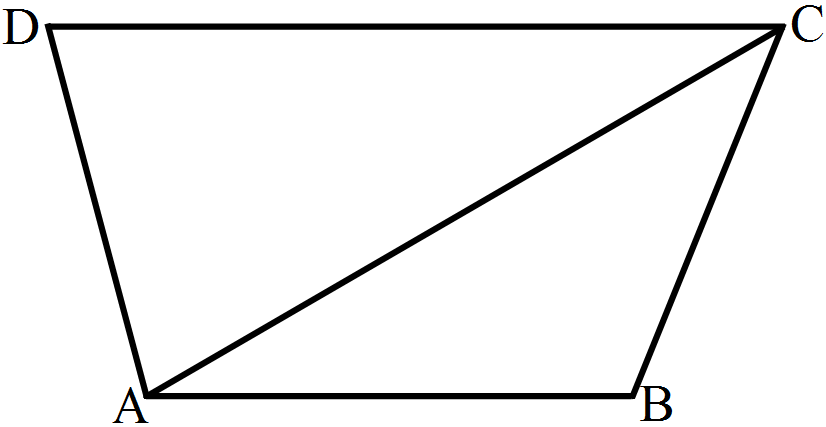
In the adjoining figure, ABCD is a quadrilateral and AC is one of its diagonals. Prove that:
(i) AB + BC + CD + DA > 2AC
(ii) AB + BC + CD > DA
(iii) AB + BC + CD + DA > AC + BD
Give a geometrical construction for finding the fourth point lying on a circle passing through three given points, without finding the centre of the circle. Justify the construction.
A soft drink is available in two packs:
  1. A tin can with a rectangular base of length $5\ cm,$ breadth $4\ cm$ and height $15\ cm.$
  2. A plastic cylinder with circular base of diameter $7\ cm$ and height $10\ cm.$
Which container has greater capacity and by how much?
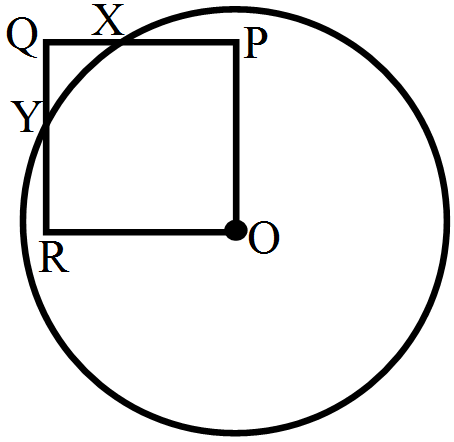
In the adjoining figure, OPQR is a square. A circle drawn with centre O cuts the square at X and Y. Prove that QX = QY.
Draw the graph of the equation, 3x + 2y = 6.
Find the coordinates of the point where the graph cuts the y-axis.
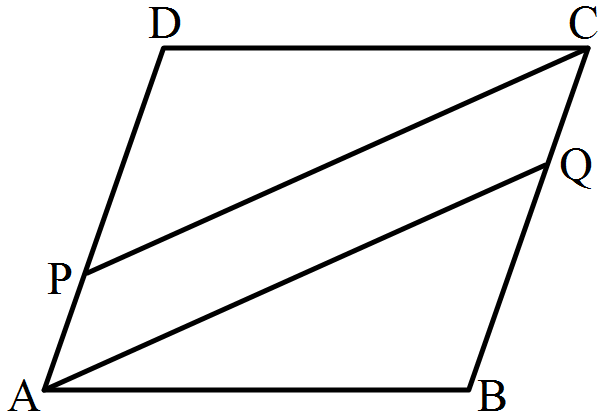
In the adjoining figure, ABCD is a parallelogram. If P and Q are points on AD and BCrespectively such that $\text{AP}=\frac{1}{2}\text{AD}$ and $\text{CQ}=\frac{1}{2}\text{BC},$ prove that AQCP is a parallelogram.