Question
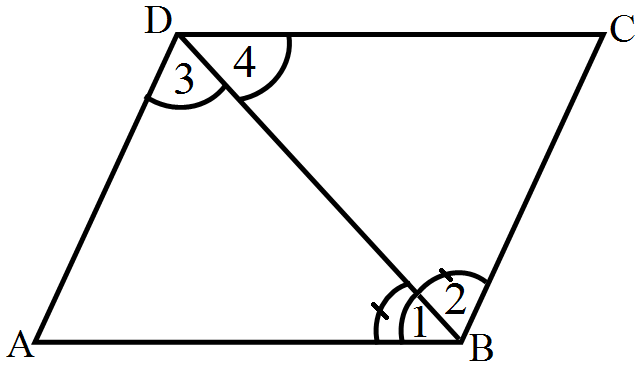
ABCD is a rectangle in which diagonal BD bisects $\angle\text{B}.$ Show that ABCD is a square.
Answer

Given: A rectangle ABCD in which diagonal BD bisects $\angle\text{B}$

To prove: ABCD is a square.

Proof: DC || AB [Opposite sides of a rectangle are parallel]

$\Rightarrow\ \angle4=\angle1\ ...(\text{i})$ [Alternate interior angles]

Similarly, $\angle3=\angle2\ ...(\text{ii})$ [Alternate interior angles]

And $\angle1=\angle2\ ...(\text{iii})$ [Given]

From equation (1), (2) and (3), we get

$\angle3=\angle4$

In $\Delta\text{BAD}$ and $\Delta\text{BDC}$ we have

$\angle1=\angle2$[Given]

BD = BD[Common side)

$\angle3=\angle4$ [proved above]

So, By ASA criterion of congruence, we have

$\Delta\text{BAD}\cong\Delta\text{BCD}$

$\therefore\ \text{AB}=\text{BC}$ [CPCT]

As, adjacent sides of rectangle are equal. So, ABCD is a square.

Need a full question paper?

Generate a complete, print-ready paper with questions like this in minutes — across 16+ boards, with answer keys.

Start Generating Free

Similar questions

It being given that $\sqrt{3}=1.732,\sqrt{5}=2.236,\sqrt{6}=2.449$ and $\sqrt{10}=3.162,$ find to three places of decimal, the value of the following:
$\frac{3+\sqrt{5}}{3-\sqrt{5}}$
Draw different pairs of circles. How many points does each pair have in common? What is the maximum number of common points?
In the given figure, ABCD is a rectangle with sides AB = 10cm and AD = 5cm. Find the area of $\triangle\text{EFG}.$

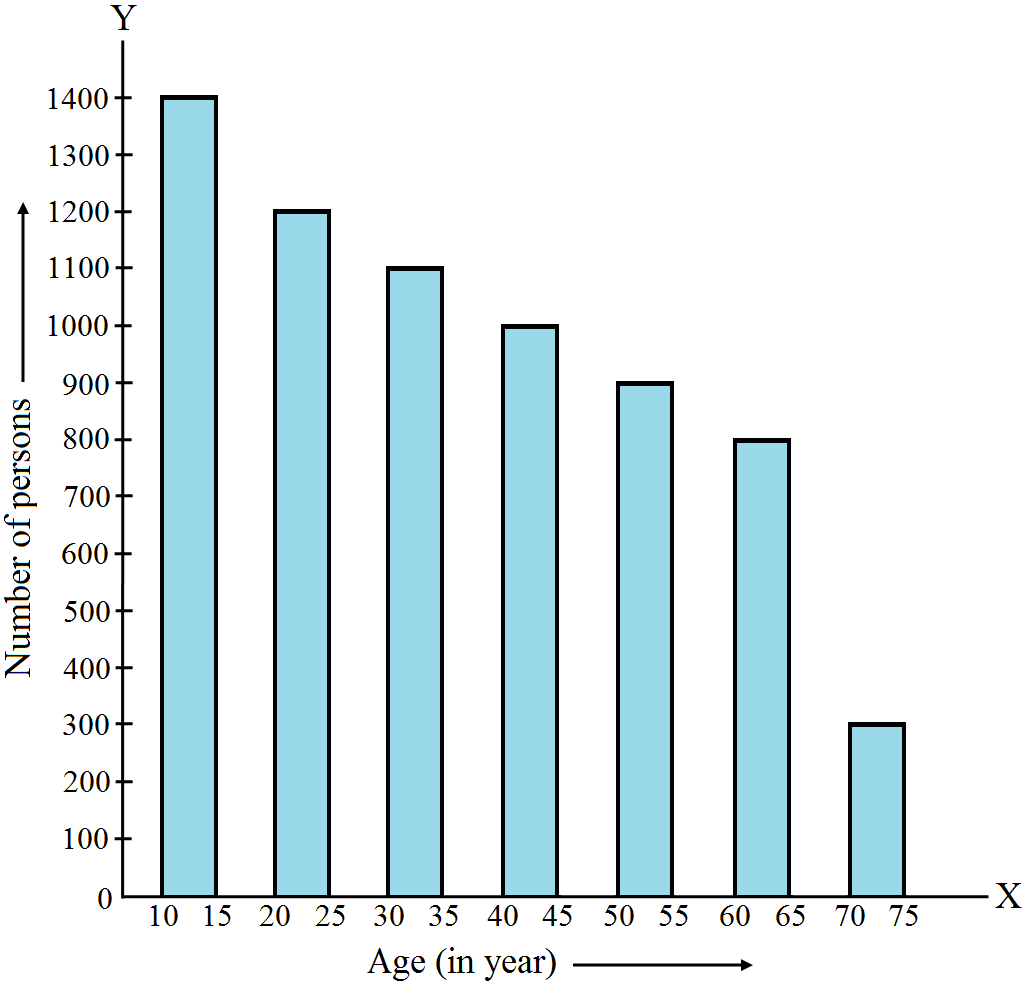
Study the bar graph representing the number of persons in various age groups in a town shown in figure Observe the bar graph and answer the following questions:
  1. What is the percentage of the youngest age-group persons over those in the oldest age group?
  2. What is the total population of the town?
  3. What is the number of persons in the age-group 60–65?
  4. How many persons are more in the age-group 10–15 than in the age group 30–35?
  5. What is the age-group of exactly 1200 persons living in the town?
  6. What is the total number of persons living in the town in the age-group 50–55?
  7. What is the total number of persons living in the town in the age-groups 10 – 15 and 60 – 65?

  1. Whether the population in general increases, decreases or remains constant with the increase in the age-group.
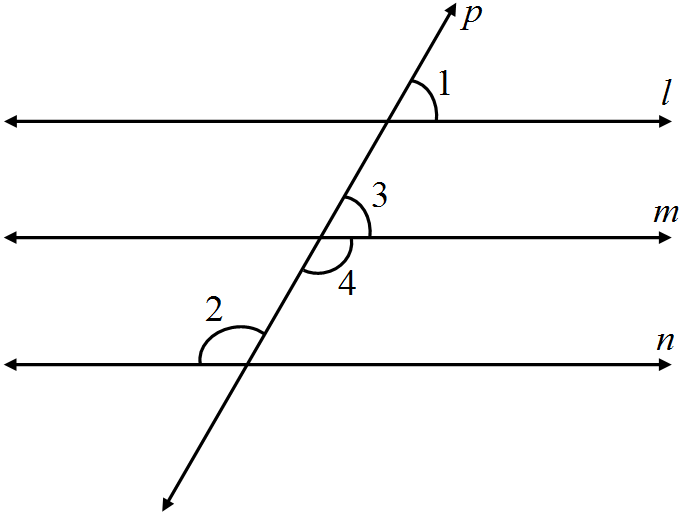
In figure, if l ∥ m ∥ n and $\angle{1}=60^\circ,$ Find $\angle{2}.$

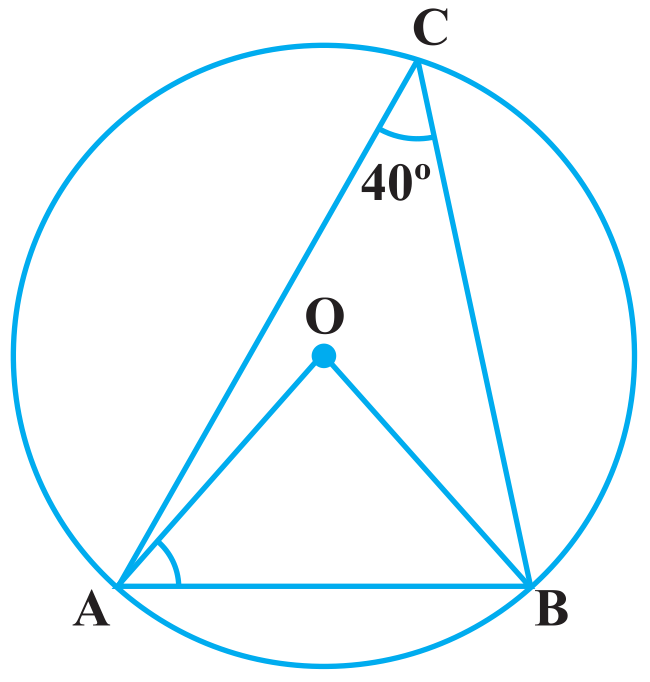
In Fig. $\angle\text{ACB}=40^\circ$. Find $\angle\text{OAB}.$

Suppose you are given a circle. Give a construction to find its centre.
Find the length of a chord which is at a distance of 4cm from the centre of a circle of radius 6cm.
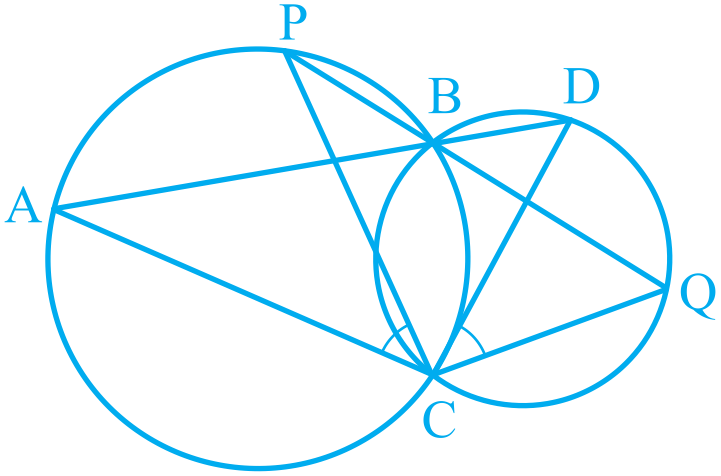
Two circles intersect at two points B and C. Through B, two line segments ABD and PBQ are drawn to intersect the circles at A, D and P, Q respectively Prove that $\angle\text{ACP}=\angle\text{QCD}.$

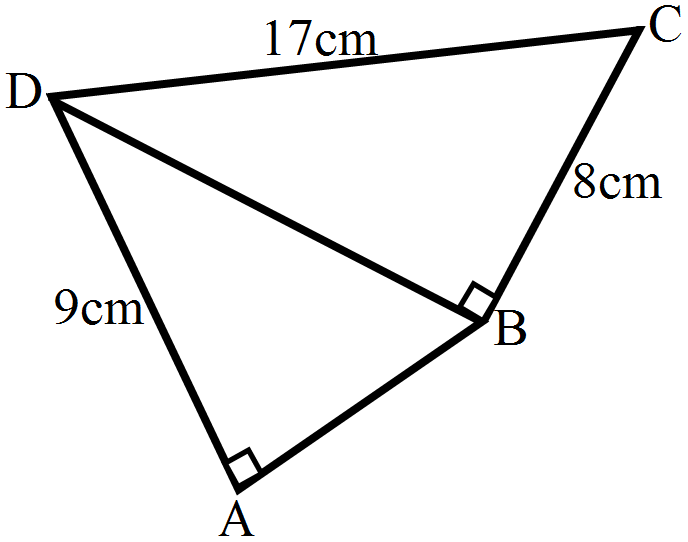
Calculate the area of quadrilateral ABCD, given in Figure (i).