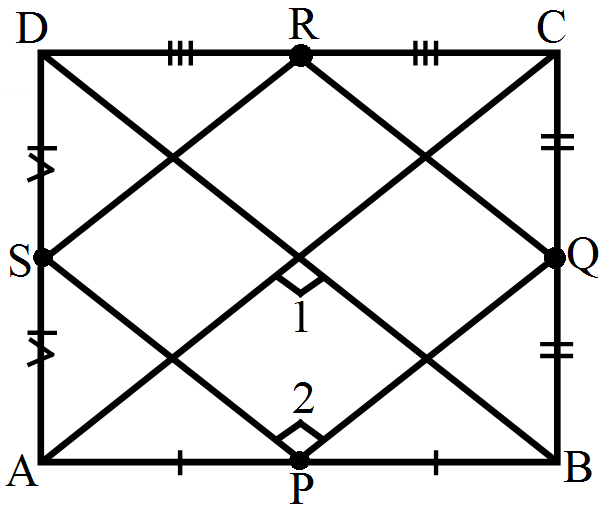
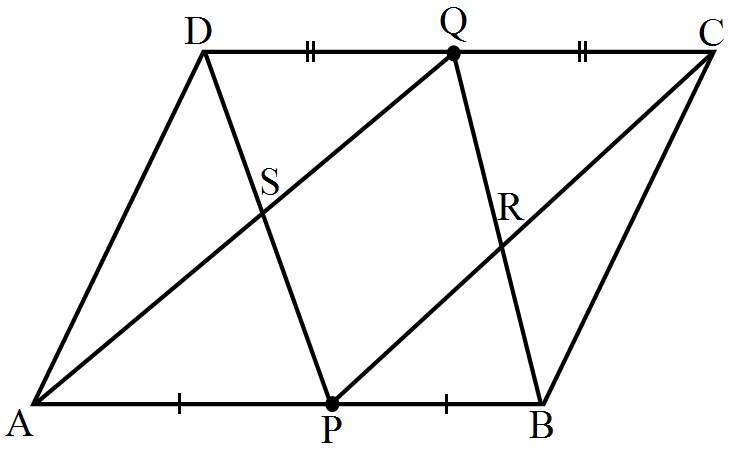
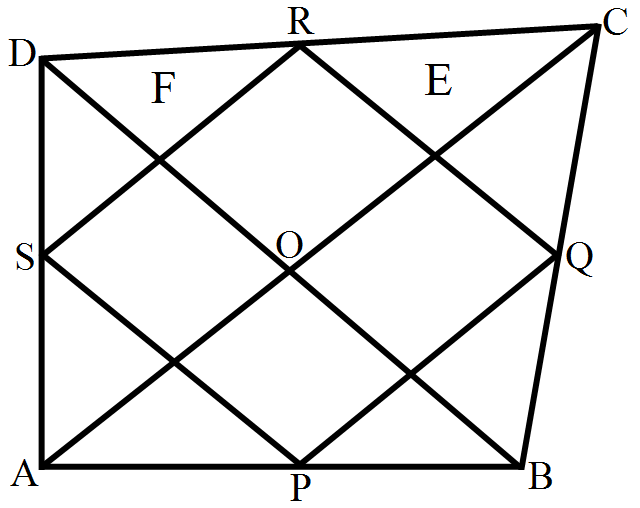
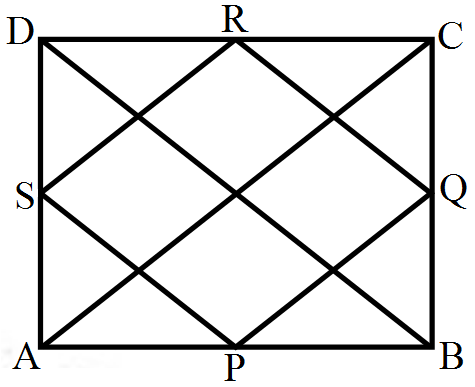
Given in a square ABCD, P Q R and S are the mid-points of AB, BC, CD and DA, respectively.
To show PQRS is a square.
Construction Join AC and BD.
Proof Since, ABCD is a square.
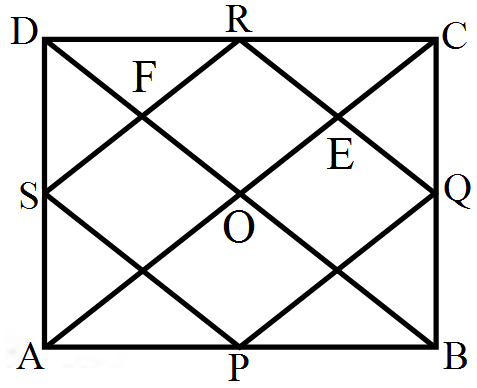
$\therefore$ AB = BC = CD = AD
Also, P. Q. R and S are the mid-points of AB, BC, CD and DA
respectively.
Then, in $\Delta\text{ADC}$
and $\text{SR}=\frac{1}{2}=\text{AC}$ [by mid-point theorem]...(i)
In $\Delta\text{ABC},$ PQ || AC
and $\text{PQ}=\frac{1}{2}\text{AC}\ ...(\text{ii})$
From Eqs. (i) and (ii).
SR || PQ and $\text{SR}=\text{PQ}=\frac{1}{2}\text{AC}\ ...(\text{iii})$
Similarly, SP || BD and BD || RQ
$\therefore$ SP || RQ and $\text{SP}=\frac{1}{2}\text{BD}$
and $\text{RQ}=\frac{1}{2}\text{BD}$
$\therefore\ \text{SP}=\text{RQ}=\frac{1}{2}\text{BD}$
Since, diagonals of a square bisect each other at right angle.
$\therefore$ AC = BD
$\text{SP}=\text{RQ}=\frac{1}{2}\text{AC}\ ...(\text{iv})$
From Eqs. (i) and (iv). $\text{SR}=\text{PQ}=\text{SP}=\text{RQ}$ [all side are equal]
Now, in quadrilateral OERF,
OE || FR and OF || ER
$\angle\text{EOF}=\angle\text{ERF}=90^\circ$
Hence, PQRS is a square. Hence proved.
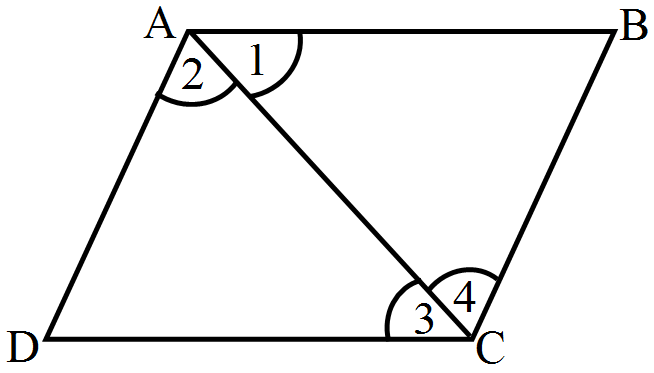
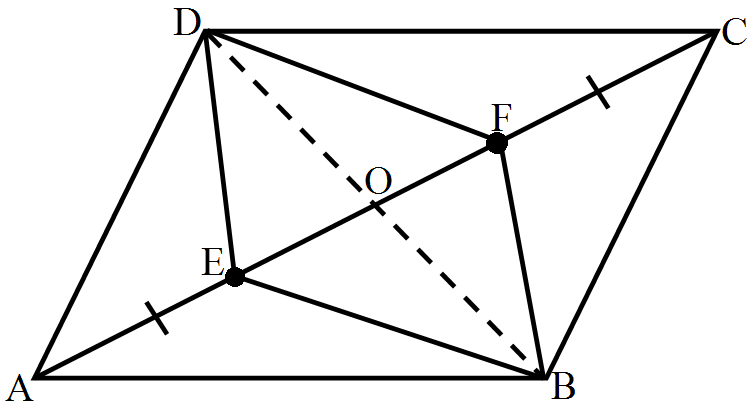 To prove: BFDE is parallelogram. Proof: ABCD is a parallelogram.