MCQ
Acceleration of a particle, executing $SHM$, at it’s mean position is
  • A
    Infinity
  • B
    Varies
  • C
    Maximum
  • Zero

Answer

Correct option: D.
Zero
d

So acceleration is minimum (zero).

Need a full question paper?

Generate a complete, print-ready paper with questions like this in minutes — across 16+ boards, with answer keys.

Start Generating Free

Similar questions

Two similar springs $P$ and $Q$ have spring constants $K_P$ and $K_Q$, such that $K_P > K_Q .$ They are stretched first by the same amount (case $a$), then by the same force (case $b$). The work done by the springs $W_P$ and $W_Q$ are related as, in case $(a)$ and case $(b)$ respectively
A piece of gold weighs $10 \,g$ in air and $9 \,g$ in water. What is the volume of cavity is ...... $cc$ (Density of gold $=19.3 \,g cm ^{-3}$ )
The dimensions of four wires of the same material are given below. In which wire the increase in length will be maximum when the same tension is applied
A bubble has surface tension $S$. The ideal gas inside the bubble has ratio of specific heats $\gamma=\frac{5}{3}$. The bubble is exposed to the atmosphere and it always retains its spherical shape. When the atmospheric pressure is $P_{a 1}$, the radius of the bubble is found to be $r_1$ and the temperature of the enclosed gas is $T_1$. When the atmospheric pressure is $P_{a 2}$, the radius of the bubble and the temperature of the enclosed gas are $r_2$ and $T_2$, respectively.

Which of the following statement($s$) is(are) correct?

$(A)$ If the surface of the bubble is a perfect heat insulator, then $\left(\frac{r_1}{r_2}\right)^5=\frac{P_{a 2}+\frac{2 S}{r_2}}{P_{a 1}+\frac{2 S}{r_1}}$

$(B)$ If the surface of the bubble is a perfect heat insulator, then the total internal energy of the bubble including its surface energy does not change with the external atmospheric pressure.

$(C)$ If the surface of the bubble is a perfect heat conductor and the change in atmospheric temperature is negligible, then $\left(\frac{r_1}{r_2}\right)^3=\frac{P_{a 2}+\frac{4 S}{r_2}}{P_{a 1}+\frac{4 S}{r_1}}$.

$(D)$ If the surface of the bubble is a perfect heat insulator, then $\left(\frac{T_2}{T_1}\right)^{\frac{5}{2}}=\frac{P_{a 2}+\frac{4 S}{r_2}}{P_{a 1}+\frac{4 S}{r_1}}$.
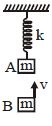
Block $A$ is hanging from a vertical spring and it is at rest. Block $'B'$ strikes the block $'A'$ with velocity $v$ and stick to it. Then the velocity $v$ for which the spring just attains natural length is:
$Pascal-Second$ has dimension of
If mass is written as $\mathrm{m}=\mathrm{kc}^{\mathrm{p}} \mathrm{G}^{-1 / 2} \mathrm{~h}^{1 / 2}$ then the value of $P$ will be : (Constants have their usual meaning with $\mathrm{k}$ a dimensionless constant)
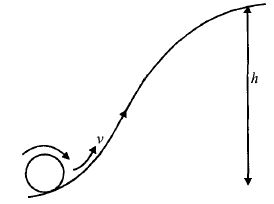
A solid sphere is rolling on a surface as shown in figure, with a translational velocity $v\,ms^{-1}$. If it is to climb the inclined surface continuing to roll without slipping, then minimum velocity for this to happen is
A particle is projected vertically upwards from $O$ with velocity $v$ and a second particle is projected at the same instant from $P$ (at a height h above $O$) with velocity $v$ at an angle of projection $\theta$ . The time when the distance between them is minimum is
Which is correct relation