MCQ
$Pascal-Second$ has dimension of
  • A
    Force
  • B
    Energy
  • C
    Pressure
  • Coefficient of viscosity

Answer

Correct option: D.
Coefficient of viscosity
d
Pascal is unit of pressure, hence its dimensional formula is

$\left[M L^{-1} T^{-2}\right]$

$\therefore$ Dimensional formula of Pascal-second is $\left[M L^{-1} T^{-1}\right]$

By the formula of coefficient of viscosity, we have

$\eta=\frac{F}{A(\Delta v / \Delta z)}$

where $F$ is force, $A$ is area and $\frac{\Delta v}{\Delta z}$ is velocity gradient.

$\therefore$ Dimensions of $\eta=\frac{\left[M L T^{-2}\right]}{\left[L^{2}\right]\left[L T^{-1} / L\right]}$

$=\left[M L^{-1} T^{-1}\right]$

Hence, Pascal-second has dimensions of coefficient of viscosity.

Need a full question paper?

Generate a complete, print-ready paper with questions like this in minutes — across 16+ boards, with answer keys.
Start Generating Free

Similar questions

What is the value of linear velocity, if $\vec \omega = 3\hat i - 4\hat j + \hat k$ and $\vec r = 5\hat i - 6\hat j + 6\hat k$
A ball is projected from the ground with a speed $15 \,ms ^{-1}$ at an angle $\theta$ with horizontal so that its range and maximum height are equal, then $tan\,\theta$ will be equal to 
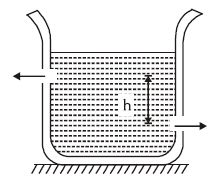
There are two identical small holes of area of cross-section a on the opposite sides of a  tank containing a liquid of density $\rho$. The difference in height between the holes is $h$. Tank  is resting on a smooth horizontal surface. Horizontal force which will have to be  applied on the tank to keep it in equilibrium is
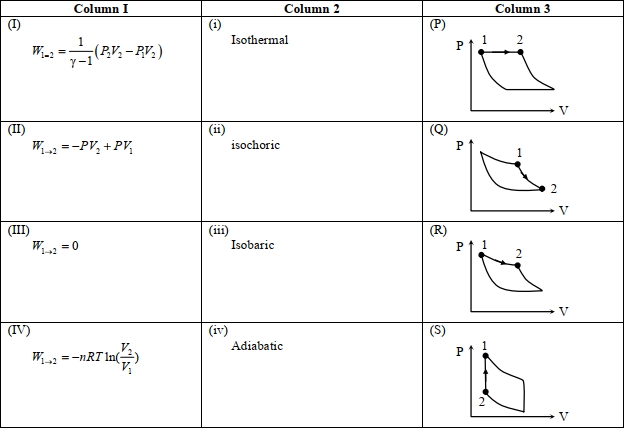
An ideal gas is undergoing a cyclic thermodynamic process in different ways as shown in the corresponding $P$ $V$ diagrams in column $3$ of the table. Consider only the path from state $1$ to $2 . W$ denotes the corresponding work done on the system. The equations and plots in the table have standard notations as used in thermodynamic processes. Here $\gamma$ is the ratio of heat capacities at constant pressure and constant volume. The number of moles in the gas is $n$.

(image)

($1$) Which of the following options is the only correct representation of a process in which $\Delta U=\Delta Q-P \Delta V$ ?

$[A] (II) (iv) (R)$    $[B] (II) (iii) (P)$    $[C] (II) (iii) (S)$   $[D] (III) (iii) (P)$

($2$)  Which one of the following options is the correct combination?

$[A] (III) (ii) (S)$    $[B] (II) (iv) (R)$   $[C] (II) (iv) (P)$   $[D] (IV) (ii) (S)$

($3$) Which one of the following options correctly represents a thermodynamic process that is used as a correction in the determination of the speed of sound in an ideal gas?

$[A] (III) (iv) (R)$  $[B] (I) (ii)$ $(\mathrm{Q})$   $[C] (IV) (ii) (R)$    $[D] (I) (iv) (Q)$
The angle between the two vectors $\overrightarrow A = 5\hat i + 5\hat j$ and $\overrightarrow B = 5\hat i - 5\hat j$ will be ....... $^o$
A barometer is constructed using a liquid (density $\left.=760 \;kg / m ^{3}\right) .$ What would be the height  (In $m$) of the liquid column, when a mercury barometer reads $76 \;cm ?$ (density of mercury $\left.=13600 \;kg / m ^{3}\right)$
$100$ coplanar forces each equal to $10 \,N$ act on a body. Each force makes angle $\pi /50$ with the preceding force. What is the resultant of the forces.......... $N$
A cyclist is travelling with velocity $v$ on a curved road of radius $R$. The angle $\theta$  through which the cyclist leans inwards is given by
A projectile is thrown in the upward direction making an angle of $60^o $ with the horizontal direction with a velocity of $147\ ms^{-1}$ . Then the time after which its inclination with the horizontal is $45^o $ , is    ......... $\sec$
A car goes around uniform circular track of radius $R$ at a uniform speed $v$ once in every $T$ seconds. The magnitude of the centripetal acceleration is $a_c$. If the car now goes uniformly around a larger circular track of radius $2 R$ and experiences a centripetal acceleration of magnitude $8 a_c$. Then, its time period is