According to Joule's law, if the potential difference across a conductor having a material of specific resistance remains constant, then the heat produced in the conductor is directly proportional to
Medium


Download our appand get started for free
Experience the future of education. Simply download our apps or reach out to us for more information. Let's shape the future of learning together!No signup needed.*
Similar Questions
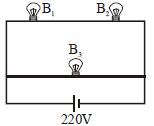
- 1A $100\, W \, bulb\, B_1$ and two $60\, W \,bulbs \,B_2$ and $B_3$, are connected to a $220\, V$ source, as shown in Figure. Now $P_1, P_2$ and $P_3$ are the output powers of the bulbs $B_1, B_2$ and $B_3$ respectively. ThenView Solution
- 2The total momentum of electrons in a straight wire of copper of length $1\, metre$ carrying a current of $16\, A$ isView Solution
- 3Three equal resistors connected in series across a source of $e.m.f.$ together dissipate $10\, watt$. If the same resistors are connected in parallel across the same $e.m.f.$, then the power dissipated will be .............. $watt$View Solution
- 4A current of $2.0$ ampere passes through a cell of $e.m.f$. $1.5\, volts$ having internal resistance of $0.15\, ohm$. The potential difference measured, in $volts$, across both the ends of the cell will beView Solution
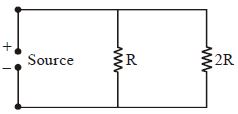
- 5The charge supplied by source varies with time $'t'$ as $Q = at -bt^2$. The total heat produced in the resistor $2R$ before current reduces to zeroView Solution
- 6If the current through a resistor in a circuit increases by $3 \%$, then the power dissipated by the resistorView Solution
- 7Two wires of same metal have the same length but their cross-sections are in the ratio $3:1$. They are joined in series. The resistance of the thicker wire is $10\,\Omega $. The total resistance of the combination will be ............. $\Omega$View Solution
- 8In the following $'I'$ refers to current and other symbols have their usual meaning, Choose the option that corresponds to the dimensions of electrical conductivityView Solution
- 9A uniform wire of resistance $9$ $\Omega$ is cut into $3$ equal parts. They are connected in the form of equilateral triangle $ABC$. A cell of $e.m.f.$ $2\,V$ and negligible internal resistance is connected across $B$ and $C$. Potential difference across $AB$ is ............... $V$View Solution
- 10View SolutionElectric current has both magnitude and direction. It is a