MCQ
According to Lewis concept of acids and bases, ether is
  • A
    Acidic
  • Basic
  • C
    Neutral
  • D
    Amphoteric

Answer

Correct option: B.
Basic
b
(b) Ether is basic because lone pairs of electrons are present on oxygen atom, $R - \mathop {\mathop O\limits_{ \bullet \, \bullet } }\limits^{ \bullet \, \bullet } - R$.

Need a full question paper?

Generate a complete, print-ready paper with questions like this in minutes — across 16+ boards, with answer keys.
Start Generating Free

Similar questions

Phosgene is the common name of
At $STP$, for complete combustion of $3\, g \,C_2H_6$ the required volume of $O_2$ will be - ............. $\mathrm{litre}$
In a linear tetrapeptide (Constituted with different amino acids), (number of amino acids) - (number of peptide bonds) is
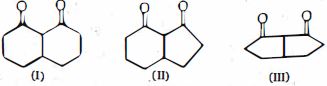
The correct decreasing order in the enol 'content of following molecules is
$4.48$  $litre$ of an ideal gas at $1$ $atm$ & $273$ $K$ requires $12$ calorie to raise the temperature by $15\,^oC$ at constant volume. The $C_p$ of the gas is..... $cal$
Which of the following compounds does give $N_2$ on heating?
Number of unpaired electrons in inert gas is
Consider the following statements for diborane 

$1.$  Boron is approximately $sp^3$ hybridized

$2.$  $B-H-B$ angle is $180^o$

$3.$  There are two terminal $B-H$ bonds for each boron atom

$4.$  There are only $12$ bonding electrons available

Of these statements

Arrange these esters in decreasing order of case of esterfication with $C{H_3}OH/{H^ \oplus }$ :

$(I)$ $\begin{array}{*{20}{c}}
  {C{H_3} - CH - COOH} \\ 
  {|\,\,\,\,\,\,\,\,\,\,\,\,\,\,} \\ 
  {C{H_3}\,\,\,\,\,\,\,} 
\end{array}$

$(II)$  $\begin{array}{*{20}{c}}
  {C{H_3} - CH - C{H_2} - COOH} \\ 
  {|\,\,\,\,\,\,\,\,\,\,\,\,\,\,\,\,\,\,\,\,\,\,\,\,\,\,\,\,\,\,} \\ 
  {C{H_3}\,\,\,\,\,\,\,\,\,\,\,\,\,\,\,\,\,\,\,\,\,\,} 
\end{array}$

$(III)$ $\begin{array}{*{20}{c}}
  \,\,{C{H_3}} \\ 
  {|\,\,\,\,\,\,\,\,} \\ 
  {C{H_3} - C - COOH} \\ 
  {|\,\,\,\,\,\,} \\ 
  \,\,{C{H_3}\,} 
\end{array}$

$(IV)$ $(CH_3-CH_2)_3C-COOH$

Starting with three different amino acid molecules, how many different tripeptide molecules are formed