MCQ
According to Werner's theory
  • Primary valency can be ionized
  • B
    Secondary valency can be ionized
  • C
    Primary and secondary valencies both cannot be ionized
  • D
    Only primary valency cannot be ionized

Answer

Correct option: A.
Primary valency can be ionized
a
It’s obvious.

Need a full question paper?

Generate a complete, print-ready paper with questions like this in minutes — across 16+ boards, with answer keys.

Start Generating Free

Similar questions

Which of the following statement does not form part of Bohr's model of the hydrogen atom
The uncertainty in momentum of an electron is $1 \times {10^{ - 5}}kg - m/s$. The uncertainty in its position will be ($h = 6.62 \times {10^{ - 34}}\,kg - {m^2}/s$)
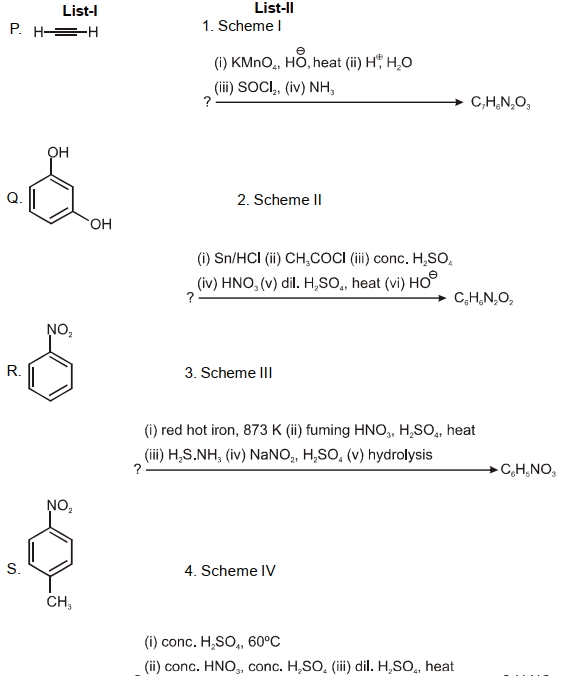
Match the four starting materials $( P , Q , R , S$ ) given in List $I$ with the corresponding reaction schemes $(I, II, III, IV)$ provided in List $II$ and select the correct answer using the code given below the lists. $Image$

Codes: $ \quad P \quad Q \quad R \quad S$
Anhydrous $ALCl_3$ is covalent however,when it is dissolved in water hydrared ionic species are formed. This transformation is owing to
$C_2H_5 -Br + CH_3ONa \to A \xrightarrow[{(cold)}]{{HI}} B,$ product $B$ is
What would be the product formed when $1\,-$ Bromo $-3-$ chloro cyclobutane reacts with two equivalents of metallic sodium in ether
Dilute nitric acid on reaction with $Ag$ liberates
Given below are two statements :

Statement $I$: Aniline reacts with con. $\mathrm{H}_2 \mathrm{SO}_4$ followed by heating at $453-473 \mathrm{~K}$ gives $\mathrm{p}$ aminobenzene sulphonic acid, which gives blood red colour in the 'Lassaigne's test'.

Statement $II$: In Friedel - Craft's alkylation and acylation reactions, aniline forms salt with the $\mathrm{AlCl}_3$ catalyst. Due to this, nitrogen of aniline aquires a positive charge and acts as deactivating group.

In the light of the above statements, choose the correct answer from the options given below :

Given below are two statements:

Statement $I$: Fluorine has most negative electron gain enthalpy in its group.

Statement $II$: Oxygen has least negative electron gain enthalpy in its group.

In the light of the above statements, choose the most appropriate from the options given below.

At $143 K$. the reaction of $XeF _4$ with $O _2 F _2$ produces a xenon compound $Y$. The total number of lone pair($s$) of electrons present on the whole molecule of $Y$ is. . . . .