Question
  1. Account for the following:
  1. Ozone is thermodynamically unstable.
  2. Solid $PCl_5$ is ionic in nature.
  3. Fluorine forms only one oxoacid HOF.
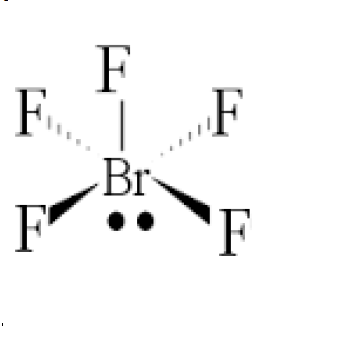
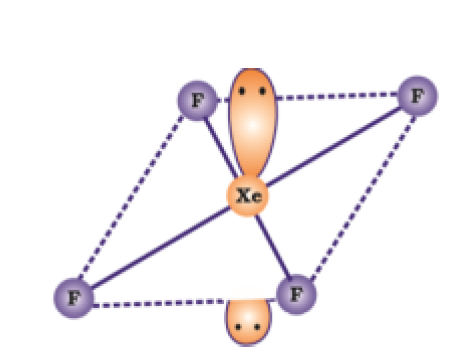
  1. Draw the structure of
  1. $BrF_{5.}$​​​​​​​
  2. $XeF_{4.}​​​​​​​$​​​​​​​

Answer

  1.  
  1. Endothermic compound/decomposition of ozone is exothermic in nature and $\Delta $G is negative/decomposition of ozone is spontaneous.
  2. Exists as $[PCl_4]^+[PCl_6]^-$
  3. Shows only $-1$ oxidation state/most electronegative element/absence of d-orbitals.
  1.  
  1.  

Need a full question paper?

Generate a complete, print-ready paper with questions like this in minutes — across 16+ boards, with answer keys.
Start Generating Free

Similar questions

How does colour appear in coordination compounds? Its explanation is based on crystal field theory.
Image
Describe the physical properties of amines.
  1. When concentrated sulphuric acid was added to an unknown salt present in a test tube a brown gas (A) was evolved. This gas intensified when copper turnings were added to this test tube. On cooling, the gas (A) changed into a colourless solid (B).
  1. Identify (A) and (B).
  2. Write the structures of (A) and (B).
  3. Why does gas (A) change to solid on cooling?
  1. Arrange the following in the decreasing order of their reducing character:
HF, HCl, HBr, HI
  1. Complete the following reaction:
$\text{XeF}_4+\text{SbF}_5\xrightarrow{\ \ \ \ \ \ \ \ }$
Match the items of Columns I and II and mark the correct option.
  Column I   Column II
$(A)$ Its partial hydrolysis does not change oxidation state of central atom $(1)$ $He$
$(B)$ It is used in modern diving apparatus $(2)$ $XeF_6$
$(C)$ It is used to provide inert atmosphere for filling electrical bulbs $(3)$ $XeF_4$
$(D)$ Its central atom is in $sp^3d^2$ hybridisation $(4)$ $Ar$
  1. $A (1) B (4) C (2) D (3)$
  2. $A (1) B (2) C (3) D (4)$
  3. $A (2) B (1) C (4) D (3)$
  4. $A (1) B (3) C (2) D (4)$
What do you understand by shape selective catalysis? Why are zeolites good shape selective catalysts?
Derive a formula to determine the molar mass of a solute by depression of freezing point.
Write the IUPAC names of the following coordination compounds:
i. $\left[ Co \left( NH _3\right) 6\right] Cl _3$
ii. $\left[ Co \left( NH _3\right)_5 Cl \right] Cl _2$
iii. $K_3\left[ Fe ( CN )_6\right]$
iv. $K_3\left[ Fe \left( C _2 O _4\right)_3\right]$
v. $K_2\left[P_{d C l}^4\right]$
vi. $\left[ Pt \left( NH _3\right)_2 Cl \left( NH _2 CH _3\right)\right] Cl$
Assign reasons for the following:
  1. Sulphur vapour is paramagnetic.
  2. Ammonia $(NH_3)$ has greater affinity for protons than phosphine $(PH_3)$.
  3. The negative value of electron gain enthalpy of fluorine is less than that of chlorine.
  4. $SF_6$​​​​​​​ is much less reactive than $SF_4$​​​​​​​.
  5. Of the noble gases only xenon is known to form well-established chemical compounds.
What is meant by stability of a coordination compound in solution? State the factors which govern stability of complexes.