MCQ
Acetamide changes into methylamine by
  • Hofmann bromamide reaction
  • B
    Hofmann reaction
  • C
    Friedel-Craft's reaction
  • D
    Hinsberg reaction

Answer

Correct option: A.
Hofmann bromamide reaction
a
Acetamide changes into methylamine by hoffman bromamide reaction. Hoffmann bromamide Reaction; When an amide is treated with bromine in an aqueous or ethanolic solution of sodium hydroxide, degradation of amide takes place leading to the formation of primary amine.

Need a full question paper?

Generate a complete, print-ready paper with questions like this in minutes — across 16+ boards, with answer keys.

Start Generating Free

Similar questions

Assertion : Sucrose undergoes mutarotation.
Reason : Sucrose is a disaccharide
What products are expected from the disproportionation reaction of hypochlorous acid?
$2-$ hexene $\longrightarrow$ Products

The two products formed in above reaction are -

Consider the sulphides $\mathrm{HgS}, \mathrm{PbS}, \mathrm{CuS}, \mathrm{Sb}_{2} \mathrm{~S}_{3}$, $\mathrm{As}_{2} \mathrm{~S}_{3}$ and $\mathrm{CdS}$. Number of these sulphides soluble in $50\, \% \,\mathrm{HNO}_{3}$ is .... .
Calcium cyanamide on treatment with steam produces:
Given below are two statements:

Statements$-I :$ In Hofmann degradation reaction, the migration of only an alkyl group takes place from carbonyl carbon of the amide to the nitrogen atom.

Statement$-II :$ The group is migrated in Hofmann degradation reaction to electron deficient atom.

In the light of the above statement, choose the most appropriate answer from the options given below

Sodium is made by the electrolysis of a molten mixture of about $40\%$ $NaCl$ and $ 60\%$ $CaC{l_2}$ because
For the cell $\mathrm{Cu}(\mathrm{s})\left|\mathrm{Cu}^{2+}(\mathrm{aq})(0.1 \mathrm{M}) \| \mathrm{Ag}^{+}(\mathrm{aq})(0.01 \mathrm{M})\right| \mathrm{Ag}(\mathrm{s})$ the cell potential $\mathrm{E}_{1}=0.3095\, \mathrm{~V}$

For the cell $\mathrm{Cu}(\mathrm{s})\left|\mathrm{Cu}^{2+}(\mathrm{aq})(0.01 \mathrm{M}) \| \mathrm{Ag}^{+}(\mathrm{aq})(0.001 \mathrm{M})\right| \mathrm{Ag}(\mathrm{s})$ the cell potential $=.....\times 10^{-2} \mathrm{~V}$

(Round off to the Nearest Integer).

[Use: $\frac{2.303 \mathrm{RT}}{\mathrm{F}}=0.059$ ]

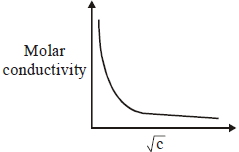
The variation of molar conductivity with concentration of an electrolyte $(X)$ in aqueous solution is shown in the given figure.

The electrolyte $X$ is :

Which of the following pairs is/are correctly matched?
  Reaction Product
$I$ $RX + AgCN$ $RNC$
$II$ $RX + KCN$ $RCN$
$III$ $RX + KNO_2$ (image)
$IV$ $RX + AgNO_2$ $R-O-N = O$