MCQ
$(A)\,\,C{H_3} - C{H_2} - C{H_2} - C{O_2}H$   $\begin{array}{*{20}{c}}
  {(B)\,\,C{H_3} - CH - C{H_{3\,\,}}} \\ 
  {\,\,\,\,\,\,\,\,\,\,|\,\,\,\,\,\,\,} \\ 
  {\,\,\,\,\,\,\,\,\,\,\,\,\,\,\,\,C{O_2}H\,\,\,} 
\end{array}\,$

$(A)$ and $(B)$ are

  • chain isomer
  • B
    position isomer
  • C
    functional isomer
  • D
    metamers

Answer

Correct option: A.
chain isomer
a

Need a full question paper?

Generate a complete, print-ready paper with questions like this in minutes — across 16+ boards, with answer keys.

Start Generating Free

Similar questions

Among the following ions the $p\pi  - d\pi $ overlap could be present in
If $20\, ml$ of $0.1\, M \,NaOH$ is added to $30\, ml$ of $0.2\, M \,CH_3COOH (pK_a =  4.74)$. Find $pH$ of resulting solution :-
The compound $HCl$  behaves as …. in the reaction, $HCl + HF \to H_2^ + Cl + {F^ - }$
Which of the following is a non-metal
Which pair represents chain isomer
With the help of following data, find out the change in heat content for the reaction

$C_2H_4(g) + H_2(g) \to C_2H_6(g)$

.......$kJ$

       Bond                        Bond energy $(kJ)$
       $C-H$

                       $413$

       $C-C$                       $348$
       $C=C$                       $610$
        $H-H$                       $436$
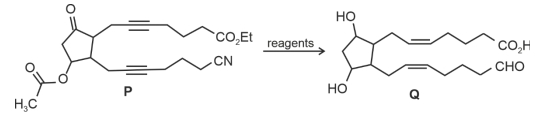
The option($s$) with correct sequence of reagents for the conversion of $P$ to $Q$ is(are)

$(A) i)$ Lindlar's catalyst, $H _2$; $ii$) $SnCl _2 / HCl$; iii) $NaBH _4$; iv) $H _3 O ^{+}$

$(B) i)$ Lindlar's catalyst, $H _2$; $ii$) $H _3 O ^{+}; iii)$ $SnCl _2 / HCl$; iv) $NaBH _4$

$(C) i)$ $NaBH _4; ii)$ $SnCl _2 / HCl; $iii$)$ $H _3 O ^{+}; iv)$ Lindlar's catalyst, $H _2$

$(D) i)$ Lindlar's catalyst, $H _2$; $ii$) $NaBH _4; iii)$ $SnCl _2 / HCl; iv)$ $H _3 O ^{+}$

In the reaction product $D$ is $\begin{array}{*{20}{c}}
  {C{H_2}} \\ 
  {||\,\,\,\,\,\,\,\,} \\ 
  {C{H_2}} 
\end{array}$ $\xrightarrow{{B{r_2}/CC{l_4}}}A\xrightarrow{{KCN}}B\xrightarrow{{{H_3}{O^ + }}}C\xrightarrow{\Delta }D$
Pure $(S)-2$ -butanol has a specific rotation of $+ 13.52$ degrees. A sample of $2$ -butanol prepared in the lab and purified by distillation has a calculated  specific rotation of $+6.76$ degrees. What can you conclude about the composition ?
Molecular orbital theory was developed mainly by