MCQ
Across a metallic conductor of non-uniform cross section a constant potential difference is applied. The quantity which remains constant along the conductor is
  • A
    current density
  • current
  • C
    drift velocity
  • D
    electric field

Answer

Correct option: B.
current
b
The area of cross section of conductor is non uniform so current density will be different but the flow of electrons will be uniform so current will be constant. 

Need a full question paper?

Generate a complete, print-ready paper with questions like this in minutes — across 16+ boards, with answer keys.
Start Generating Free

Similar questions

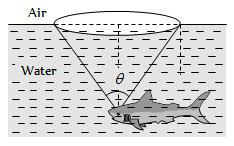
A fish is a little away below the surface of a lake. If the critical angle is 49°, then the fish could see things above the water surface within an angular range of θ° where

The dispersive power is maximum for the material
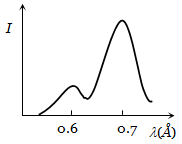
In the diagram a graph between the intensity of X-rays emitted by a molybdenum target and the wavelength is shown, when electrons of 30 keV are incident on the target. In the graph one peak is of $\mathrm{K}_\alpha$ line and the other peak is of $\mathrm{K}_\beta$ line
If the equivalent resistance is to be increased, then the number of resistances should be connected in:
An electron moves in a circular orbit with a uniform speed $v$. It produces a magnetic field $B$ at the centre of the circle. The radius of the circle is proportional to
X-ray beam can be deflected:
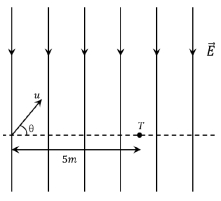
A uniform electric field, $\vec{E}=-400 \sqrt{3} \hat{y} NC ^{-1}$ is applied in a region. A charged particle of mass $m$ carrying positive charge $q$ is projected in this region with an initial speed of $2 \sqrt{10} \times 10^6 ms ^{-1}$. This particle is aimed to hit a target $T$, which is $5 m$ away from its entry point into the field as shown schematically in the figure. Take $\frac{ q }{ m }=10^{10} Ckg ^{-1}$. Then-

$(A)$ the particle will hit $T$ if projected at an angle $45^{\circ}$ from the horizontal

$(B)$ the particle will hit $T$ if projected either at an angle $30^{\circ}$ or $60^{\circ}$ from the horizontal

$(C)$ time taken by the particle to hit $T$ could be $\sqrt{\frac{5}{6}} \mu s$ as well as $\sqrt{\frac{5}{2}} \mu s$

$(D)$ time taken by the particle to hit $T$ is $\sqrt{\frac{5}{3}} \mu s$
In a series circuit $C = 2\,\mu F,\,\,L = 1\,mH$ and $R = 10\,\Omega .$ When the current in the circuit is maximum, at that time the ratio of the energies stored in the capacitor and the inductor will be
The equivalent resistance of a group of resistances is $R$. If another resistance is connected in parallel to the group , its new equivalent becomes $R_1$ and if it is connected in series to the group , its new equivalent becomes $R_2$ we have :
A circular current carrying coil has a radius $R$. The distance from the centre of the coil on the axis where the magnetic induction will be $\frac{1}{8}^{th}$ to its value at the centre of the coil, is