Question
AIF3 is a high melting solid whereas SiF4 is a gas. Explain.

Answer

AIF3 is an ionic compound and there is strong force of attraction between Al3+ and F- ions. Whereas SiF4 is a covalent compound formed by sharing of electrons.

Need a full question paper?

Generate a complete, print-ready paper with questions like this in minutes — across 16+ boards, with answer keys.
Start Generating Free

Similar questions

How the phosphorus is analysed in organic compound? Explain.
'All Lewis bases are also Bronsted bases'. Is it true? If yes, Why?
Arrange the elements with the following electronic configurations in order of increasing electron gain enthalpy.
  1. 1s2 2s2 2p5
  2. 1s2 2s2 2p4
  3. 1s2 2s2 2p3
  4. 1s2 2s2 2p6 3s2 3p4
Complete the following reactions:
  1. $(\text{CH}_3)_2\text{C}=\text{CH}-\text{CH}_3\xrightarrow[\text{heat}]{\text{KMnO}_4/\text{KOH}}$
  2. $(\text{CH}_3)_2\text{C}=\text{CH}-\text{CH}_3\xrightarrow{\text{cold KMnO}_4/\text{KOH}}$
  1. Give condensed and bond line structural formulae of the following:
  1. Cyclo octa-1,5-diene.
  2. 2(4-iso butyl phenyl) propanoic.
  1. Identify electrophilic centre in the following CH3CHO and CH3CN.
The enthalpy of reaction for the reaction : $2\text{H}_2(\text{g})+\text{O}_2(\text{g})\rightarrow2\text{H}_2\text{O}(\text{l})\ \text{is}\ \Delta_\text{r}\text{H}^\ominus=-572\text{kJ}\ \text{mol}^{-1}$
What will be standard enthalpy of formation of H2O (l)?
What is the total number of electrons in $\text{NO}^-_ 3?$
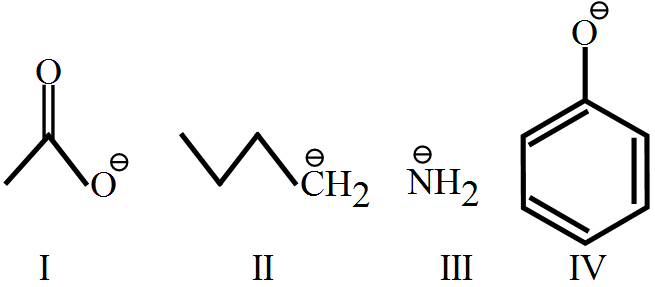
Arrange the following in increasing order of base strength:

 
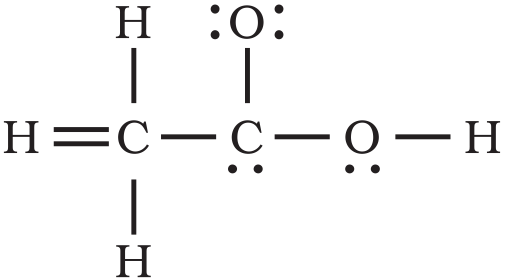
The skeletal structure of CH3COOH as shown below is correct, but some of the bonds are shown incorrectly.Write the correct Lewis structure for acetic acid.

A sample of pure $PCl _5$ was introduced into an evacuated vessel at 473 K . After equilibrium was attained, concentration of $PCl _5$ was found to be $0.5 \times 10^{-1} mol L ^{-1}$. If value of $K _{ c }$ is $8.3 \times 10^{-3}$, what are the concentration of $PCl _3$ and $Cl _2$ at equilibrium?
$PCl _5(g) \rightleftharpoons PCl _3(g)+ Cl _2(g)$