MCQ
Aldehydes and ketones can be reduced to hydrocarbon by using
  • A
    $LiAl{H_4}$
  • B
    ${H_2}/Pd - BaS{O_4}$
  • C
    $Na - Hg/HCl$
  • $N{H_2} - N{H_2}/{C_2}{H_5}ONa$

Answer

Correct option: D.
$N{H_2} - N{H_2}/{C_2}{H_5}ONa$
d
(d) $HI/P/, \,Zn/Hg/conc. \,HCl$ and

$N{H_2} - N{H_2}/O{H^ - }/{C_2}{H_5}ONa$

used to the reduction of $ - \mathop C\limits^{_{||}^O} - $group into $ - C{H_2} - $ group.
 

Need a full question paper?

Generate a complete, print-ready paper with questions like this in minutes — across 16+ boards, with answer keys.

Start Generating Free

Similar questions

The reaction speed rule is given $\frac{d P}{d t}=K[A][B]$ for $2 A+ B \longrightarrow$ Product $( P )$ when $[ B ] \gg[ A ]$, then order of reaction is this situation will be :
Which of the following is non-ionizable ?
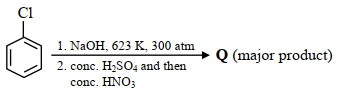
The weight percentage of hydrogen in $Q$, formed in the following reaction sequence, is. . . . 

[Given : Atomic mass of $H =1, C =12, N =14, O =16, S =32, Cl =35$ ]
When ethyl alcohol $({C_2}{H_5}OH)$ is mixed with ammonia and passed over heated alumina, the compound formed is
$\begin{array}{*{20}{c}}
  {OH\,\,\,\,\,\,\,\,\,\,\,\,\,\,\,\,\,\,\,\,\,\,\,\,\,\,} \\ 
  {|\,\,\,\,\,\,\,\,\,\,\,\,\,\,\,\,\,\,\,\,\,\,\,\,\,\,\,\,\,\,\,} \\ 
  {Ph - CH - C{H_3}\xrightarrow{{PCC}}(A)} 
\end{array}\xrightarrow{{\begin{array}{*{20}{c}}
  {\,\,\,\,\,\,\,\,\,\,\,\,\,O} \\ 
  {\,\,\,\,\,\,\,\,\,\,\,\,\,||} \\ 
  {N{H_2} - NH - C - N{H_2}} 
\end{array}}}(B)$

Product $(B)$ is

Which of the following is used as white pigment
Match List$-l$ with List$-ll$ :

List$-I$ (Oxoacids of Sulphur) List$-II$ (Bonds)
$A$. Peroxodisulphuric acid $I$. Two $S - OH$, Four $S = O$, One $S - O - S$
$B$. Sulphuric acid $II$. Two $S - OH$, One $S = O$
$C$. Pyrosulphuric acid $III$. Two $S - OH$, Four $S = O$, One $S - O - O - S$
$D$. Sulphurous acid $IV$. Two $S - OH$, Two $S = O$

Choose the correct answer from the options given below.

The enzymes act between the temperature range of:
Number of Faradays involved in the net reaction of Lead accumulator is __________.
By heating ammonium chloride with two equivalents of formaldehyde it forms: