MCQ
Alternating current can not be measured by dc ammeter because
  • A
    ac cannot pass through dc ammeter
  • Average value of complete cycle is zero
  • C
    ac is virtual
  • D
    ac changes its direction

Answer

Correct option: B.
Average value of complete cycle is zero
In $d c$ ammeter, a coil is free to rotate in the magnetic field of a fixed magnet.If an alternating current is passed through such a coil, the torque will reverse it's direction each time the current changes direction and the average value of the torque will be zero.

Need a full question paper?

Generate a complete, print-ready paper with questions like this in minutes — across 16+ boards, with answer keys.
Start Generating Free

Similar questions

The de-Broglie wavelength $\lambda$ associated with an electron having kinetic energy $E$ is given by the expression
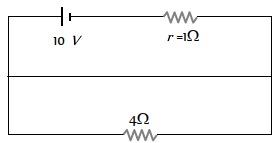
Potential difference across the terminals of the battery shown in figure is $(r=$ internal resistance of battery)

Image

In a $P N$-junction diode
Three discs $A, B$ and $C$ having radii $2 m, 4 m$, and $6 m$ respectively are coated with carbon black on their other surfaces. The wavelengths corresponding to maximum intensity are $300 \mathrm{~nm}, 400 \mathrm{~nm}$ and $ 500 n m$, respectively. The power radiated by them are $Q, Q$, and $Q$ respectively
The amplitude of two waves are in ratio $5: 2$. If all other conditions for the two waves are same, then what is the ratio of their energy densities
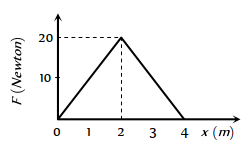
The graph between the resistive force $F$ acting on a body and the distance covered by the body is shown in the figure. The mass of the body is $25 \mathrm{~kg}$ and initial velocity is $2 \mathrm{~m} / \mathrm{s}$. When the distance covered by the body is $4 m$, its kinetic energy would be
Image
Two rods $A$ and $B$ are of equal lengths. Their ends are kept between the same temperature and their area of cross-sections are $A_1$ and $A_2$ and thermal conductivities $K_1$ and $K_2$. The rate of heat transmission in the two rods will be equal, if
The first law of thermodynamics is concerned with the conservation of
Temperature of a black body increases from $327^{\circ} \mathrm{C}$ to $927^{\circ} \mathrm{C}$, the initial energy possessed is $2 \mathrm{KJ}$, what is its final energy
An ideal black body at room temperature is thrown into a furnace. It is observed that