MCQ
Aluminium $(III)$ chloride forms a dimer because
- ✓Higher coordination number can be achieved by aluminium
- BAluminium has high ionization energy
- CAluminium belongs to $III$ group
- DIt cannot form a trimer
Generate a complete, print-ready paper with questions like this in minutes — across 16+ boards, with answer keys.
$N_{2(g)} + O_{2(g)} \rightleftharpoons 2NO_{(g)}$ is $K,$ the equilibrium constant for $\frac{1}{2} N_{2(g)} + \frac{1}{2} O_{2(g)} \rightleftharpoons NO_{(g)}$ will be
Which of the following is/are true about $\mathrm{A}^{\prime}, \mathrm{B}^{\prime}, \mathrm{C}^{\prime}$ and $\mathrm{D}^{\prime}$ ?
$A$. Order of atomic radii: $\mathrm{B}^{\prime}<\mathrm{A}^{\prime}<\mathrm{D}^{\prime}<\mathrm{C}^{\prime}$
$B$. Order of metallic character: $\mathrm{B}^{\prime}<\mathrm{A}^{\prime}<\mathrm{D}^{\prime}<\mathrm{C}^{\prime}$
$C$. Size of the element : $\mathrm{D}^{\prime}<\mathrm{C}^{\prime}<\mathrm{B}^{\prime}<\mathrm{A}^{\prime}$
$D$. Order of ionic radii : $\mathrm{B}^{\prime+}<\mathrm{A}^{\prime+}<\mathrm{D}^{\prime+}<\mathrm{C}^{\prime+}$
Choose the correct answer from the options given below :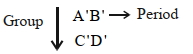

$3p_x,\,2s,\,4d_{xy},\,3s,\,4p_z,\,3p_y,\,4s$