Questions · Page 1 of 11

M.C.Q (1 Marks)

🎯

Test yourself on this topic

50 questions · timed · auto-graded

MCQ 11 Mark
Match List$-I$ with List$-II$. 

List$-I$ List$-II$
$A$ Coke $I$ Carbon atoms are $sp ^3$ hybridised
$B$ Diamond $II$ Used as a dry lubricant
$C$ Fullerene $III$  Used as a reducing agent
$D$ Graphite $IV$ Cage like molecules

Choose the correct answer from the options given below :

  • A
    $A-III, B-IV, C-I, D-II$
  • B
    $A-II, B-IV, C-I, D-III$
  • C
    $A-IV, B-I, C-II, D-III$
  • $A-III, B-I, C-IV, D-II$
Answer
Correct option: D.
$A-III, B-I, C-IV, D-II$
d
Coke is largely used as a reducing agent in metallurgy.

In diamond, each carbon atom undergoes $sp ^3$ hybridisation and linked to four other carbon atoms by using hybridised orbitals in tetrahedral fashion.

Buckminsterfullerene contains six membered and five membered rings and hence is a cage like molecule.

Graphite is very soft and slippery. Hence, it is used as a dry lubricant in machines running at high temperature.

View full question & answer
MCQ 21 Mark
Taking stability as the factor, which one of the following represents correct relationship?
  • $TlI > TlI _3$
  • B
    $TlCl _3 > TlCl$
  • C
    $\operatorname{InI}_3 > \ln I$
  • D
    $AlCl > AlCl _3$
Answer
Correct option: A.
$TlI > TlI _3$
a
$T l^{+}$ and $I ^{-}$ > $T l^{+3}$ and $3 I ^{-}$

due to inert pair effect $Tl^{+}$is more stable than $Tl^{+3}$.

View full question & answer
MCQ 31 Mark
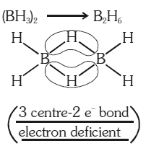
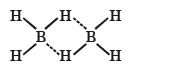
Which of the following statement is not correct about diborane?
  • A
    The four terminal $B-H$ bonds are two centre two electron bonds.
  • B
    The four terminal Hydrogen atoms and the two Boron atoms lie in one plane.
  • Both the Boron atoms are $s p^{2}$ hybridised.
  • D
    There are two $3-$centre$-2-$electron bonds.
Answer
Correct option: C.
Both the Boron atoms are $s p^{2}$ hybridised.
c
$B$ has $sp ^{3}$ Hybridisation

Non- planar

View full question & answer
MCQ 41 Mark
Choose the correct statement:
  • A
    Diamond is covalent and graphite is ionic.
  • Diamond is $s p^{3}$ hybridised and graphite is $s p^{2}$ hybridized.
  • C
    Both diamond and graphite are used as dry lubricants.
  • D
    Diamond and graphite have two dimensional network.
Answer
Correct option: B.
Diamond is $s p^{3}$ hybridised and graphite is $s p^{2}$ hybridized.
b
In diamond each carbon is bonded with four other carbon atoms. So hybridisation of carbon atom is $sp ^{3}$.

In graphite each carbon is bonded with three other carbon atoms. So hybridisation of carbon atom is $sp ^{2}$.

View full question & answer
MCQ 51 Mark
Which one of the following reactions does not come under hydrolysis type reaction?
  • A
    $P _{4} O _{10( s )}+6 H _{2} O _{( I )} \rightarrow 4 H _{3} PO _{4( aq )}$
  • B
    $SiCl _{4( l )}+2 H _{2} O _{( I )} \rightarrow SiO _{2( s )}+4 HCl _{( aq )}$
  • C
    $Li _{3} N _{( s )}+3 H _{2} O _{( i )} \rightarrow NH _{3( g )}+3 LiOH _{( aq )}$
  • $2 F _{2( g )}+2 H _{2} O _{( l )} \rightarrow 4 HF _{( aq )}+ O _{2( g )}$
Answer
Correct option: D.
$2 F _{2( g )}+2 H _{2} O _{( l )} \rightarrow 4 HF _{( aq )}+ O _{2( g )}$
d
Reaction of $F _{2}$ with $H _{2} O$ gives $HF ( aq )$ and $O _{2}( g )$ as products in which fluorine oxidises water into oxygen which does not come under hydrolysis type reaction
View full question & answer
MCQ 61 Mark
The liquified gas that is used in dry cleaning along with a suitable detergent is
  • A
    Water gas
  • B
    $CO$
  • C
    $NO_2$
  • $CO_2$
Answer
Correct option: D.
$CO_2$
d
View full question & answer
MCQ 71 Mark
Which of the following is incorrect statement ?
  • $PbF_4$ is covalent in nature
  • B
    $SiCl_4$ is easily hydrolysed
  • C
    $GeX_4\; (X = F, Cl, Br, I)$ is more stable than $GeX_2$
  • D
    $SnF_4$ is ionic in nature
Answer
Correct option: A.
$PbF_4$ is covalent in nature
a
$PbF_4$ is an ionic compound due to large size of cation and small size of anion. Rest all are correct options
View full question & answer
MCQ 81 Mark
Which of the following compounds is used in cosmetic surgery?
  • A
    Silica
  • B
    Silicates
  • Silicones
  • D
    Zeolites
Answer
Correct option: C.
Silicones
c
Silicones are used as sealant, greases,electrical insulators and for water proofing of fabrics. Being biocompatible they are also used in surgical and cosmetic plants.
View full question & answer
MCQ 91 Mark
Which one of the following elements is unable to form $MF_{6}^{3-}$ ion?
  • A
    $Ga$
  • B
    $Al$
  • $B$
  • D
    $In$
Answer
Correct option: C.
$B$
c
$\mathrm{MF}_{6}^{-3}$

Boron belongs to $2^{\text {nd }}$ period and it does not have vacant $d-$orbital.

View full question & answer
MCQ 101 Mark
The correct order of atomic radii in group $13$ elements is
  • A
    $\mathrm{B} < \mathrm{Al} < \mathrm{In} < \mathrm{Ga} < \mathrm{Tl}$
  • B
    $\mathrm{B} < \mathrm{Al} < \mathrm{Ga} < \mathrm{In} < \mathrm{T}$
  • C
    $\mathrm{B} < \mathrm{Ga} < \mathrm{Al} < \mathrm{T}) < \mathrm{In}$
  • $\mathrm{B} < \mathrm{Ga} < \mathrm{Al} < \mathrm{In}  < \mathrm{Tl}$ 
Answer
Correct option: D.
$\mathrm{B} < \mathrm{Ga} < \mathrm{Al} < \mathrm{In}  < \mathrm{Tl}$ 
d
In group $13$ due to transition contraction $[Al > Ga]$
View full question & answer
MCQ 111 Mark
It is because of inability of $ns^2$ electrons of the valence shell to participate in bonding that
  • A
    $Sn^{2+}$ is oxidising while $Pb^{4+}$ is reducing
  • B
    $Sn^{2+}$ and $Pb^{2+}$ are both oxidising and reducing
  • C
    $Sn^{4+}$ is reducing while $Pb^{4+}$ is oxidising
  • $Sn^{2+}$ is reducing while $Pb^{4+}$ is oxidising.
Answer
Correct option: D.
$Sn^{2+}$ is reducing while $Pb^{4+}$ is oxidising.
d
Inability of $n s^{2}$ electrons of the valence shell to participate in bonding on moving down the group in heavier p-block elements is called inert pair effect

As a result, $Pb(II)$ is more stable than $Pb(IV)$

$\mathrm{Sn}(\mathrm{IV})$ is more stable than $\mathrm{Sn}(\mathrm{II})$

$\mathrm{Pb}(\mathrm{IV})$ is easily reduced to $\mathrm{Pb}(\mathrm{II})$

$\mathrm{Pb}(\mathrm{IV})$ is oxidizing agent

$\mathrm{Sn}(\mathrm{II})$ is easily oxidized to $\mathrm{Sn}(\mathrm{IV})$

$\mathrm{Sn}(\mathrm{II})$ is reducing agent

View full question & answer
MCQ 121 Mark
The species, having bond angles of $120^o $ is
  • A
    $ClF_3$
  • B
    $NCl_3$
  • $BCl_3$
  • D
    $PH_3$
Answer
Correct option: C.
$BCl_3$
c

View full question & answer
MCQ 131 Mark
The tendency to form monovalent compounds among the Group $13$ elements is correctly exhibited in :
  • $B < Al < Ga < In < Tl$
  • B
    $Tl < In < Ga < Al < B$
  • C
    $Tl \approx In < Ga < Al < B$
  • D
    $B \approx Al \approx Ga \approx In \approx Tl$
Answer
Correct option: A.
$B < Al < Ga < In < Tl$
a
$B < Al < Ga < In < Tl$
View full question & answer
MCQ 141 Mark
Boric acid is an acid because its molecule 
  • A
    contains replaceable $H^+$ ion
  • B
    gives up a proton
  • accepts $OH^-$ from water releasing proton.
  • D
    combines with proton from water molecule.
Answer
Correct option: C.
accepts $OH^-$ from water releasing proton.
c
Boric acid is an acid because its molecule accepts $\mathrm{OH}^{-}$ from water releasing proton

$\mathrm{B}(\mathrm{OH})_{3}+\mathrm{H}_{2} \mathrm{O} \longrightarrow\left[\mathrm{B}(\mathrm{OH})_{4}\right]^{(-)}(\mathrm{aq})+\mathrm{H}^{(-)}(\mathrm{aq})$

View full question & answer
MCQ 151 Mark
$AlF_3$ is soluble in $HF$ only in presence of $KF.$ It is due to the formation of
  • A
    $K_3[AlF_3H_3]$
  • $K_3[AlF_6]$
  • C
    $AlH_3$
  • D
    $K[AlF_3H]$
Answer
Correct option: B.
$K_3[AlF_6]$
b
$\mathrm{AIF}_{3}+\mathrm{KF} \stackrel{H F}{\longrightarrow} \mathrm{K}_{3}\left[\mathrm{AIF}_{6}\right]$

maximum $C.N.$ of $A l^{+3}$ is six so it forms $AlF_{6}^{3-}$

View full question & answer
MCQ 161 Mark
Which of these is not a monomer for a high molecular mass silicone polymer ?
  • $Me_3SiCl$
  • B
    $PhSiCl_3$
  • C
    $MeSiCl_3$
  • D
    $Me_2SiCl_2$
Answer
Correct option: A.
$Me_3SiCl$
a
$Me_3SiCl$ is not a monomer for a high molecular mass silicone polymer because it generates $Me_3SiOH$ when subjected to hydrolysis which contains only one reacting site. Hence, the polymerization reaction stops just after first step.

$\begin{array}{*{20}{c}}
  {Me} \\ 
  | \\ 
  {Me - Si - OH} \\ 
  | \\ 
  {Me} 
\end{array}$ $+$ $\begin{array}{*{20}{c}}
  {Me} \\ 
  | \\ 
  {HO - Si - Me} \\ 
  | \\ 
  {Me} 
\end{array}$ $\xrightarrow[{ - {H_2}O}]{}$ $\mathop {\begin{array}{*{20}{c}}
  {\,\,Me\,\,\,\,\,\,\,\,\,\,\,\,\,Me} \\ 
  {|\,\,\,\,\,\,\,\,\,\,\,\,\,\,\,\,\,\,\,\,|} \\ 
  {Me - Si - O - Si - Me} \\ 
  {|\,\,\,\,\,\,\,\,\,\,\,\,\,\,\,\,\,\,\,\,|} \\ 
  {\,\,Me\,\,\,\,\,\,\,\,\,\,\,\,\,Me} 
\end{array}}\limits_{Final\,product\,(\dim er)} $

View full question & answer
MCQ 171 Mark
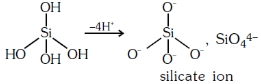
The basic structural unit of silicates is
  • A
    $SiO_3^{2-}$
  • B
    $SiO_4^{2-}$
  • C
    $SiO^-$
  • $SiO_4^{-4}$
Answer
Correct option: D.
$SiO_4^{-4}$
d
Silicates - Salt of silicic acid $H_{4} S i O_{4}$
View full question & answer
MCQ 181 Mark
Which statement is wrong ?
  • A
    Beryl is an example of cyclic silicate.
  • B
    $Mg_2SiO_4$ is orthosilicate.
  • C
    Basic structural unit in silicates is the $SiO_4$ tetrahedron.
  • Feldspars are not aluminosilicates.
Answer
Correct option: D.
Feldspars are not aluminosilicates.
d
Oomycetes (egg fungus) include water moulds, white rusts and downy mildews. In these, female gamete is smaller and motile, whereas male gamete is larger and non-motile. Isogametes are found in algae like Ultrix, Chlamydornonas, Spirogyra, etc., which are similar in structure, function and behavior. An isogametes are found in Chlamydornonas in which one gamete is larger and non-motile and the other one is motile and smaller. Oogamy is the fusion of non-motile egg with motile sperm. The gametes, differ both morphologically as well as physiologically. It occurs in Chlamydomonas, Fucus Chara, Volvox, etc.
View full question & answer
MCQ 191 Mark
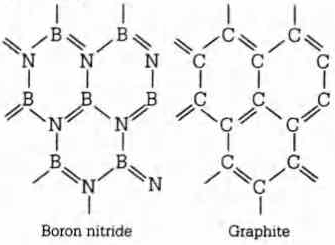
Which of the following structure is similar to graphite ?
  • A
    $B_4C$
  • B
    $B_2H_6$
  • $BN$
  • D
    $B$
Answer
Correct option: C.
$BN$
c
Boron nitride $(B N)_{x}$ resembles with graphite in structure as
View full question & answer
MCQ 201 Mark
Which of the following statements about the interstitial compounds is incorrect?
  • A
    They are much harder than the pure metal.
  • B
    They have higher melting points than the pure metal.
  • C
    They retain metallic conductivity.
  • They are chemically reactive.
Answer
Correct option: D.
They are chemically reactive.
d
Interstitial compounds are obtained when small atoms like $H, B, C,N,$ etc, fit into the interstitial space of lattice metals.

These retain metallic conductivity. These resemble the parent metal in chemical properties (reactivity) but differ in physical properties like hardness, melting point, etc.

View full question & answer
MCQ 211 Mark
Which base among the following reacts with diborane to cleave it unsymmetrically ?
  • A
    $T.H.F.$
  • B
    $Me_3N$
  • C
    $C_5H_5N$
  • $MeNH_2$
Answer
Correct option: D.
$MeNH_2$
d
$T.H.F. , Me_3N , C_5H_5N$ give symmetrical cleavage.
View full question & answer
MCQ 221 Mark
Colour of the bead in borax bead test is mainly due to the formation of
  • A
    metal oxides
  • B
    boron oxide
  • metal metaborates
  • D
    elemental boron
Answer
Correct option: C.
metal metaborates
c
Information (Borax bead: $NaBO_2 + B_2O_3$ )
View full question & answer
MCQ 231 Mark
$B{X_3} + N{H_3}\ \xrightarrow {R.T}\ B{X_3}.N{H_3} +$ Heat  of  adduct formation $\left( {\Delta H} \right)$  The numerical value of $\Delta H$ is found to be maximum for
  • A
    $BF_3$
  • B
    $BCl_3$
  • C
    $BBr_3$
  • $BI_3$
Answer
Correct option: D.
$BI_3$
d
$\mathrm{BX}_{3} \cdot \mathrm{NH}_{3}$

Adduct form $^{\mathrm{n}}$ order $\mathrm{BI}_{3}>\mathrm{BBr}_{3}>\mathrm{BCl}_{3}>\mathrm{BF}_{3}$

As in $\mathrm{BF}_{3}$ strong back bonding occur. So adduct form $^{\mathrm{n}}$ decreases. Back bonding $\alpha \frac{1}{\text { adduct }}$ form $^{\text {n }}$

View full question & answer
MCQ 241 Mark
Which is correct statement about Borax
  • A
    It shows intumescent property on heating
  • B
    It consists of $2$ identical six member rings
  • C
    $1$ mole of Borax require approximately $2$ mole of $HCl$ for neutralisation
  • All of these
Answer
Correct option: D.
All of these
d
View full question & answer
MCQ 251 Mark
Consider the following reaction 

$(a)\, B_2H_6 + 6H_2O \to$
$(b)\, B_2H_6 + 6CH_3OH \to$
$(c)\, B_2H_6 + 3Cl_2 \to$
$(d)\, BR_3 + 3CH_3COOH \to$

Identify incorrect statement about product $(s)$

  • $H_2$ is common product in all the reactions
  • B
    Reaction $(d)$ forms alkane
  • C
    Product of reaction $(a)$ has $H-$ bond in solid state
  • D
    one of the product of reaction $(c)$ is used for dissolving noble metals along with $HNO_3$ (conc.)
Answer
Correct option: A.
$H_2$ is common product in all the reactions
a
View full question & answer
MCQ 261 Mark
In $B_2H_6$
  • A
    there is direct boron-boron bond
  • B
    the $B—H$ bonds are ionic
  • C
    it is isostructural to $C_2H_6$
  • boron atoms are linked through hydrogen bridges
Answer
Correct option: D.
boron atoms are linked through hydrogen bridges
d

View full question & answer
MCQ 271 Mark
The Lewis acid nature of $BX_3$ follows the order
  • A
    $BF_3 > BCl_3 > BBr_3 > BI_3$
  • $BF_3 < BCl_3 < BBr_3 < BI_3$
  • C
    $BCl_3 > BF_3 > BBr_3 > BI_3$
  • D
    $BF_3 < BBr_3 < BCl_3 < BI_3$
Answer
Correct option: B.
$BF_3 < BCl_3 < BBr_3 < BI_3$
b
Conceptual
View full question & answer
MCQ 281 Mark
Correct order of Lewis Acidic strength?
  • $BF_3 < BCl_3 < BBr_3 < BI_3$
  • B
    $BF_3 > BCl_3 > BBr_3 > BI_3$
  • C
    $BF_3 = BCl_3 = BBr_3 = BI_3$
  • D
    $BF_3 > BCl_3 < BBr_3 > BI_3$
Answer
Correct option: A.
$BF_3 < BCl_3 < BBr_3 < BI_3$
a
(i) On the basis of back bonding, smaller be the halide atom, more effective be the back bonding and show less tendency to accept a pair of electrons.

(ii) Size of halides increase down the group, hence the ability of back bonding decreases making the molecule more acidic.

Hence, correct order of Lewis acid for boron-halides is $\mathrm{Bl}_{3}>\mathrm{BBr}_{3}>\mathrm{BCl}_{3}>\mathrm{BF}_{3}$

View full question & answer
MCQ 291 Mark
In which of the following reaction, the hybridisation of the central atom changes from $sp^2$ to $sp^3$ ?
  • A
    $N{H_3} + {H^ + } \to NH_4^ + $
  • B
    $Al{F_3} + 3{F^ - } \to AlF_6^{3 - }$
  • $B{F_3} + {F^ - } \to BF_4^ - $
  • D
    ${H_2}O + {H^ + } \to {H_3}{O^ + }$
Answer
Correct option: C.
$B{F_3} + {F^ - } \to BF_4^ - $
c
$\mathop {\mathop {B{F_3} + {F^ - }}\limits_{s{p^2}}  \to \mathop {BF_4^ - }\limits_{s{p^3}} }\limits_{\,\,\,\,\,\,\,\,\,\,\,\,\,\,\,\,\,\,\,\,\,\,\,\,\,\,\,\,\,\,\,\,\,\,\,\,\,\,\,\,\,\,\,\,\,\,\,\,\,\,\,\,\,\,\,\,} $
View full question & answer
MCQ 301 Mark
When $AlCl_3·6H_2O$ is strongly heated, then it forms
  • $Al_2O_3$
  • B
    $AlCl_3$
  • C
    $Al(OH)_3$
  • D
    All of these
Answer
Correct option: A.
$Al_2O_3$
a
$AlC{l_3} \cdot 6{H_2}O\xrightarrow[{Strongly}]{\Delta }A{l_2}{O_3}$
View full question & answer
MCQ 311 Mark
Correct Lewis acidity order of $BX_3$ is
  • $BF_3 < BCl_3 < BBr_3 < BI_3$
  • B
    $BF_3 > BCl_3 > BBr_3 > BI_3$
  • C
    $BCl_3< BBr_3 < BI_3 < BF_3$
  • D
    $BF_3 < BI_3 < BBr_3 < BCl_3$
Answer
Correct option: A.
$BF_3 < BCl_3 < BBr_3 < BI_3$
a
(i) On the basis of back bonding, smaller be the halide atom, more effective be the back bonding and show less tendency to accept a pair of electrons.

(ii) Size of halides increase down the group, hence the ability of back bonding decreases making the molecule more acidic.

Hence, correct order of Lewis acid for boron-halides is $\mathrm{Bl}_{3}>\mathrm{BBr}_{3}>\mathrm{BCl}_{3}>\mathrm{BF}_{3}$

View full question & answer
MCQ 321 Mark
Which of the following is sparingly soluble in cold water and fairly soluble in hot water ?
  • A
    $Pb(NO_3)_2$
  • $PbCl_2$
  • C
    $PbSO_4$
  • D
    $PbCrO_4$
Answer
Correct option: B.
$PbCl_2$
b
$Pb \left( NO _3\right)_2$ is sparingly soluble in cold water and fairly soluble in hot water. It's an experimental observation.
View full question & answer
MCQ 331 Mark
Silicon dissolves in excess of $HF$ due to formation of
  • A
    $SiF_4$
  • B
    $SiH_4$
  • $H_2SiF_6$
  • D
    $H_2SiF_4$
Answer
Correct option: C.
$H_2SiF_6$
c
HF is a very strong acid and can also react with silicon and corrode its lattice

$\mathrm{Si}+4 \mathrm{HF} \rightarrow \mathrm{SiF}_{4}+4 \mathrm{H}^{+}$

$\begin{array}{l}\downarrow \mathrm{HF} \\\mathrm{H}_{2} \mathrm{SiF}_{6}\end{array}$

View full question & answer
MCQ 341 Mark
Which of the Following halides dose not hydrolyse at room temperature ?
  • A
    $PbCl_4$
  • B
    $SiCl_4$
  • $CCl_4$
  • D
    $SnCl_4$
Answer
Correct option: C.
$CCl_4$
c
since carbon has no d-orbital, hence it cannot extend its coordination number beyond four, thus its hatides are not attacked (hydrolysed) by water.
View full question & answer
MCQ 351 Mark
$SiCl_4$ on hydrolysis gives
  • A
    silica
  • silicic acid
  • C
    silicone
  • D
    silicate
Answer
Correct option: B.
silicic acid
b
$\mathrm{SiCl}_{4}$ on hydrolysis gives silicic acid.

The reaction is as follows:

$\mathrm{SiCl}_{4}+4 \mathrm{H}_{2} \mathrm{O} \rightarrow \mathrm{Si}(\mathrm{OH})_{4}+4 \mathrm{HCl}$

Hence, silicic acid is formed when $\mathrm{SiCl}_{4}$ undergoes hydrolysis.

View full question & answer
MCQ 361 Mark
Which substance is having molecular solid
  • A
    graphite
  • $C_{60}$
  • C
    gold
  • D
    $Ca_3(PO_4)_2$
Answer
Correct option: B.
$C_{60}$
b
Buckminsterfullerene is a type of fullerene with the formula $C_{60}$. It has a cagelike fused-ring structure that resembles a soccer ball, made of twenty hexagons and twelve pentagons. Each carbon atom has three bonds. It is a black solid that dissolves in hydrocarbon solvents to produce a violet solution.
View full question & answer
MCQ 371 Mark
A cyclic skeleton of silicon and oxygen can constructed by the silicate ion composition
  • A
    $Si_2O_7^{4-}$
  • B
    $Si_2O_5^{2-}$
  • $SiO_3^{2-}$
  • D
    $SiO_4^{4-}$
Answer
Correct option: C.
$SiO_3^{2-}$
c
Cyclic silicates contain $\left( SiO _3\right)_{ n }^{2 n -}$ ions which are formed by linking three or more tetrahedral $SiO _4^{4-}$ units cyclically. Each unit shares two oxygen atoms with other units.
View full question & answer
MCQ 381 Mark
Which of the following is an organo silicon polymer?
  • A
    Silica
  • Silicone
  • C
    Silicon carbide
  • D
    Silicic acid
Answer
Correct option: B.
Silicone
b
Silicone is a polymeric organo silicon compound which is chemically inert and thermally stable.
View full question & answer
MCQ 391 Mark
$SnCl_2$ acts as a reducing agent
  • A
    $SnCl_2$ can accept electrons readily
  • B
    $Sn^{2+}$ is more stable than $Sn^{4+}$
  • $Sn^{4+}$ is more stable than $Sn^{2+}$
  • D
    $Sn^{2+}$ can be easily converted to metallic tin
Answer
Correct option: C.
$Sn^{4+}$ is more stable than $Sn^{2+}$
c
$\mathrm{SnCl}_{2}$ acts as a reducing agent because there is high tendency of $\operatorname{Sn}(\mathrm{II})$ ions to convert into $\mathrm{Sn}(\mathrm{IV})$ as $\mathrm{Sn}^{4+}$ is more stable than $\mathrm{Sn}^{2+}$

Hence, option $\mathrm{C}$ is the correct answer.

View full question & answer
MCQ 401 Mark
Which of the following is correct
  • A
    Basicity of phosphorous acid is $3$
  • B
    Perchloric acid has one peroxy linkage
  • C
    Trimeta phosphoric acid does not have cyclic structure
  • Borazine has zero dipole moment
Answer
Correct option: D.
Borazine has zero dipole moment
d
$B_3N_3H_6$      $\vec \mu \,\, = \,\,0$
View full question & answer
MCQ 411 Mark
$B_2H_6 + 2NaH \to$ compound $'P'$ Identify the hybridisation of Boron in compound $'P'$


  • A
    $sp^2$
  • $sp^3$
  • C
    $sp^3d$
  • D
    $sp$
Answer
Correct option: B.
$sp^3$
b
$Na[BH_4]\,sp^3$
View full question & answer
MCQ 421 Mark
$BF_3$ on hydrolysis forms
  • A
    $H_3BO_3$
  • B
    $HBF_4$
  • both $(A)$ and $(B)$
  • D
    none of these
Answer
Correct option: C.
both $(A)$ and $(B)$
c
$\mathrm{BF}_{3}$ Partial hydrolysis.

$\mathrm{BF}_{3}+3 \mathrm{H}_{2} \mathrm{O} \rightarrow \mathrm{B}(\mathrm{OH})_{3}+3 \mathrm{HF}$

$3 \mathrm{HF}+3 \mathrm{BF}_{3} \rightarrow 3 \mathrm{H}\left[\mathrm{BF}_{4}\right]$

$\_\_\_\_\_\_\_\_\_\_\_\_\_\_\_\_\_\_\_\_\_\_\_\_\_\_\_\_\_\_\_\_\_\_\_\_\_$

$4 \mathrm{BF}_{3}+3 \mathrm{H}_{2} \mathrm{O} \rightarrow \mathrm{B}(\mathrm{OH})_{3}+3 \mathrm{H}\left[\mathrm{BF}_{4}\right]$

View full question & answer
MCQ 431 Mark
Anhydrous aluminium chloride fumes in moist air owing to the formation of
  • A
    gaseous aluminium chloride
  • B
    chlorine
  • C
    chlorine dioxide
  • hydrogen chloride
Answer
Correct option: D.
hydrogen chloride
d
White fumes are due to the presence of HCl gas.

Anhydrous aluminium chloride is hydrolysed partially with the moisture in the atmosphere to give HCl gas.

This HCI combines with the moisture in the air and appears white in colour.

$\mathrm{AlCl}_{3}+3 \mathrm{H}_{2} \mathrm{O} \longrightarrow \mathrm{Al}(\mathrm{OH})_{3}+3 \mathrm{HCl}(\text { white fumes })$

Hence, the correct answer is option D.

View full question & answer
MCQ 441 Mark
Colour of the bead in borax bead test is mainly due to the formation of
  • A
    metal oxides
  • B
    boron oxide
  • metal metaborates
  • D
    elemental boron
Answer
Correct option: C.
metal metaborates
c
Correct option $(\mathrm{C})$ metal metaborates

Explanation:

Borax on strong heating loses its water of crystallization and then shrinks forming a transparent glassy bead of sodium metaborate and boric anhydride. Boric anhydride, being non-volatile displaces more volatile acidic oxides and combine with basic oxides present to form metaborates which are identified through their characteristic colours

View full question & answer
MCQ 451 Mark
Which of the following compounds of boron does not exist in the free form
  • A
    $BC{l_3}$
  • B
    $B{F_3}$
  • C
    $BB{r_3}$
  • $B{H_3}$
Answer
Correct option: D.
$B{H_3}$
d
(d) Hydride of boron does not exist in $B{H_3}$ form. It is stable as its dimer di borane $({B_2}{H_6})$.
View full question & answer
MCQ 461 Mark
The type of hybridisation of boron in diborane is
  • A
    $sp$ - hybridisation
  • B
    $s{p^2}{\rm{ - }}$ hybridisation
  • $s{p^3}{\rm{ - }}$ hybridisation
  • D
    $s{p^3}{d^2}{\rm{ - }}$ hybridisation
Answer
Correct option: C.
$s{p^3}{\rm{ - }}$ hybridisation
c
Boron has three valence electrons, so it is supposed to make $3$ bonds in a molecule with hybridization, $sp ^2$ as only s and two $p$ orbitals are used in hybridization and last $p$ orbitalis vacant.

But diborane, $B _2 H _6$ contains two electrons each, three centred bonds. Each Boron atom is in a link with four hydrogen atoms. This makes tetrahedral geometry.

Hence, each Boron atom is $sp ^3$ - hybridized.

View full question & answer
MCQ 471 Mark
Identify the statement that is not correct as far as structure of diborane is concerned
  • A
    There are two bridging hydrogen atoms in diborane
  • B
    Each boron atom forms four bonds in diborane
  • C
    The hydrogen atoms are not in the same plane in diborane
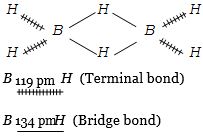
  • All $B - H$ bonds in diborane are similar
Answer
Correct option: D.
All $B - H$ bonds in diborane are similar
d
(d) ${B_2}{H_6}$ has two types of $B - H$ bonds
 
View full question & answer
MCQ 481 Mark
Soft heavy metal melts at ${30\,^o}C$ and is used in making heat sensitive thermometers the metal is
  • Galium
  • B
    Sodium
  • C
    Potassium
  • D
    Caesium
Answer
Correct option: A.
Galium
a
Gallium is a silvery, glass-like, soft metal. Its properties are close to the nonmetals in the periodic table and its metallic properties are not as metallic as most other metals. Solid gallium is brittle and is a poorer electrical conductor than lead. Gallium has the second largest liquid range of any element and is one of the few metals that is liquid near room temperature (m.pt. $29.76$), melting in the hand. So it is used in thermometer.
View full question & answer
MCQ 491 Mark
Which of the following is formed when aluminium oxide and carbon is strongly heated in dry chlorine gas
  • A
    Aluminium chloride
  • B
    Hydrate aluminium chloride
  • Anhydrous aluminium chloride
  • D
    None of these
Answer
Correct option: C.
Anhydrous aluminium chloride
c
When aluminum oxide and carbon are strongly heated in dry chlorine gas anhydrous aluminum chloride is formed.
View full question & answer
MCQ 501 Mark
Which metal burn in air at high temperature with the evolution of much heat
  • A
    $Cu$
  • B
    $Hg$
  • C
    $Pb$
  • $Al$
Answer
Correct option: D.
$Al$
d
Aluminium has high boiling point and melting point. At high temperature only, it burns in air and in turn, as it is a metal, it evolutes much heat.
View full question & answer