MCQ
Ammonium hydroxide is a weak base because
  • A
    It has low vapour pressure
  • It is only slightly ionized
  • C
    It is not a hydroxide of any metal
  • D
    It has low density

Answer

Correct option: B.
It is only slightly ionized
(b)It is a weak electrolyte since slightly ionized.

Need a full question paper?

Generate a complete, print-ready paper with questions like this in minutes — across 16+ boards, with answer keys.

Start Generating Free

Similar questions

The value of $K_b$ is given by $mRT_b^2/1000\, X$. In this relation $X$ is :-
When acidified $KMnO_4$ is added to hot oxalic acid solution, the decolourization is slow in the beginning, but becomes very rapid after some time. This is because :
The Bronsted acids in the reversible reaction are $HCO_3^ - (aq.) + O{H^ - }(aq.)\,$ $\rightleftharpoons$ $CO_3^{2 - }(aq.) + {H_2}O$
Select correct statement $(s)$ regarding $[Ni(DMG)_2]$ complex compound
The reaction $2A(g)+ B(g)  \rightleftharpoons  3C(g) + D(g)$ is began with the concentrations of $A$ and $B$ both at an initial value of $1.00\, M$. When equilibrium is reached, the concentration of $D$ is measured and found to be $0.25\, M$. The value for the equilibrium constant for this reaction is given by the expression
The solubility of a gas in liquid generally increases with :-
The sequence of ionic mobility in aqueous solutions is
Select the elements belonging to same group from the following list :-
The standard reduction potentials at $298 \mathrm{~K}$ for the following half cells are given below :

$\mathrm{Cr}_2 \mathrm{O}_7{ }^{2-}+14 \mathrm{H}^{+}+6 \mathrm{e}^{-} \rightarrow 2 \mathrm{Cr}^{3+}+7 \mathrm{H}_2 \mathrm{O}, \mathrm{E}^{\circ}=1.33 \mathrm{~V}$

$\mathrm{Fe}^{3+}(\mathrm{aq})+3 \mathrm{e}^{-} \rightarrow \mathrm{Fe}  \mathrm{E}^{\circ}=-0.04 \mathrm{~V}$

$\mathrm{Ni}^{2+}(\mathrm{aq})+2 \mathrm{e}^{-} \rightarrow \mathrm{Ni}  \mathrm{E}^{\circ}=-0.25 \mathrm{~V}$

$\mathrm{Ag}^{+}(\mathrm{aq})+\mathrm{e}^{-} \rightarrow \mathrm{Ag} \mathrm{E}^{\circ}=0.80 \mathrm{~V}$

$\mathrm{Au}^{3+}(\mathrm{aq})+3 \mathrm{e}^{-} \rightarrow \mathrm{Au} \mathrm{E}^{\circ}=1.40 \mathrm{~V}$

Consider the given electrochemical reactions, The number of metal$(s)$ which will be oxidized be $\mathrm{Cr}_2 \mathrm{O}_7{ }^{2-}$, in aqueous solution is. . . . . . 
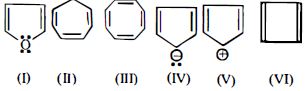
Which of the following compounds are antiaromatic