MCQ
Among the following for which one mathematical expression $\lambda = \frac{h}{p}$ stands
- ✓De Broglie equation
- BEinstein equation
- CUncertainty equation
- DBohr equation
$\therefore \lambda=\frac{h}{p}$
It's the de-Broglie relation.
Generate a complete, print-ready paper with questions like this in minutes — across 16+ boards, with answer keys.
$(A)$ The acidity of compound $I$ is due to delocalization in the conjugate base.
$(B)$ The conjugate base of compound IV is aromatic.
$(C)$ Compound II becomes more acidic, when it has a $- NO _2$ substituent.
$(D)$ The acidity of compounds follows the order $I > IV > V > II > III$.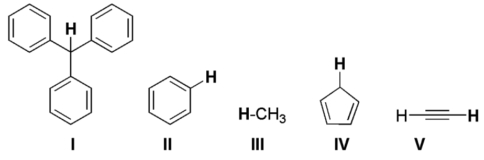
$(A)$ $SnCl _2 \cdot 2 H _2 O$ is a reducing agent.
$(B)$ $SnO _2$ reacts with $KOH$ to form $K _2\left[ Sn ( OH )_6\right]$.
$(C)$ A solution of $PbCl _2$ in $HCl$ contains $Pb ^{2+}$ and $Cl ^{-}$ions.
$(D)$ The reaction of $Pb _3 O _4$ with hot dilute nitric acid to give $PbO _2$ is a redoxreaction.