MCQ
Among the following, the compound that is both paramagnetic and coloured is
- A${K_2}C{r_2}{O_7}$
- B${(N{H_4})_2}(TiC{l_6})$
- ✓$VOS{O_4}$
- D${K_3}\left[ {Cu(C{N_4})} \right]$
$1 $ unpaired electrons.
Hence, it is paramagnetic and coloured compound.
Generate a complete, print-ready paper with questions like this in minutes — across 16+ boards, with answer keys.
$\begin{array}{*{20}{c}}
{^{C{H_3}}} \\
{_H}
\end{array}\begin{array}{*{20}{c}}
{{\text{ }}\backslash {\text{ }}} \\
/
\end{array}\mathop C\limits^{} {\mkern 1mu} = \mathop C\limits^{} {\mkern 1mu} \begin{array}{*{20}{c}}
/ \\
{{\text{ }}\backslash {\text{ }}}
\end{array}_{\mathop C\limits^{} {\kern 1pt} \equiv \mathop C\limits^{} {\kern 1pt} - \mathop C\limits^{} {\kern 1pt} {H_2}\mathop C\limits^{} {\kern 1pt} {H_3}}^H{\mkern 1mu} $
(image)
$A \rightarrow B$ is an adiabatic process. If the total heat absorbed in the entire process ( $A \rightarrow B$ and $B \rightarrow C$ ) is $R T_2 \ln 10$, the value of $2 \log V_3$ is . . . . . [Use, molar heat capacity of the gas at constant pressure, $\mathrm{C}_{\mathrm{p}, \mathrm{m}}=\frac{5}{2} \mathrm{R}$ ]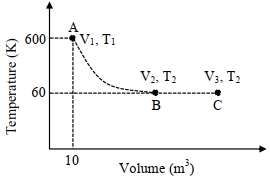
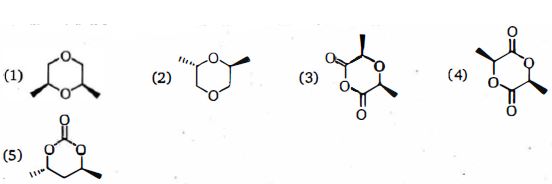
$\begin{array} {|l|p{0.6\linewidth}|} \hline List\,\,I\,\,Equations & List\,\,II\,\,Type\,\,of\,\,processes \\ \hline A. K_p > Q & (i)\,\,Non-\,\,spontaneous \\ \hline B.\, \Delta G^o < RT ln Q & (ii)\,\,Equilibrium \\ \hline C. K_p=Q & (iii)\,\,Spontaneous\,\,and\,\,endothermic \\ \hline D. T > \frac{\Delta H}{\Delta S} & (iv)\,\,Spontaneous \\ \hline \end{array}$