MCQ
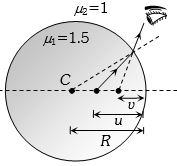
An air bubble in sphere having $4 \,cm$ diameter appears $1 \,cm$ from surface nearest to eye when looked along diameter. If $_a\mu_g = 1.5$, the distance of bubble from refracting surface is.....$cm$
  • $1.2$
  • B
    $3.2$
  • C
    $2.8 $
  • D
    $1.6$

Answer

Correct option: A.
$1.2$
a
(a) $v = 1 \,cm, R = 2 \,cm$
By using
$\frac{{{\mu _2}}}{v} - \frac{{{\mu _1}}}{u} = \frac{{{\mu _2} - {\mu _1}}}{R}$
$\frac{1}{{ - 1}} - \frac{{1.5}}{u} = \frac{{1 - 1.5}}{{ - 2}}$
$ \Rightarrow u = - 1.2\,cm$

Need a full question paper?

Generate a complete, print-ready paper with questions like this in minutes — across 16+ boards, with answer keys.
Start Generating Free

Similar questions

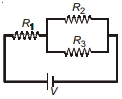
Three identical resistors $R_1=R_2=R_3$ are connected as shown to a battery of constant e.m.f. The power dissipated is ...........
The electric potential at a point $(x, y, z)$ is given by $V=-x^2y-xz^3 +4 $. The electric field at that point is  
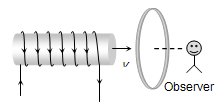
A current carrying solenoid is approaching a conducting loop as shown in the figure. The direction of induced current as observed by an observer on the other side of the loop will be

A convex lens is made of a material having refractive index $1.2.$ Both the surfaces of the lens are convex. If it is dipped into water $(\mu=1.33),$ it will behave like:
The peak voltage in a 220V AC source is:
Which is the correct expression for half-life
A man runs towards mirror at a speed of $15\,m/s.$What is the speed of his image.....$m/s$
When a particle is restricted to move along $x$-axis between $x=0$ and $x=a$, where $a$ is of nanometer dimension, its energy can take only certain specific values. The allowed energies of the particle moving in such a restricted region, correspond to the formation of standing waves with nodes at its ends $x=0$ and $x=a$. The wavelength of this standing wave is related to the linear momentum $p$ of the particle according to the de Broglie relation. The energy of the particle of mass $m$ is related to its linear momentum as $E=\frac{p^2}{2 m}$. Thus, the energy of the particle can be denoted by a quantum number ' $n$ ' taking values $1,2,3, \ldots \quad(n=1$, called the ground state) corresponding to the number of loops in the standing wave.

Use the model described above to answer the following three questions for a particle moving in the line $x=0$ to $x=a$. Take $h=6.6 \times 10^{-34} \mathrm{~J} \mathrm{~s}$ and $e=1.6 \times 10^{-19} \mathrm{C}$.

$1.$ The allowed energy for the particle for a particular value of $n$ is proportional to

$(A)$ $a^{-2}$ $(B)$ $a^{-3 / 2}$ $(C)$ $a^{-1}$ $(D)$ $a^2$

$2.$ If the mass of the particle is $m=1.0 \times 10^{-30} \mathrm{~kg}$ and $a=6.6 \mathrm{~nm}$, the energy of the particle in its ground state is closest to

$(A)$ $0.8 \ \mathrm{meV}$ $(B)$ $8 \ \mathrm{meV}$ $(C)$ $80 \ \mathrm{meV}$ $(D)$ $800 \ \mathrm{meV}$

$3.$ The speed of the particle, that can take discrete values, is proportional to

$(A)$ $n^{-3 / 2}$ $(B)$ $n^{-1}$ $(C)$ $n^{1 / 2}$ $(D)$ $n$

Give the answer question $1, 2$ and $3.$
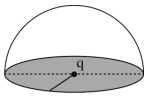
If a charge $q$ is placed at the centre of a closed hemispherical non-conducting surface, the total flux passing through the flat surface would be
Two coherent sources of light interfere and produce fringe pattern on a screen. For central maximum, the phase difference between the two waves will be,