MCQ 11 Mark
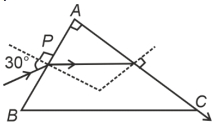
A light ray enters through a right angled prism at point $P$ with the angle of incidence $30^{\circ}$ as shown in figure. It travels through the prism parallel to its base $B C$ and emerges along the face $A C$. The refractive index of the prism is:
- ✓
$\frac{\sqrt{5}}{2}$
- B
$\frac{\sqrt{3}}{4}$
- C
$\frac{\sqrt{3}}{2}$
- D
$\frac{\sqrt{5}}{4}$
AnswerCorrect option: A. $\frac{\sqrt{5}}{2}$
a
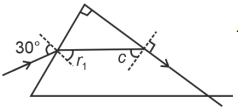
$\text { In prism, } r_1 +c=A$
$r_1 =90^{\circ}-c$ $.......(1)$
$\sin c=\frac{1}{\mu} \Rightarrow \cos c=\frac{\sqrt{\mu^2-1}}{\mu}$
$\Rightarrow$ Apply Snell's law, on incidence surface
$1 \cdot \sin 30^{\circ}=\mu \sin \left(r_1\right) \Rightarrow 1 \times \frac{1}{2}=\mu \times \sin \left(90^{\circ}-c\right)$
$\frac{1}{2}=\mu \times \frac{\sqrt{\mu^2-1}}{\mu}$
On squaring $\frac{1}{4}=\mu^2-1$
$\Rightarrow \mu^2=\frac{5}{4} \Rightarrow \mu=\frac{\sqrt{5}}{2}$
View full question & answer→MCQ 21 Mark
A small telescope has an objective of focal length $140$ ~$cm$ and an eye piece of focal length $5.0 ~cm$. The magnifying power of telescope for viewing a distant object is:
Answera
$f_0=140 \mathrm{~cm}$ and $f_e=5 \mathrm{~cm}$
For distant object,
$m=\frac{f_0}{f_e}=\frac{140}{5}=28$
View full question & answer→MCQ 31 Mark
Light travels a distance $x$ in time $t_1$ in air and $10 x$ in time $t_2$ in another denser medium. What is the critical angle for this medium?
- ✓
$\sin ^{-1}\left(\frac{10 t_1}{t_2}\right)$
- B
$\sin ^{-1}\left(\frac{t_2}{t_1}\right)$
- C
$\sin ^{-1}\left(\frac{10 t_2}{t_1}\right)$
- D
$\sin ^{-1}\left(\frac{t_1}{10 t_2}\right)$
AnswerCorrect option: A. $\sin ^{-1}\left(\frac{10 t_1}{t_2}\right)$
a
Speed of light is air $V_1=\frac{x}{t_1}$
speed of light is a medium $V_2=\frac{10 x}{t_2}$
$\sin \theta_c=\frac{V_2}{V_1}=\frac{10 x}{t_2} \frac{t_1}{x}$
$\theta_c=\sin ^{-1}\left(\frac{10 t_1}{t_2}\right)$
View full question & answer→MCQ 41 Mark
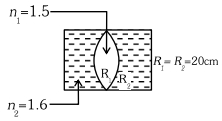
In the figure shown here, what is the equivalent focal length (in $cm$) of the combination of lenses (Assume that all layers are thin)?
AnswerCorrect option: D. $-100$
d
$\text { Use } \frac{1}{f}=[\mu-1]\left[\frac{1}{R_1}-\frac{1}{R_2}\right]$
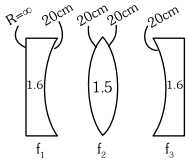
$\frac{1}{f_1}=[1.6-1]\left[\frac{1}{\infty}-\frac{1}{20}\right]=\frac{-3}{100}$
$\frac{1}{f_2}=[1.5-1]\left[\frac{1}{20}+\frac{1}{20}\right]=\frac{1}{20}$
$\frac{1}{f_3}=\frac{-3}{100}$
$\frac{1}{f_{\text {eq }}}=\frac{1}{f_1}+\frac{1}{f_2}+\frac{1}{f_3}$
$\frac{1}{f_{\text {eq }}}=-\frac{3}{100}+\frac{1}{20}-\frac{3}{100}=\frac{-1}{100}$
View full question & answer→MCQ 51 Mark
Two thin lenses are of same focal lengths $(f)$, but one is convex and the other one is concave. When they are placed in contact with each other, the equivalent focal length of the combination will be:
Answera
$\frac{1}{f_{e q}}=\frac{1}{f_1}+\frac{1}{f_2}$
$\frac{1}{f_{e q}}=\frac{1}{f}-\frac{1}{f}$
$f_{e q}=\infty$
View full question & answer→MCQ 61 Mark
A light ray falls on a glass surface of refractive index $\sqrt{3}$, at an angle $60^{\circ}$. The angle between the refracted and reflected rays would be ....... $^o$
Answerb
Method (i)
By Snell's law
$1 \sin 60^{\circ}=\sqrt{3} \sin r$
$\frac{\sqrt{3}}{2}=\sqrt{3} \sin r$
$\sin r=\frac{1}{2}$
$r=30^{\circ}$
Angle between refracted and reflected ray is $90^{\circ}$
Method $(ii)$
Because angle of incidence is Brewster's angle so that angle between reflected and refracted ray is $90^{\circ}$
$\operatorname{tani}_{p}=\mu=\sqrt{3}$
$i_{p}=60^{\circ}= i$
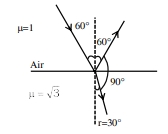
View full question & answer→MCQ 71 Mark
Two transparent media $A$ and $B$ are separated by a plane boundary. The speed of light in those media are $1.5 \times 10^{8}\,m / s$ and $2.0 \times 10^{8}\,m / s$, respectively. The critical angle for a ray of light for these two media is :
- ✓
$\sin ^{-1}(0.750)$
- B
$\tan ^{-1}(0.500)$
- C
$\tan ^{-1}(0.750)$
- D
$\sin ^{-1}(0.500)$
AnswerCorrect option: A. $\sin ^{-1}(0.750)$
a
$\mu=\frac{ C }{ u } \Rightarrow u \propto \frac{1}{\mu}$
Critical angle
$\text { Sini i }_{c}=\frac{\mu_{ R }}{\mu_{ D }}=\frac{ u _{ D }}{ u _{ R }}=\frac{1.5}{2}=\frac{3}{4}$
$i _{c}=\sin ^{-1}\left(\frac{3}{4}\right)$
$\sin i_{c}=\frac{\mu_{R}}{\mu_{D}}=\frac{u_{D}}{u_{R}}$
$i_{c}=\sin ^{-1}\left(\frac{3}{4}\right)$
View full question & answer→MCQ 81 Mark
A biconvex lens has radii of curvature, $20\,cm$ each. If the refractive index of the material of the lens is $1.5$, the power of the lens is .... $D$
Answerb
$R _{1}= R _{2}=20 cm =0.2 m$
$\mu=\frac{3}{2}$
$P =\frac{1}{ f }=(\mu-1)\left(\frac{1}{ R _{1}}-\frac{1}{ R _{2}}\right)$
$P=\left(\frac{3}{2}-1\right)\left(\frac{1}{0.2}+\frac{1}{0.2}\right)$
$P=\frac{1}{2}\left(\frac{2}{0.2}\right)=\frac{10}{2}=+5 D$
View full question & answer→MCQ 91 Mark
An astronomical refracting telescope is being used by an observer to observe planets in normal adjustment. The focal lengths of the objective and eye piece used in the construction of the telescope are $20\,m$ and $2\,cm$ respectively. Consider the following statements about the telescope :
$(a)$ The distance between the objective and eye piece is $20.02\; m$
$(b)$ The magnification of the telescope is $1000$
$(c)$ The image of the planet is erect and diminished
$(d)$ The aperture of eye piece is smaller than that of objective
The correct statements are :
- A
$(a), (b)$ and $(c)$
- B
$(b), (c)$ and $(d)$
- C
$(c), (d)$ and $(a)$
- ✓
$(a), (b)$ and $(d)$
AnswerCorrect option: D. $(a), (b)$ and $(d)$
d
$f _0=20\,m =2000\,cm$
$f _e=2\,cm$
for Normal adjustment
$\rightarrow \text { M.P. }=\frac{f_0}{f_e}=\frac{2000}{2}=1000$
$\rightarrow$ Distance between both lens $= f _0+ f _e$
$=2000+2$
$=2002\,cm$
$=20.02\,m$
$\rightarrow$ Image is inverted and magnified
$\rightarrow$ Aperture of eye piece is smaller than objective.
View full question & answer→MCQ 101 Mark
During a cloudy day, a primary and a secondary rainbow may be created, then the:
- A
primary rainbow is due to double internal reflection and is formed above the secondary one.
- B
primary rainbow is due to double internal reflection and is formed below the secondary one.
- ✓
secondary rainbow is due to double internal reflection and is formed above the primary one.
- D
secondary rainbow is due to single internal reflection and is formed above the primary one.
AnswerCorrect option: C. secondary rainbow is due to double internal reflection and is formed above the primary one.
c
Secondary Rainbow is due to double internal reflection and it is formed above the Primary Rainbow.
View full question & answer→MCQ 111 Mark
A convex lens $'A'$ of focal length $20\, \mathrm{~cm}$ and a concave lens $'B'$ of focal length $5\, \mathrm{~cm}$ are kept along the same axis with a distance $'\mathrm{d}'$ between them. If a parallel beam of light falling on $'A'$ leaves $'B'$ as a parallel beam, then the distance $'d'$ in $cm$ will be :
Answerb
$d=f_{1}-f_{2}$
$=20-5$
$=15\, \mathrm{~cm}$
View full question & answer→MCQ 121 Mark
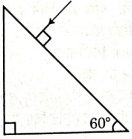
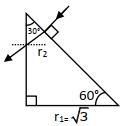
Find the value of the angle of emergence from the prism. Refractive index of the glass is $\sqrt{3}$. (in $^{\circ}$)
Answera
$r_{1}+r_{2}=A=30^{\circ}$
$r_{2}=30^{\circ}\left(r_{1}=0^{\circ}\right)$
from Snell's law
$\sqrt{3} \sin r_{2}=1 \times \sin e$
View full question & answer→MCQ 131 Mark
A lens of large focal length and large aperture is best suited as an objective of an astronomical telescope since :
- A
a large aperture contributes to the quality and visibility of the images.
- B
a large area of the objective ensures better light gathering power.
- C
a large aperture provides a better resolution.
- ✓
Answerd
$\mathrm{MP}=\frac{\mathrm{f}_{0}}{\mathrm{f}_{\mathrm{e}}}$
$\text { R.P. }=\frac{\mathrm{a}}{1.22 \lambda}$
Large aperture$(a)$ of the objective lens provides bettern resolution
$\therefore$ good quality of image is formed and also it gathers more light.
View full question & answer→MCQ 141 Mark
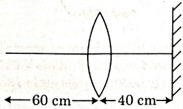
A point object is placed at a distance of $60\, \mathrm{~cm}$ from a convex lens of focal length $30 \,\mathrm{~cm}$. If a plane mirror were put perpendicular to the principal axis of the lens and at a distance of $40\, \mathrm{~cm}$ from it, the final image would be formed at a distance of :
- A
$20\, \mathrm{~cm}$ from the lens, it would be a real image.
- B
$30 \,\mathrm{~cm}$ from the lens, it would be a real image.
- C
$30 \,\mathrm{~cm}$ from the plane mirror, it would be a virtual image.
- ✓
$20 \,\mathrm{~cm}$ from the plane mirror, it would be a virtual image.
AnswerCorrect option: D. $20 \,\mathrm{~cm}$ from the plane mirror, it would be a virtual image.
d
First for image formation from lens
$\mathrm{u}=-60\, \mathrm{~cm}$
$\mathrm{f}=+30\, \mathrm{~cm}$
$\Rightarrow \mathrm{v}=\frac{\mathrm{uf}}{\mathrm{u}+\mathrm{f}}=\frac{-60 \times 30}{-60+30}=60\, \mathrm{~cm}$
This real image formed by lens acts as virtual object for mirror
Real image from plane mirror is formed $20 \mathrm{~cm}$ in front of mirror, hence at $20 \mathrm{~cm}$ distance from lens. Now for second refraction from lens,
$\mathrm{u}=-20\, \mathrm{~cm}$
$\mathrm{f}=+30\, \mathrm{~cm}$
$v=\frac{\mathrm{uf}}{\mathrm{u}+\mathrm{f}}=\frac{-20 \times 30}{-20+30}=-60\, \mathrm{~cm}$
So, final virtual image is $60\, \mathrm{~cm}$ from lens, or $20\, \mathrm{~cm}$ behind mirror
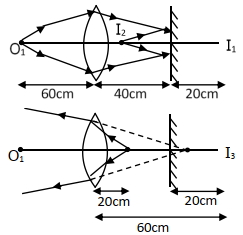
View full question & answer→MCQ 151 Mark
An object is placed on the principal axis of a concave mirror at a distance of $1.5 f(f$ is the focal length). The image will be at ....... $f$
Answerb
By mirror formula
$\frac{1}{v}+\frac{1}{u}=\frac{1}{f}$
$\frac{1}{v}-\frac{1}{\frac{3 f}{2}}=\frac{1}{-f}$
$\frac{1}{v}-\frac{2}{3 f}=-\frac{1}{f}$
$\frac{1}{v}=-\frac{1}{f}+\frac{2}{3 f}$
$\frac{1}{v}=\frac{-3+2}{3 f}$
$v=-3 f$
View full question & answer→MCQ 161 Mark
If the critical angle for total internal reflection from a medium to vacuum is $45^{\circ}$, then velocity of light in the medium is,
- A
$3 \times 10^{8} \;m / s$
- B
$1.5 \times 10^{8} \;m / s$
- ✓
$\frac{3}{\sqrt{2}} \times 10^{8}\; m / s$
- D
$\sqrt{2} \times 10^{8} \;m / s$
AnswerCorrect option: C. $\frac{3}{\sqrt{2}} \times 10^{8}\; m / s$
c
$\sin C =\frac{1}{\mu}$
$\sin 45^{\circ}=\frac{1}{\mu}$
$\frac{1}{\sqrt{2}}=\frac{1}{\mu}$
$\mu=\sqrt{2}$
Velocity of light in medium
$v =\frac{ c }{\mu}$
$v =\frac{3 \times 10^{8}}{\sqrt{2}} m / s$
View full question & answer→MCQ 171 Mark
The power of a biconvex lens is $10$ dioptre and the radius of curvature of each surface is $10 \;cm$. Then the refractive index of the material of the lens is,
- ✓
$\frac{3}{2}$
- B
$\frac{4}{3}$
- C
$\frac{9}{8}$
- D
$\frac{5}{3}$
AnswerCorrect option: A. $\frac{3}{2}$
a
$\frac{1}{f}=(\mu-1)\left(\frac{1}{R_{1}}-\frac{1}{R_{2}}\right)$
as $P=\frac{1}{f(\text { in } m)}$
$10=(\mu-1)\left(\frac{1}{0.10}+\frac{1}{0.10}\right)$
$(\mu-1)=\frac{1}{2}$
$\mu=\frac{3}{2}$
View full question & answer→MCQ 181 Mark
A plano-convex lens of unknown material and unknown focal length is given. With the help of a Spherometer we can measure the,
- A
refractive index of the material
- B
- ✓
radius of curvature of the curved surface
- D
AnswerCorrect option: C. radius of curvature of the curved surface
c
Spherometer measure the radius of curvature of the curved surface
View full question & answer→MCQ 191 Mark
A ray is incident at an angle of incidence i on one surface of a small angle prism (with angle of prism $A$) and emerges normally from the opposite surface. If the refractive index of the material of the prism Is $\mu,$ then the angle of incidence is nearly equal to
- A
$\frac{\mu A }{2}$
- B
$\frac{ A }{ 2 \mu}$
- C
$\frac{2 A }{\mu}$
- ✓
$\mu A$
AnswerCorrect option: D. $\mu A$
d
$r _{2}=0$
$r_{1}=A$
Apply Snell's law
$\sin 1=\mu \sin r _{1}$
for small angle $\left( r _{1}= A \right)$
$i=\mu A$

View full question & answer→MCQ 201 Mark
A double convex lens has focal length $25\; \mathrm{cm}$. The radius of curvature of one of the surfaces is double of the other. Find the radii If the refractive index of the material of the lens is $1.5 $
- A
$100 \;\mathrm{cm}, 50\; \mathrm{cm}$
- B
$25\; \mathrm{cm}, 50\; \mathrm{cm}$
- ✓
$18.75\; \mathrm{cm}, 37.5 \;\mathrm{cm}$
- D
$ 50\; \mathrm{cm}, 100\; \mathrm{cm}$
AnswerCorrect option: C. $18.75\; \mathrm{cm}, 37.5 \;\mathrm{cm}$
c
$\frac{1}{f}=\left(\frac{\mu_{2}-\mu_{1}}{\mu_{1}}\right)\left(\frac{1}{R_{1}}-\frac{1}{R_{2}}\right)$
$\Rightarrow \frac{1}{25}=\left(\frac{1.5-1}{1}\right)\left(\frac{1}{R}-\frac{1}{(-2 R)}\right) $
$\Rightarrow \frac{2}{25}=\frac{3}{2 R}$
$\Rightarrow R=\frac{75}{4}=18.75$
View full question & answer→MCQ 211 Mark
Two similar thin equi-convex lenses, of focallength feach, are kept coaxially in contact with each other such that the focallength of the combination is $\mathrm{F}_{1}$. When the space between the two lenses is filled with gyoern(which has the same refractive index ( $\mu =1.5$ ) as that of glass then the equivalent focal length is $\mathrm{F}_{2} .$ The ratio $\mathrm{F}_{1}: \mathrm{F}_{2}$ will be
Answerb
$\frac{1}{\mathrm{F}_{1}}=\frac{1}{\mathrm{f}}+\frac{1}{\mathrm{f}}$
$\Rightarrow \mathrm{F}_{1}=\mathrm{f} / 2$
$\Rightarrow \mathrm{F}_{2}=\mathrm{f}$
$\Rightarrow \frac{\mathrm{F}_{1}}{\mathrm{F}_{2}}=\frac{1}{2}$
View full question & answer→MCQ 221 Mark
In total internal reflection when the angle of incidence is equal to the critical angle for the pair of media in contact, what will be angle of refraction.......$^o$ ?
- A
$180$
- B
$0$
- C
equal to angle of incidence
- ✓
$90$
Answerd
At critical angle
angle of refraction $= 90^o$
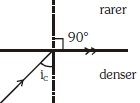
View full question & answer→MCQ 231 Mark
An equiconvex lens has power $\mathrm{P}$. It is cut into two symmetrical halves by a plane containing the principal axis The power of one part will be
- A
$0$
- B
$\frac P2$
- C
$\frac P4$
- ✓
$P$
Answerd
Focal length do not change $\rightarrow$ Power do not change
View full question & answer→MCQ 241 Mark
Pick the wrong answer in the context with rainbow
- A
When the light rays undergo two internal reflections in a water drop, a secondary rainbow is formed.
- B
The order of colours is reversed in the secondary rainbow.
- ✓
An observer can see a rainbow when his front is towards the sun.
- D
Rainbow is a combined effect of dispersion refraction and reflection sunlight.
AnswerCorrect option: C. An observer can see a rainbow when his front is towards the sun.
c
An observer can see a rainbow when his back is towards the sun.
View full question & answer→MCQ 251 Mark
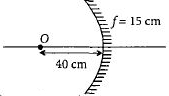
An object is placed at a distance of $40\,\, cm$ from a concave mirror of focal length $15\,\, cm.$ If the object is displaced through a distance of $20\,\, cm$ towards the mirror, the displacement of the image will be
- A
$30 cm$ away from the mirror
- ✓
$36 cm$ away from the mirror
- C
$36{\rm{\;cm\;}}\;$ towards the mirror
- D
$30{\rm{\;cm\;}}\;$ towards the mirror
AnswerCorrect option: B. $36 cm$ away from the mirror
b
Using mirror formula,
$\frac{1}{f}=\frac{1}{v_{1}}+\frac{1}{u_{1}} ;-\frac{1}{15}=\frac{1}{v_{1}}-\frac{1}{40} \Rightarrow \frac{1}{v_{1}}=\frac{1}{-15}+\frac{1}{40}$
$v_{1}=-24 \,\mathrm{cm}$
When object is displaced by $20 \,\mathrm{cm}$ towards mirror Now, $u_{2}=-20\, \mathrm{cm}$
$\frac{1}{f}=\frac{1}{v_{2}}+\frac{1}{u_{2}} ; \frac{1}{-15}=\frac{1}{v_{2}}-\frac{1}{20} \Rightarrow \frac{1}{v_{2}}=\frac{1}{20}-\frac{1}{15}$
$v_{2}=-60\, \mathrm{cm}$
So, the image will be shift away from mirror by $(60-24) \mathrm{cm}=36 \,\mathrm{cm}$
View full question & answer→MCQ 261 Mark
An astronomical refracting telescope will have large angular magnification and high angular resolution, when it has an objective lens of
- A
small focal length and large diameter
- B
large focal length and small diameter
- C
small focal length and small diameter
- ✓
large focal length and large diameter
AnswerCorrect option: D. large focal length and large diameter
d
For telescope, angular magnification $=\frac{f_{0}}{f_{e}}$
Angular resolution $=\frac{D}{1.22 \lambda}$ should be large.
So, objective lens should have large focal length $\left(f_{o}\right)$ and large diameter $D$ for large angular
View full question & answer→MCQ 271 Mark
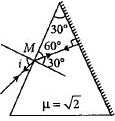
The refractive index of the material of a prism is $\sqrt 2$ and the angle of the prism is $30^o $. One of the two refracting surfaces of the prism is made a mirror inwards, by silver coating. A beam of monochromatic light entering the prism from the other face will retrace its path (after reflection from the silvered surface) if its angle of incidence on the prism is
Answerb
For retracing the path shown in figure, light ray should be incident normally on the silvered face.
Applying Snell's law at point $M,$
$\frac{\sin i}{\sin 30^{\circ}}=\frac{\sqrt{2}}{1} \Rightarrow \sin i=\sqrt{2} \times \frac{1}{2}$
$\sin i=\frac{1}{\sqrt{2}} i . e_{.}, i=45^{\circ}$
View full question & answer→MCQ 281 Mark
A thin prism having refracting angle $10^o $ is made of glass of refractive index $1.42.$ This prism is combined with another thin prism of glass of refractive index $1. 7.$ This combination produces dispersion without deviation. The refracting angle of second prism should be....$^o$
Answera
The condition for dispersion without deviation is given as $(\mu-1) A=\left(\mu^{\prime}-1\right) A^{\prime}$
Given $\mu=1.42, A=10^{\circ}, \mu^{\prime}=1.7, A^{\prime}=?$
$\therefore \quad(1.42-1) \times 10=(1.7-1) A^{\prime}$
$(0.42) \times 10=0.7 \times A^{\prime}$
or $\quad A^{\prime}=\frac{0.42 \times 10}{0.7}=6^{\circ}$
View full question & answer→MCQ 291 Mark
A person has near point at $60\; cm$. The focal length of spectacles lenses to read at $22\; cm$ having glasses separated $2 \;cm$ from the eyes, is
Answerc
$u =-60$
$v=-(22-2)=-20$
$\frac{1}{ f }=\frac{1}{-20}-\frac{1}{-60}$
$\frac{1}{ f }=\frac{-60+20}{20 \times 60}$
$f =\frac{1200}{-40}$
$f =30$
View full question & answer→MCQ 301 Mark
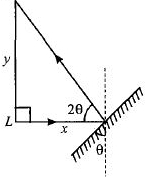
A beam of light from a source $L$ is incident normally on a plane mirror fixed at a certain distance $x$ from the source. The beam is reflected back as a spot on a scale placed just above the source $L.$ When the mirror is rotated through a small angle $\theta$, the spot of the light is found to move through a distance $y$ on the scale. The angle $\theta$ is given by
- A
$\frac{y}{x}$
- B
$\;\frac{x}{{2y}}$
- C
$\;\frac{x}{y}$
- ✓
$\;\frac{y}{{2x}}$
AnswerCorrect option: D. $\;\frac{y}{{2x}}$
d
When mirror is rotated by $\theta$ angle reflected ray will be rotated by $2 \theta .$ For small angle $\theta$
$\quad \tan 2 \theta \approx 2 \theta=\frac{y}{x}$
$\therefore \theta=\frac{y}{2 x}$
View full question & answer→MCQ 311 Mark
If the angle of a prism is $60^{\circ}$ and angle of minimum deviation is $40^{\circ}$, then the angle of refraction will be
Answera
For minimum deviation $r_{1}=r_{2}=r$
$r =\frac{ A }{2} r =\frac{60^{\circ}}{2} r =30^{\circ}$
View full question & answer→MCQ 321 Mark
Match the corresponding entries of column $I$ with column $II$. [Where $m$ is the magnification produced by the mirror]
$\begin{array}{|l|l|} \hline Column\,\,-I & Column\,\,-\,\,II\,\, \\ \hline 1.\,\,m=-2 & a.\,\,Convex\,\,mirror \\ \hline 2.\,\,m=\,\,\frac{-1}{2} & b.\,\,Concave\,\,mirror \\ \hline 3.\,\,m=+2 & c.\,\,Real\,\,Image \\ \hline 4.\,\,m=\,\,\frac{+1}{2} & d.\,\,Virtual\,\,image \\ \hline \end{array}$
- A
$(1-a $ and $ c),(2-a$ and $ d),(3-a $ and $b) (4-c$ and $d)$
- B
$(1-a$ and $d),(2-b $ and $c),(3-b$ and $ d) (4-b$ and $c)$
- C
$(1-c $ and $d),(2-b$ and $d),(3-b$ and $c) (4-a $ and $ d)$
- ✓
$(1-b$ and $c),(2-b$ and $c),(3-b$ and $d) (4-a$ and $d)$
AnswerCorrect option: D. $(1-b$ and $c),(2-b$ and $c),(3-b$ and $d) (4-a$ and $d)$
d
Magnification in the mirror, $m=-\frac{v}{u}$
$m=-2 \Rightarrow v=2 u$
As $v$ and $u$ have same signs so the mirror is concave and image formed is real.
$m=-\frac{1}{2} \Rightarrow v=\frac{u}{2} \Rightarrow$ Concave mirror and real image.
$m=+2 \Rightarrow v=-2 u$
As $v$ and $u$ have different signs but magnification is $2$ so the mirror is concave and image formed is virtual.
$m=+\frac{1}{2} \Rightarrow v=-\frac{u}{2}$
As $v$ and $u$ have different signs with magnification $\left(\frac{1}{2}\right)$ so the mirror is convex and image formed is virtual.
View full question & answer→MCQ 331 Mark
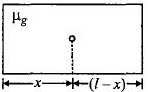
An air bubble in a glass slab with refractive index $1.5$ (near normal incidence) is $5\,\, cm$ deep when viewed from one surface and $3\,\, cm$ deep when viewed from the opposite face. The thickness (in $cm$) of the slab is
Answera
Here $\mu =1.5$
$l=$ length of the slab
$x=$ position of air bubble from one side As per question, total apparent length of slab $=5+3$
or $\frac{x}{\mu}+\frac{(l-x)}{\mu}=8$ or $\frac{l}{\mu}=8 \therefore l=8 \mu=8 \times 15=12\, \mathrm{cm}$
View full question & answer→MCQ 341 Mark
The angle of incidence for a ray of light at a refracting surface of a prism is $45^o $. The angle of prism is $60^o $ . If the ray suffers minimum deviation through the prism, the angle of minimum deviation and refractive index of the material of the prism respectively, are
- ✓
$30^o $,$\sqrt 2 $
- B
$45^o $,$\sqrt 2 $
- C
$30^o $,$\frac{1}{{\sqrt 2 }}$
- D
$45^o $,$\frac{1}{{\sqrt 2 }}$
AnswerCorrect option: A. $30^o $,$\sqrt 2 $
a
Given, $i=45^o$ , $A=60^o$
since the ray undergoes minimum deviation, therefore, angle of emergence from second face, $e=i=45^o$
$\therefore \quad \delta_{m}=i+e-A=45^o+45^o-60^o=30^o$
$\mu = \frac{{\sin \left( {\frac{{A + {\delta _m}}}{2}} \right)}}{{\sin \left( {\frac{A}{2}} \right)}}$ $ = \frac{{\sin \left( {\frac{{{{60}^o} + {{30}^o}}}{2}} \right)}}{{\sin \left( {\frac{{{{60}^o}}}{2}} \right)}}{\text{ }}$
$ = \frac{{\sin {{45}^o}}}{{\sin {{30}^o}}} = \frac{1}{{\sqrt 2 }} \times \frac{2}{1} = \sqrt 2 $
View full question & answer→MCQ 351 Mark
A person can see clearly objects only when they lie between $50\,\, cm$ and $400\,\, cm$ from his eyes. In order to increase the maximum distance of distinct vision to infinity, the type and power of the correcting lens, the person has to use, will be
- ✓
concave,$-0.25$ diopter
- B
convex,$+0.15 $ diopter
- C
convex,$+2.25 $ diopter
- D
concave, $-0.2$ diopter
AnswerCorrect option: A. concave,$-0.25$ diopter
a
$\text { Here, } u=400 \,\mathrm{cm}=4 \,\mathrm{m}, v=\infty, f=?$
Using lens formula, $\frac{1}{v}-\frac{1}{u}=\frac{1}{f}$
or $\frac{1}{\infty}-\frac{1}{4}=\frac{1}{f}$ or $f=-4\, \mathrm{m}$
Lens should be concave.
Power of lens $=\frac{1}{f}=\frac{1}{-4}=-0.25\, \mathrm{D}$
View full question & answer→MCQ 361 Mark
A astronomical telescope has objective and eyepiece of focal lengths $40\,\, cm$ and $4\,\, cm$ respectively. To view an object $200\,\, cm$ away from the objective, the lenses must be separated by a distance.....$cm$
Answerc
Here $f_{o}=40\, \mathrm{cm}$, $f_{e}=4 \,\mathrm{cm}$
Tube length( $(l)=$ Distance between lenses $=v_{o}+f_{e}$ For objective lens,
${u_o} = - 200{\text{cm}},{v_o} = ?$
$\frac{1}{v} - \frac{1}{{{u_o}}} = \frac{1}{{{f_o}}}$ or $\frac{1}{{{v_o}}} - \frac{1}{{ - 200}} = \frac{1}{{40}}$
or $\frac{1}{{{v_0}}} = \frac{1}{{40}} - \frac{1}{{200}} = \frac{4}{{200}}$ $\therefore {v_0} = 50\,{\text{cm}}$
$\therefore \quad l=50+4=54\, \mathrm{cm}$
View full question & answer→MCQ 371 Mark
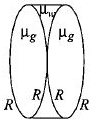
Two identical glass $(\mu_g = 3/2)$ equiconvex lenses of focal length $f$ each are kept in contact. The space between the two lenses is filled with water $(\mu_w = 4/3).$ The focal length of the combination is
- A
$\frac{{4f}}{3}$
- ✓
$\;\frac{{3f}}{4}$
- C
$\;\frac{f}{3}$
- D
$f$
AnswerCorrect option: B. $\;\frac{{3f}}{4}$
b
$\text { Here, } \mu_{g}=\frac{3}{2}, \mu_{w}=\frac{4}{3}$
Focal length $(f)$ of glass convex lens is given by
$\frac{1}{f}=\left(\mu_{g}-1\right)\left(\frac{2}{R}\right)$
or $\frac{1}{f}=\left(\frac{3}{2}-1\right) \frac{2}{R}=\frac{1}{R}$ or $f=R.........(i)$
Focal length $(f)$ of water filled concave lens is given by
$\frac{1}{f^{\prime}} =\left(\mu_{w}-1\right)\left(-\frac{2}{R}\right) \text { or } \frac{1}{f^{\prime}}=\left(\frac{4}{3}-1\right)\left(-\frac{2}{R}\right) $
$=-\frac{2}{3 R}=-\frac{2}{3 f} \quad[\text { Using } \operatorname{eqn} .(\mathrm{i})]$
Equivalent focal length $\left(f_{e q}\right)$ of lens system $\frac{1}{f_{e q}}=\frac{1}{f}-\frac{2}{3 f}+\frac{1}{f}=\frac{3-2+3}{3 f}=\frac{4}{3 f}$
$\therefore f_{e q}=\frac{3 f}{4}$
View full question & answer→MCQ 381 Mark
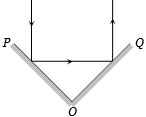
What should be the angle between two plane mirrors so that whatever be the angle of incidence, the incident ray and the reflected ray from the two mirrors be parallel to each other.....$^o$
Answerb
( b)Incident ray and finally reflected ray are parallel to each other means $\delta = {180^o}$
From $\delta = 360 - 2\theta $$ \Rightarrow 180 = 360 - 2\theta $$ \Rightarrow \theta = {90^o}$
View full question & answer→MCQ 391 Mark
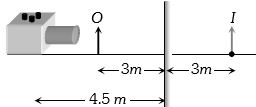
It is desired to photograph the image of an object placed at a distance of $3\;m$ from the plane mirror. The camera which is at a distance of $4.5\;m$ from the mirror should be focussed for a distance of......$m$
Answerd
(d) $F_o$ using distance of image $= 4.5 \,m + 3\, m = 7.5\, m.$
View full question & answer→MCQ 401 Mark
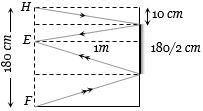
A man is $180\,cm$ tall and his eyes are $10\,cm$ below the top of his head. In order to see his entire height right from toe to head, he uses a plane mirror kept at a distance of $1m$ from him. The minimum length of the plane mirror required is.....$cm$
Answerb
(b) According to the following ray diagram length of mirror
$ = \frac{1}{2}(10 + 170) = 90\,cm$
View full question & answer→MCQ 411 Mark
A person is in a room whose ceiling and two adjacent walls are mirrors. How many images are formed
Answerc
(c) The walls will act as two mirrors inclined to each other at $90^\circ $
and so will form $\left({\frac{{360}}{{90}} - 1} \right) = $$4 -1 $ i.e. $3$ images of the person.
Now these images with person will act as objects for the ceiling mirror and so ceiling mirror will form $4$ images further.
Therefore total number of images formed $ = 3 + 3 + 1 = 7$
Note : He can see. $6$ images of himself.
View full question & answer→MCQ 421 Mark
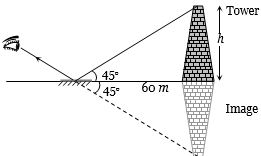
When a plane mirror is placed horizontally on a level ground at a distance of $60m$ from the foot of a tower, the top of the tower and its image in the mirror subtend an angle of $90^\circ $ at the eye. The height of the tower will be.....$m$
Answerb
(b) $\tan 45^\circ = \frac{h}{{60}}$ $ \Rightarrow h = 60\,m$
View full question & answer→MCQ 431 Mark
Two plane mirrors are inclined at an angle of ${72^0}$. The number of images of a point object placed between them will be
Answerc
( c)$n = \left( {\frac{{360}}{\theta } - 1} \right) \Rightarrow n = \left( {\frac{{360}}{{72}} - 1} \right) = 4$
View full question & answer→MCQ 441 Mark
A man of length $h$ requires a mirror, to see his own complete image of length at least equal to
- A
$\frac{h}{4}$
- B
$\frac{h}{3}$
- ✓
$\frac{h}{2}$
- D
$h$
AnswerCorrect option: C. $\frac{h}{2}$
c
(c) In a plane mirror of height H.we can see an object completely which has a height $2 \mathrm{H}$.
So in order to see a man of height h, the mirror should be of height $\frac{h}{2}$
View full question & answer→MCQ 451 Mark
Two plane mirrors are at $45^\circ $ to each other. If an object is placed between them, then the number of images will be
Answerc
( c)$n = \frac{{360}}{{45}} - 1 = 7$
View full question & answer→MCQ 461 Mark
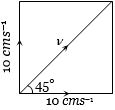
A room (cubical) is made of mirrors. An insect is moving along the diagonal on the floor such that the velocity of image of insect on two adjacent wall mirrors is $10 cms^{-1}$. The velocity of image of insect in ceiling mirror is
AnswerCorrect option: D. $10\sqrt 2 \, cms^{-1}$
d
( d) $v \;\cos 45^\circ = 10$ $v = 10\sqrt 2 cms^{-1} $
In the ceiling mirror the original velocity will be seen.
View full question & answer→MCQ 471 Mark
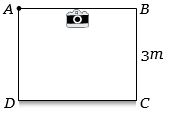
Figure shows a cubical room $ABCD$ with the wall $CD$ as a plane mirror. Each side of the room is $3\,m$. We place a camera at the midpoint of the wall $AB$. At what distance should the camera be focussed to photograph an object placed at $A$
- A
$1.5\, m$
- B
$3\, m$
- C
$6\, m$
- ✓
More than $6\, m$
AnswerCorrect option: D. More than $6\, m$
d
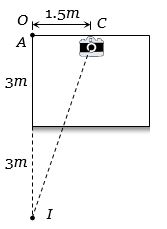
(d) According to the following figure distance of image $I$ from camera
$ = \sqrt {{{(6)}^2} + {{(1.5)}^2}} = 6.18\,m$
View full question & answer→MCQ 481 Mark
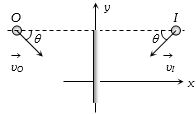
If an object moves towards a plane mirror with a speed $v$ at an angle $\theta $ to the perpendicular to the plane of the mirror, find the relative velocity between the object and the image
- A
$v$
- B
$2v$
- ✓
$2v\cos \theta $
- D
$2v\sin \theta $
AnswerCorrect option: C. $2v\cos \theta $
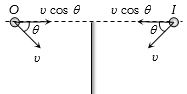
c
(c) From figure it is clear that relative velocity between object and it's image $ = 2v cos\theta$
View full question & answer→MCQ 491 Mark
A person runs with a speed u towards a bicycle moving away from him with speed $v.$ The person approaches his image in the mirror fixed at the rear of bicycle with a speed of
- A
$u -v$
- B
$u -2v$
- C
$2u -v$
- ✓
$2(u -v)$
AnswerCorrect option: D. $2(u -v)$
d
(d) Velocity of approach of man towards the bicycle $= (u -v)$
Hence velocity of approach of image towards man is $2(u -v).$
View full question & answer→MCQ 501 Mark
An object is initially at a distance of $100 \;cm$ from a plane mirror. If the mirror approaches the object at a speed of $10\; cm/sec$, then after $6\; sec$ the distance between the object and its image will be
Answerb
The distance of object from plane mirror $D =100 cm$ So, initial distance of image and object
$=100-(-100)$
$=200 cm$
Now, object approaches the mirror with the speedv $=10 cm / s$ So, distance travelled by object in $6\; sec$
$D =10 \times 6$
$D =60 cm$
At this instant,
Distance between mirror and object
$D =100-60$
$D =40 cm$
Now, the distance between image and object is
$D =40-(-40)$
$D =80\;0 cm$
View full question & answer→